
WorkReferences studies what happens when former supervisors, employers, and work histories become difficult to verify. This is our living research hub — where real prospect and customer interactions become ongoing analysis of the employment reference landscape.

A professional reference used to be a phone call away. Increasingly, it isn’t. The people who once vouched for a candidate’s work have moved on, retired, or been instructed not to comment — and the companies that employed them have changed shape entirely. The result is a verification gap that is widening across the workforce.
The manager who knew a candidate's work best is often no longer reachable through their former employer.
The manager who knew a candidate's work best is often no longer reachable through their former employer.
The manager who knew a candidate's work best is often no longer reachable through their former employer.
The manager who knew a candidate's work best is often no longer reachable through their former employer.
The manager who knew a candidate's work best is often no longer reachable through their former employer.
The manager who knew a candidate's work best is often no longer reachable through their former employer.
Every day, people reach out to WorkReferences because a reference has fallen through. Those conversations are a uniquely direct signal of where the verification system is breaking down. Our Voice of Customer program analyzes monthly, quarterly, and annual patterns from prospect and customer inquiries to understand why people seek help — and what those reasons reveal about the wider industry.
The chart below illustrates the format WorkReferences uses to report recurring reference challenges. It shows the share of prospects who describe each obstacle when they first reach out.
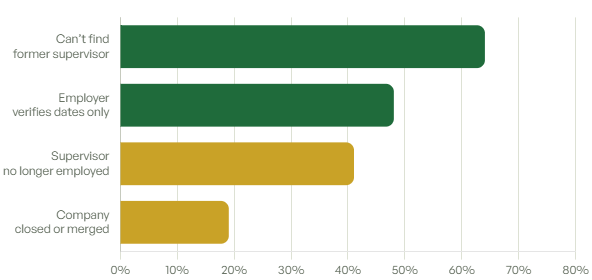
The pattern points to a single underlying theme: the breakdown is rarely about a candidate’s record and almost always about access to the people and systems that can speak to it. When the most-cited obstacle is simply locating a former supervisor, the bottleneck is continuity of relationships — not the quality of a candidate’s work.
It is also notable that these challenges stack. A prospect whose supervisor has left is often the same prospect whose former employer now confirms dates only, and whose company has since been absorbed into a larger entity. Verification doesn’t fail at one point; it erodes from several directions at once, which is why a missing reference so rarely has a simple fix.
This page is designed to grow. As research is validated, it will be published on a recurring schedule so readers can follow how reference behavior shifts over time.
A short, regular read on the obstacles prospects raised this month — a fast pulse on what people are running into right now.
A deeper look at how challenges are trending across a quarter, with comparisons that put each month in context.
Our flagship yearly analysis — the long view of how the reference and verification landscape is evolving.
WorkReferences sits at the exact point where reference verification breaks down — in direct conversation with the people experiencing it. That position makes it possible to see patterns early, before they become widely discussed industry issues.
Our insights come from real cases, not surveys at a distance.
A continuous stream of inquiries, analyzed on a regular cadence.
We know how these problems behave in practice — not just in theory.
We surface emerging issues before they become widely recognized industry trends.