
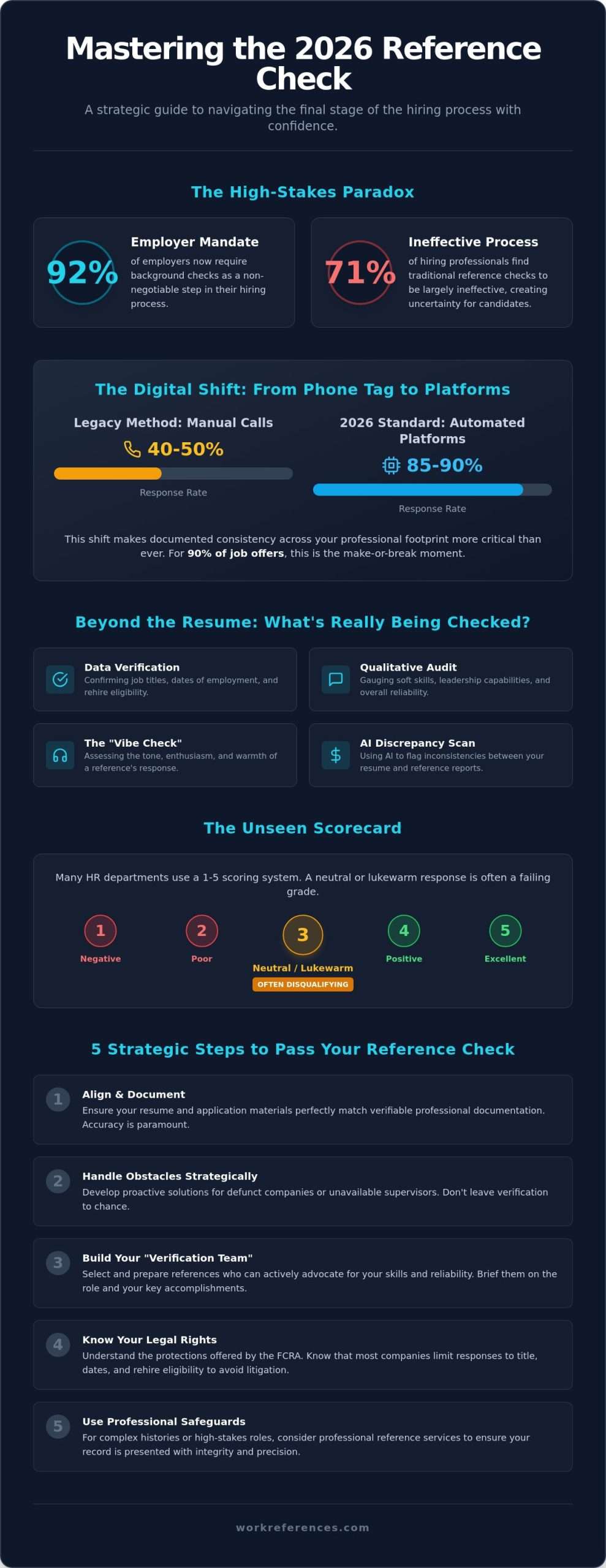
Did you know that while 92% of employers now mandate background checks, a staggering 71% of hiring professionals find traditional reference checks to be largely ineffective? This creates a high-stakes paradox for the modern candidate. You have navigated the interview gauntlet and reached the final stage, yet you may feel a deep sense of uncertainty regarding the verification of your history. Whether you are concerned about a defunct company that cannot be reached or a supervisor who has moved on, these anxieties are a natural response to a process that often feels outside of your control.
Mastering how to pass a reference check in 2026 requires more than passive hope. It demands a sophisticated strategy to ensure your professional record is validated with precision and integrity. This guide provides a clear roadmap to navigate the final stage of the hiring process, offering expert solutions for handling missing supervisors and complex employment gaps. We will explore the rise of automated verification platforms, the implications of recent “Clean Slate” laws, and the exact steps you can take to transform this potential hurdle into a final confirmation of your professional value.
Key Takeaways
- Learn the exact methodology for how to pass a reference check by aligning your resume with verifiable professional documentation.
- Understand how the shift toward automated verification platforms in 2026 changes the way hiring managers evaluate your behavioral history.
- Identify strategic methods to handle defunct companies and missing supervisors.
- Master a five-step audit process to select and prepare a “Verification Team” that actively advocates for your professional capabilities.
- Discover how professional reference services act as an essential safeguard for candidates who have complex histories or high-stakes career goals.
What Is a Reference Check? Understanding the Final Hurdle in 2026
The reference check is the final gatekeeper between a signed offer letter and a missed opportunity. While a standard background check focuses on objective facts like criminal records or credit history, the reference check is a multi-layered validation of your professional integrity. It serves as a qualitative audit of your past performance, designed to confirm that the person described in the interview matches the person who actually showed up to work. In 2026, this process has evolved from casual phone conversations into a data-driven verification phase that 92% of employers now mandate as a non-negotiable step in their hiring protocol.
By 2026, the landscape of verification has shifted toward automated platforms. These digital systems have replaced traditional phone tag, offering response rates of 85-90% compared to the 40-50% seen with manual calls. This shift means that understanding how to pass a reference check is no longer a matter of luck; it’s about ensuring your professional footprint is documented and consistent across all digital touchpoints. For 90% of job offers, this stage is the “make or break” moment where a single inconsistency can trigger a red flag, leading to a rescinded offer before you even start your first day.
Why Employers Conduct Qualitative Checks
Modern hiring managers look far beyond basic employment dates. They utilize qualitative checks to verify soft skills, leadership capabilities, and overall reliability. It’s a search for behavioral patterns that a resume cannot fully capture. Furthermore, the rise of the “backdoor reference” has changed the game. Managers often leverage professional networks to find mutual connections who weren’t on your official list. Mastering how to pass a reference check involves more than just listing names. You must ensure your entire professional reputation is aligned. Current HR technology in 2026 uses AI to flag discrepancies between your resume and the verbal or digital reports provided by your references, making accuracy more critical than ever.
The Legal Landscape of Employment Verification
You have specific rights during the screening process that protect you from unfair practices. While former employers can legally disclose a wide range of information, most corporate policies limit responses to job titles, dates of employment, and rehire eligibility to avoid litigation. However, if you’ve provided written consent, they may share more detailed performance data. The Fair Credit Reporting Act (FCRA) in 2026 serves as the primary federal framework ensuring that all third-party employment verifications are conducted with transparency, accuracy, and respect for the candidate’s right to dispute incorrect information. This legal shield ensures that the verification process remains a tool for integrity rather than an avenue for hearsay.
The Anatomy of a Successful Reference: What Managers Actually Ask
A reference check is far more than a simple confirmation of your resume. It functions as an objective evaluation of an applicant’s past job performance, designed to predict future success through the lens of past behavior. While the process begins with a verification of facts like job titles and employment dates, modern hiring managers quickly pivot to high-stakes qualitative questions. They aren’t just looking for a “good” employee. They’re looking for proof of reliability and cultural alignment. Understanding the specific questions asked is the first step in learning how to pass a reference check with ease.
In 2026, many HR departments have moved toward sophisticated scoring systems to evaluate reference feedback. Instead of just taking notes, recruiters rank responses on a scale, often from one to five. A neutral or lukewarm response is frequently recorded as a three, which can be a disqualifying score in a competitive market. Tone and enthusiasm act as the hidden currency of this stage. If a former supervisor provides the correct facts but speaks with noticeable hesitation or a lack of warmth, it signals a lack of genuine endorsement. This subtle “vibe check” can carry as much weight as the actual words spoken.
Common Reference Interview Questions
Recruiters typically focus on behavioral patterns and conflict resolution. You should expect them to ask your references questions such as:
- “Can you describe a specific time this candidate handled a high-pressure deadline?”
- “How would you rank their productivity compared to others in a similar role?”
- “What was their primary area for professional growth while reporting to you?”
- “Can you give an example of how they managed a disagreement with a peer?”
- “Would you rehire this individual without any reservations?”
The “hidden meaning” behind responses is where many candidates stumble. For example, if a reference says you were “always on time” but fails to mention your results, the recruiter hears that you were punctual but perhaps not impactful. Preparing your references for these specific inquiries ensures they don’t accidentally damn you with faint praise.
Identifying Red Flags Before the Call
A failed check often stems from inconsistencies. If your resume states you left a position in August but the HR record shows July, you’ve created a red flag regarding your honesty. Hesitation is another silent killer. If a manager pauses before answering the rehire question, the recruiter assumes the worst. The danger of the “lukewarm” reference is that they don’t say anything bad, but they also don’t say anything great. This lack of advocacy can be just as damaging as a negative review. You can learn about common red flags in reference checks to help you audit your list before you submit it. If you suspect a gap in your history might cause a pause, it may be time to consult with a professional advocate to secure your verification strategy.
Overcoming Obstacles: Closed Companies and Unavailable Supervisors
The most paralyzing anxiety for many candidates is the “dead end” in their career timeline. You may worry that a closed company or a supervisor who has vanished from the professional grid will derail your progress. This is a legitimate concern. Learning how to pass a reference check when your previous employer no longer exists requires a shift from passive hope to proactive verification. In 2026, recruiters view a lack of verifiable history as a significant risk factor, but they also respect candidates who provide a structured, professional solution to this problem.
Desperation often leads to dangerous shortcuts. Some candidates consider using personal friends as “fake” supervisors or hiring unverified services that provide fabricated testimonials. This is a catastrophic error. Modern background check technology is designed to cross-reference IP addresses, LinkedIn profiles, and corporate phone registries. If your references don’t stand up to this scrutiny, you aren’t just losing a job. You’re risking your entire career trajectory. Professional verification has become the industry-standard solution for defunct businesses, providing a legitimate path forward that protects your integrity.
What Happens if You Get Caught with Fake References?
If a recruiter discovers a falsified reference, the consequences are swift and severe. Your job offer will be revoked immediately, often without the possibility of appeal. In our connected digital economy, many industries maintain informal “do not hire” lists, and a reputation for dishonesty can follow you through every subsequent application. It’s simply not worth the risk. You can find more detail on The Truth About Fake References and Legitimate Alternatives to understand why authenticity remains your greatest asset in a high-stakes market.
Solving the ‘Missing Manager’ Problem
When a company is defunct, you must provide alternative proof of your professional contributions. Start by gathering objective documentation such as W-2s, tax records, or signed performance reviews. These items prove you were on the payroll and met expectations. However, many recruiters still require a live point of contact to confirm your soft skills and reliability. This is where professional reference services provide an essential bridge. By offering live phone answering and consistent documentation, these services ensure your history is verified according to 2026 standards. Knowing how to pass a reference check involves presenting this evidence clearly to your recruiter before they start the verification process. Transparency, backed by professional verification, is the only way to secure your future with confidence.
5 Strategic Steps to Pass Your Reference Check with Confidence
Securing a job offer is a process of elimination, and the reference stage is the final filter. To navigate this successfully, you must move from being a passive participant to a strategic manager of your own professional narrative. Knowing how to pass a reference check is about removing variables that cause recruiter doubt. By following a structured five-step approach, you transform a high-stakes vulnerability into a verified asset.
Start by conducting a rigorous audit of your own history. Ensure absolute alignment between your resume and what your references will report. Discrepancies in dates or titles are the primary cause of rescinded offers. You can consult The Critical Guide to Resume and Reference Consistency to ensure your documentation is airtight. Next, select your “Verification Team” based on the specific requirements of the new role. If the job requires leadership, ensure at least one reference can speak directly to your management style. For technical roles, prioritize a peer or supervisor who understood the mechanics of your daily output.
Once your team is selected, confirm their availability and preferred contact methods. In 2026, many automated platforms prioritize email verification, while executive roles still favor live phone calls. Ensure your references are prepared for both. Finally, monitor the process by following up with the recruiter 48 hours after providing your list. A simple inquiry regarding whether they have everything they need projects professional momentum rather than anxiety.
The Briefing Document: Empowering Your References
Empower your references by providing a formal briefing document. This should include the job description and three key project wins you want them to highlight. This strategic alignment is the most effective way to understand how to pass a reference check with a perfect score. If asked about “areas for growth,” coach them to discuss a genuine skill you have successfully improved. This creates a narrative of continuous development rather than a list of flaws. It ensures your references feel prepared and confident when the call or email arrives.
Timing and Professionalism
Wait for the formal request before providing your list. Front-loading references can appear over-eager and may signal a lack of boundaries. If you haven’t resigned from your current role, explicitly mark those references as “confidential” or provide them only after a contingent offer is made. This protects your current standing while satisfying the recruiter’s need for verification. Finally, always send a professional thank you note to your references once the check is complete. Their advocacy is a professional favor that deserves recognition. If your history includes complex gaps or unavailable supervisors, it is vital to speak with a career advocate to secure your verification strategy.
Ensuring Verification Success with Professional Reference Services
The final step in securing your professional future isn’t just about what you say; it’s about what can be verified. Even the most prepared candidate can face structural hurdles like closed companies or supervisors who have left the industry. These gaps create a vacuum of information that recruiters often fill with doubt. To understand how to pass a reference check when traditional paths are blocked, you must look toward professional verification services that provide legitimacy through structured documentation and live support. This proactive approach ensures your career narrative remains intact despite external circumstances outside your control.
WorkReferences acts as a strategic partner by bridging these gaps with professional authority. Our approach isn’t about circumventing the hiring process. It’s about facilitating it. By providing a live point of contact and consistent employment records, we ensure that your history meets the rigorous 2026 compliance standards. The value of live phone answering cannot be overstated in a market increasingly dominated by automated systems. While digital platforms are efficient, they often fail to capture the qualitative nuances that human recruiters look for in high-level candidates. A live, professional response provides the human touch that validates your soft skills and reliability, ensuring your behavioral scoring remains high. This level of professional document optimization is often the final piece of the puzzle that turns a “maybe” into a definitive job offer.
Legitimate Alternatives to Career Gaps
Many candidates confuse professional verification with the “fake” references found on anonymous forums. The difference is one of legal security and procedural integrity. While a fake reference relies on deception, a Professional Reference Package provides a legitimate, verified point of contact for companies that are no longer operational. This service ensures that when a recruiter calls to verify your history, they reach a professional entity capable of confirming your roles and responsibilities with authority. This eliminates the red flags associated with “missing” managers or defunct businesses. You can explore our Professional Reference Packages to find the tier that best matches your career level and specific needs.
Securing Your Executive Future
For those in leadership positions, the stakes are significantly higher. Senior roles often require a level of discretion and priority that standard verification processes cannot provide. The Executive Reference Package is designed specifically for these high-stakes transitions. It offers a sophisticated layer of protection for your reputation, ensuring that your leadership history is presented with the nuance it deserves. This package prioritizes speed and accuracy, which are critical when navigating the complex background checks required for C-suite or director-level roles. Knowing how to pass a reference check at this level requires a partner who understands the hidden hurdles of executive hiring.
If you are ready to remove the uncertainty from your hiring process, contact WorkReferences today to secure your job offer. Professional career advocacy provides the essential peace of mind that your hard-earned work history will be validated with the precision and integrity your career demands.
Secure Your Professional Future with Confidence
The transition from a candidate to a new hire often hinges on the final verification stage. By now, you understand that mastering how to pass a reference check in 2026 is a matter of proactive management rather than passive hope. Success requires a meticulous audit of your history to ensure total alignment between your resume and your references. It also demands a strategic solution for complex hurdles like defunct companies or unavailable supervisors who can no longer advocate for your work. You don’t have to leave this high-stakes moment to chance.
WorkReferences provides the essential safeguard your career deserves. Our services offer live professional phone answering and expert resume-reference alignment to ensure your background is verified with absolute integrity. With national coverage for all career levels, we bridge the gaps that might otherwise stall your momentum. It’s time to take control of your narrative and finalize your career advancement with certainty. Secure your job offer with a Professional Reference Package today. You’ve worked hard to build your reputation; let’s ensure it’s protected through the finish line.
Frequently Asked Questions
Can I pass a reference check if I was fired from my last job?
You can successfully pass a reference check even if you were terminated from a previous role. The strategy is to provide a balanced list of other supervisors and colleagues who can vouch for your professional capabilities and integrity. If the recruiter asks about the termination, respond with a brief, factual explanation and focus on the skills you have developed since that transition.
What happens if my reference doesn’t answer the phone or email?
Recruiters typically make two or three attempts to reach a reference over a 48 to 72 hour window. If they receive no response, they’ll likely ask you to provide an alternative contact to keep the hiring process moving. To prevent this delay, always confirm your references’ current contact information and availability before you submit your final list to the employer.
Is it okay to use a coworker instead of a manager as a reference?
A direct supervisor is the gold standard, but using a coworker is acceptable as a secondary reference. Peer feedback offers valuable insight into your daily collaboration and teamwork. However, you should ensure that at least one of your primary references is a person of higher authority who can provide a formal evaluation of your performance and reliability.
How far back do employers usually go for reference checks in 2026?
Most employers focus on the last five to seven years of your employment history during a standard check. For high-stakes executive positions, this lookback period frequently extends to ten years. Learning how to pass a reference check for senior roles involves ensuring that your documentation for older positions remains consistent and that you have a plan to verify history from companies that may no longer exist.
Can I see what my references said about me?
You generally do not have a right to see reference feedback unless the hiring company chooses to share it or a specific state law requires disclosure. Most organizations keep these reports confidential to ensure that references feel comfortable providing candid, honest feedback. If you are worried about potential negative comments, it is best to audit your list and select advocates you trust completely.
What should I do if a company I worked for is now defunct?
If your former employer is now defunct, you should provide objective evidence of your tenure such as W-2 forms, tax records, or signed performance reviews. You can also utilize professional verification services to provide a live point of contact for recruiters. This proactive step ensures that a closed business does not result in an unverified gap that could jeopardize your job offer.
Do employers check references before or after a job offer?
Most organizations conduct reference checks after a contingent job offer has been extended to the candidate. However, some firms prefer to verify history before the final interview stage to narrow their selection. Understanding how to pass a reference check means having your verification team briefed and ready to respond at any point in the interview cycle to maintain professional momentum.
Will a bad reference automatically disqualify me from the job?
A single negative reference is a significant hurdle, but it doesn’t always lead to automatic disqualification. Recruiters often look for patterns; if your other references are glowing, they may ask you for an additional contact to clarify the discrepancy. However, a lukewarm or hesitant response is often recorded as a red flag, which is why selecting enthusiastic advocates is critical to your success.
Article by
William Schmidt
William Schmidt is a former Fortune 500 recruiter and founder of WorkReferences.com, a pioneering employment verification and professional reference service established in 2009. With extensive experience working alongside hiring managers, recruiters, and background screening agencies, he helps job seekers overcome career obstacles through credible, third-party verification solutions that strengthen resumes and restore confidence in the hiring process