

What if the missing link in your employment history wasn’t a liability, but a strategic hurdle that could be cleared with professional precision? It’s a paralyzing realization to reach the final stage of a 2026 hiring cycle only to be asked for a supervisor list you simply don’t have. Whether you’re escaping a toxic management culture, navigating a gap, or your former employer has vanished from the corporate registry, the anxiety of being found out is real. You’re likely wondering what to do when you have no references and the job offer is contingent on a verification process that feels stacked against you.
You don’t have to let a lack of traditional contacts derail your career advancement. This guide will show you how to secure your next role by utilizing professional verification strategies and identifying alternative advocates who can validate your expertise. We’ll explore how to build a professional-grade reference list that satisfies modern HR compliance and provides the peace of mind you need to sign that contract. Discover how to bridge the gap between your professional talent and the rigid requirements of corporate security.
Key Takeaways
- Understand why automated background screening in 2026 has made professional references a non-negotiable requirement for securing high-stakes job offers.
- Learn exactly what to do when you have no references by leveraging horizontal strategies that utilize peers and subordinates as credible advocates.
- Navigate the challenge of defunct companies and unavailable managers by implementing verification strategies that maintain your professional legitimacy.
- Audit your career documentation to ensure perfect alignment between your resume and reference data, eliminating discrepancies that trigger automated red flags.
- Discover how a Professional Reference Package provides an essential safeguard through live phone answering, ensuring your candidacy remains secure during the final hiring stages.
The Reference Paradox: Why Missing Advocates Stop Job Offers in 2026
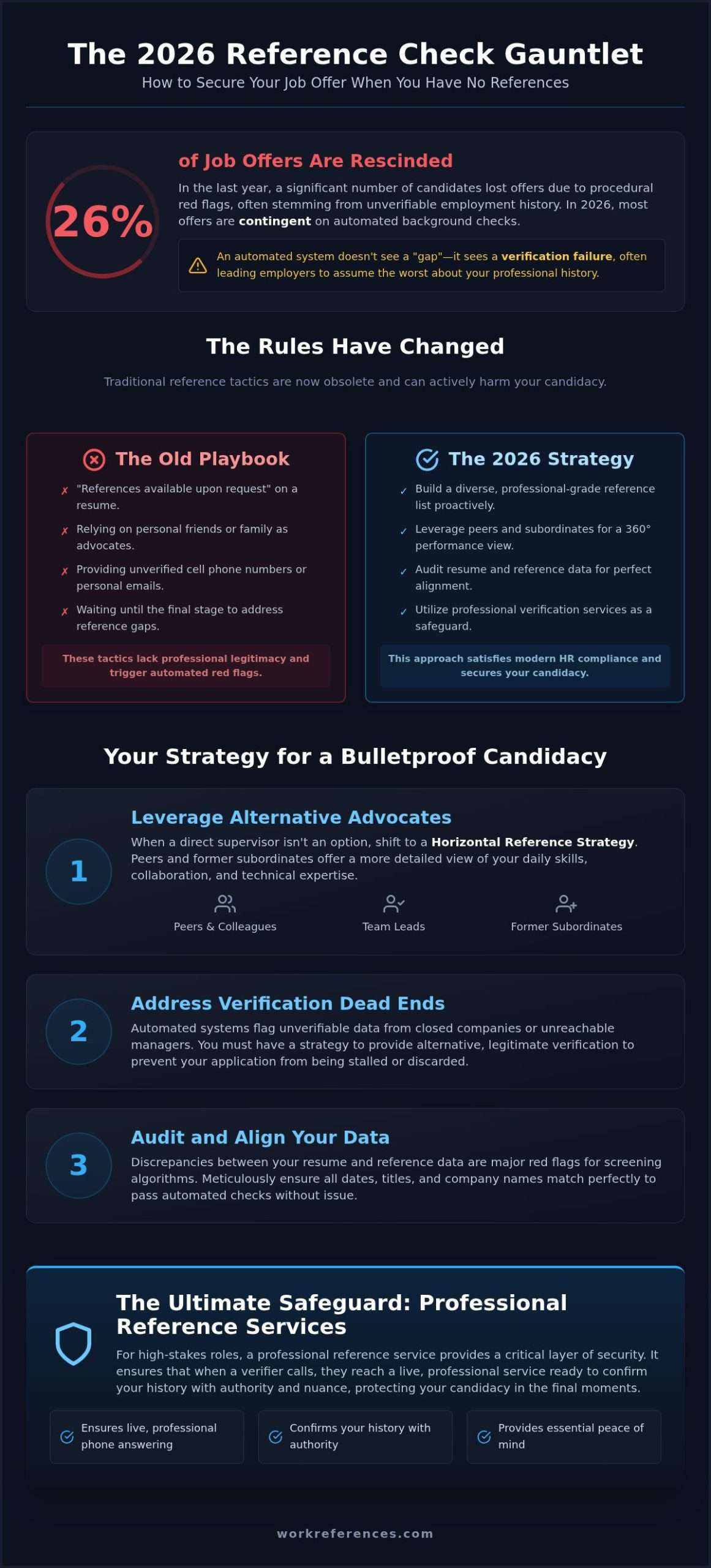
In 2026, the final interview is no longer the finish line. It’s a conditional gateway. Most job offers are now “contingent” on the successful completion of automated background checks. If you are currently wondering what to do when you have no references, you are facing a systemic barrier rather than a personal one. Automated HR systems don’t view a missing supervisor contact as a neutral detail. They interpret it as a failure in the professional verification chain. This data gap creates immediate anxiety for hiring managers, often leading to rescinded offers. Recent data shows that 26% of candidates have faced a rescinded offer in the last year, frequently due to these types of procedural red flags.
A “no reference” status is rarely taken at face value. Without a professional advocate to validate your tenure, hiring teams often default to the worst-case scenario. They may assume your departure was due to a performance issue or that you’re hiding a toxic professional history. You aren’t just missing a phone number; you’re missing the “qualified privilege” that protects truthful professional feedback. This is why a missing history is so damaging. It leaves a vacuum that the employer fills with doubt.
The Reality of Modern Background Screening
Third-party verification firms have shifted the burden of proof onto the candidate. These firms use sophisticated algorithms to flag “unverifiable” employment history, especially in high-security sectors like IT or finance. If a previous company has closed or a manager is unreachable, the system triggers an alert. The traditional tactic of listing “references available upon request” is obsolete in 2026. By the time an employer asks, their automated screening tools have already identified the absence of verifiable data. This makes a missing history a terminal error for many high-paying roles.
When Traditional Networking Fails
Personal advocates don’t satisfy modern corporate compliance. While a personal employment reference or job reference is helpful for character assessment, it lacks the weight of professional verification. HR departments prioritize sources they can link to official corporate entities. Relying on a friend’s personal email or a cell phone number often looks like an attempt to bypass standard protocols. It creates a lack of legitimacy that can stall your progress.
Securing your narrative requires a more robust approach. When traditional networking falls short, investing in a Professional Reference Package acts as a critical safeguard. It ensures that when a recruiter calls, they reach a professional, live answering service that confirms your history with authority. Understanding what to do when you have no references is about more than just filling a form. It’s about protecting your professional reputation against automated systems that lack nuance. This level of procedural integrity is what separates successful hires from rescinded offers.
Leveraging Alternative Professional Advocates: Beyond the Direct Supervisor
When the traditional path of a direct supervisor reference is blocked, you must pivot to a multi-dimensional strategy. Modern hiring managers are increasingly receptive to a skills-based approach, which allows for a wider range of professional advocates. If you’re struggling with what to do when you have no references from a former boss, look toward your horizontal and downward professional connections. Peers and former subordinates can often provide a more detailed account of your daily performance and technical contributions than a distant executive. This approach creates a 360-degree view of your capabilities that a single manager simply cannot offer.
This “Horizontal Reference Strategy” is particularly effective in collaborative environments. It bypasses the bottleneck of a single toxic or unavailable manager by focusing on the people who worked alongside you every day. You can find more practical tips on How to Get Hired with No References, which emphasizes the value of networking and providing tangible work samples alongside these alternative advocates. Diversifying your list ensures that one missing link doesn’t collapse your entire candidacy.
Peer and Colleague References
Selecting the right peer is a matter of strategic alignment. Choose colleagues who were directly involved in your high-impact projects or those who tracked your technical KPIs. Before they take a call, brief them on the specific job description you’re targeting. Consistency is vital here. If their testimony contradicts your resume or your own interview statements, it triggers the same red flags as a missing reference. Ensure your peer advocates understand the specific “Reference Worker” narrative you need to project to maintain procedural integrity throughout the background check.
External Professional Witnesses
External witnesses often carry a high level of objective credibility because they aren’t bound by internal company politics. Long-term clients or vendors can validate your work ethic and reliability from an outsider’s perspective. They act as “character witnesses” with a professional edge. Similarly, mentors from industry associations or volunteer coordinators can speak to your leadership and commitment. These advocates bridge the gap when traditional corporate channels are unavailable, proving your value through external validation.
Navigating these alternative routes requires precision and careful coordination. If you’re unsure how to structure these non-traditional contacts for a background check, you can consult with a career advocate to ensure your strategy is airtight. Expanding your orbit of advocates doesn’t just fill a gap. It demonstrates a level of professional maturity and resourcefulness that hiring managers in 2026 deeply value.
Navigating Dead Ends: References for Closed Companies and Unavailable Managers
The modern economy is volatile. Corporate restructuring and rapid business closures have created a landscape of “ghost companies” that exist only on old resumes. If you are wondering what to do when you have no references because your former office has been shuttered, you are not alone. This isn’t just a logistical hurdle. It’s a procedural threat to your candidacy. HR departments in 2026 are increasingly skeptical of unverifiable history. They often prioritize candidates with active, reachable supervisors over those with a trail of defunct organizations.
When a manager disappears or a company dissolves, the legal and procedural hurdles multiply. Third-party background check firms often mark these entries as “unable to verify,” which can lead to an automatic disqualification in high-compliance industries. You must take control of the narrative before the automated systems flag your history as a risk. Procedural integrity depends on your ability to provide a legitimate path for verification, even when the original source is gone.
Solving the ‘Closed Company’ Dilemma
Validating your tenure at a closed firm requires a rigorous paper trail. In the absence of a live supervisor, you must provide secondary documentation to prove your employment. Gather your W-2s, final paystubs, and any saved performance reviews. These documents act as forensic evidence of your professional contributions. Professional services specialize in bridging this gap by providing a legitimate point of contact for verification firms. For a deeper look at this process, see our guide on References for Closed Companies: How to Secure Your Work History in 2026. This proactive documentation prevents your history from being dismissed as “unverifiable.”
When Your Manager is ‘MIA’
Managers move on. They retire, change industries, or simply lose touch. When a recruiter asks for a specific supervisor who is now unreachable, the protocol is clear: be transparent but prepared. Inform the recruiter early that the manager is no longer with the firm or is currently unavailable. Don’t leave them to find a disconnected number during the background check. This transparency builds trust, but it doesn’t solve the verification gap on its own.
Finding a workaround is essential for high-stakes transitions. This is why Professional Reference Packages have become the industry standard for candidates with missing supervisors. These services provide a consistent, professional point of contact that satisfies HR requirements. They ensure that when a verification call is made, it’s answered by a live professional who can validate your history with authority. You don’t have to let a missing manager end your career momentum. Taking these steps ensures that “what to do when you have no references” has a concrete, professional resolution.
Strategic Alignment: Ensuring Your Resume and Reference Data Match Perfectly
Consistency is the primary indicator of legitimacy for modern background checkers. In 2026, automated HR systems are programmed to flag even minor discrepancies as high-risk anomalies. If your resume claims a specific title or tenure that your advocates cannot confirm, the system triggers a red flag that often leads to a rescinded offer. For those determining what to do when you have no references from a direct supervisor, this alignment is your final safeguard. You must ensure that every piece of data you provide is synchronized across all platforms and testimonies.
Discrepancies between a resume and a reference check are a leading cause of hiring failures. A “near match” is no longer good enough. When an automated system identifies a one-month gap in employment dates or a slight variation in a job title, it doesn’t ask for clarification. It simply marks the file as inconsistent. Maintaining procedural integrity means auditing your own history before a third party does it for you. If you’re unsure what to do when you have no references to lean on, start by securing the absolute accuracy of the data you *do* have.
The Resume Validation Audit
Your public professional record must mirror your private applications. Start by cross-referencing your LinkedIn profile with the reference list you intend to provide. Many candidates fall victim to “accidental” discrepancies, such as listing a promotion date that differs from official HR records. You can find detailed steps in The Critical Guide to Resume and Reference Consistency in 2026. This audit identifies potential red flags before they reach a recruiter’s desk, allowing you to correct the narrative while you still hold the initiative.
Briefing Your References for Consistency
Even the most supportive advocates need a structured narrative to follow. Provide your references with a “cheat sheet” that outlines your key achievements, exact employment dates, and the specific job titles you used on your resume. This ensures that every person on your list provides a consistent testimony that reinforces your credibility. Professional Resume Writing and Editing services play a vital role here, as they help align your documented history with the expectations of modern verification firms. When your advocates speak the same language as your resume, you project an image of stability and authenticity.
Your career transition is too high-stakes to leave to chance. If you need assistance synchronizing your professional narrative to pass a rigorous background check, contact our career advocates today for a professional consultation. Protecting your reputation requires meticulous attention to detail and a proactive approach to data integrity.
Professional Reference Services: The Modern Solution for High-Stakes Career Transitions
For mid-level and senior professionals, traditional networking often hits a ceiling. If your career history includes defunct firms or gaps that peers can’t fully validate, you need a more robust infrastructure. This is what to do when you have no references that meet the rigorous standards of 2026 corporate compliance. Relying on a DIY approach is a gamble when six-figure salaries are on the line. Investing in a Professional Reference Package shifts the burden from your personal network to a dedicated verification system. It provides a level of procedural integrity that personal advocates simply cannot match.
Hiring managers today look for stability and legitimacy. They want to know that your history is verifiable through standard corporate channels. When you use a professional service, you aren’t just filling a gap. You’re adopting the mindset of a vigilant career advocate. This approach ensures that your candidacy isn’t derailed by a missing phone number or a manager who moved to a competitor. It’s about taking control of the verification process before the background check firm does.
Why Live Phone Answering is Critical
Background check firms operate on tight deadlines. If they hit a voicemail or play “phone tag” with a busy former colleague, they often mark the reference as unreachable. This delay can be fatal in a fast-paced hiring cycle. A professional answering service projects corporate legitimacy by ensuring every call is handled by a live agent who understands the verification protocol. It eliminates the risk of a missed connection costing you the job. You can explore the data behind these interactions in our analysis: Do Jobs Actually Call References? The 2026 Reality of Employment Verification. Consistency in how these calls are answered is the primary indicator of authenticity for HR departments.
Choosing the Right Tier for Your Career Level
Not every career transition requires the same level of support. A Basic Reference Package is often sufficient for entry-to-mid-level roles where simple tenure validation is the primary goal. It’s a cost-effective way to ensure your history is confirmed without the stress of tracking down ghosts from your past. However, for leadership positions, the Executive Reference Package offers priority processing and high-tier verification tailored for complex backgrounds. This includes more comprehensive support for those wondering what to do when you have no references that can speak to executive-level KPIs. You can view WorkReferences pricing and packages to determine which level of protection fits your current trajectory. This isn’t a luxury. It’s a procedural necessity that ensures your professional narrative remains intact during the most critical phase of the hiring process.
Securing Your Professional Narrative
Your career transition shouldn’t be stalled by a missing supervisor or a defunct company. We’ve explored how leveraging horizontal advocates and ensuring meticulous resume alignment can bridge the gap in your history. Knowing what to do when you have no references is about shifting from a reactive state of anxiety to a proactive strategy of professional verification. It’s about protecting the years of hard work you’ve already invested in your field through strategic procedural integrity.
With over 20 years of career documentation expertise, WorkReferences provides the essential safeguard your candidacy requires. Our team offers legitimate verification for defunct or closed companies and ensures live phone answering for every reference check. This level of professional oversight ensures that no call goes unanswered and no history remains unvalidated. Don’t let automated screening hurdles dictate your professional future. Secure your professional future with a WorkReferences Package today and move forward with the prepared confidence of a fully verified candidate. You’ve earned your next role. Now it’s time to claim it with authority.
Frequently Asked Questions
What should I do if I have no professional references for my first job?
You should pivot to academic mentors, volunteer coordinators, or internship supervisors to establish your initial professional credibility. These figures can speak to your work ethic and reliability even without a formal corporate history. If you’re stuck on what to do when you have no references for an entry-level role, these alternative advocates provide the necessary validation. Ensure you provide them with your resume so their testimony aligns with your stated skills.
Can I use a friend as a job reference if we worked together?
You can use a friend only if you shared a formal professional relationship, such as being colleagues on the same team. In this case, they serve as a horizontal peer reference rather than a personal one. It’s vital to maintain professional boundaries during the verification call. They must focus on your technical KPIs and collaborative contributions. Using a friend who wasn’t a coworker is risky and often flagged by screening algorithms.
How do I explain to a recruiter that I have no references from my last role?
You should provide a concise, factual explanation that focuses on structural changes rather than personal conflict. State clearly if the company went out of business or if your direct supervisor has left the industry and is unreachable. Transparency builds trust, but you must follow up with alternative advocates or professional verification. This prevents the recruiter from assuming your lack of references is due to a performance issue or a toxic departure.
Is it illegal to use a professional reference service?
It is entirely legal to use a professional reference service to secure your career transition. These services act as a strategic safeguard by providing legitimate verification of your work history and professional narrative. They ensure that your employment data is consistent and that verification calls are handled with corporate-grade professionalism. This isn’t job placement or legal representation; it’s a procedural tool used to maintain your professional integrity during high-stakes hiring cycles.
What happens if a background check company can’t reach my references?
If a background check firm cannot reach your contacts, they typically mark your history as “unverifiable.” This status is a major red flag that can lead to a rescinded job offer. Automated systems don’t often allow for nuance, which is why having a live phone answering service is essential. It ensures that every inquiry is met with a professional response, preventing the “voicemail tag” that frequently stalls or ends a candidacy.
Can I use a reference from a company that went out of business?
You can and should list references from defunct companies, but you must support them with secondary documentation like W-2s or paystubs. Since the physical office no longer exists, providing a professional verification contact is the most effective way to validate your tenure. If you’re unsure what to do when you have no references from a closed firm, professional services can bridge that gap by acting as a legitimate point of contact for your historical data.
How many references do I realistically need for a corporate job in 2026?
You realistically need three professional references for most corporate roles in 2026. A standard list typically includes one direct supervisor, one horizontal peer, and one subordinate or long-term client. This 360-degree view provides the verification depth that modern HR departments require. High-tier executive roles may demand more, but having three solid, reachable advocates is the baseline for passing a standard background check and securing a contingent job offer.
Does a ‘no reference’ status automatically mean I won’t get the job?
A “no reference” status doesn’t mean an automatic rejection, but it significantly increases the risk of your offer being retracted. With 26% of candidates reporting rescinded offers in the past year, any data gap is a liability. Hiring managers interpret a lack of advocates as a sign of potential performance issues or instability. You must proactively fill this vacuum with alternative advocates or professional verification services to ensure your candidacy remains competitive.
Article by
William Schmidt
William Schmidt is a former Fortune 500 recruiter and founder of WorkReferences.com, a pioneering employment verification and professional reference service established in 2009. With extensive experience working alongside hiring managers, recruiters, and background screening agencies, he helps job seekers overcome career obstacles through credible, third-party verification solutions that strengthen resumes and restore confidence in the hiring process