
What happens to your professional identity when the company that signed your paychecks simply ceases to exist? It’s a chilling thought that’s becoming a common reality for many high-level professionals. You’ve dedicated years to building a reputation, yet a sudden corporate merger can instantly transform your solid work history into an “unverifiable” liability. We understand the frustration of watching a dream job offer stall because an automated background check can’t find a record of a business that was swallowed by a competitor. Handling employment verification after company acquisition shouldn’t be a source of anxiety that keeps you up at night.
You deserve to have your career achievements recognized, regardless of corporate restructuring. This guide will teach you how to proactively manage your professional records and fill the “verification void” left behind by defunct HR departments. We’ll provide a foolproof strategy to navigate the complexities of 2026 screening standards with absolute confidence. From replacing missing corporate entities to securing your history against automated failures, you’re about to learn how to safeguard your professional future. We will examine the specific tools available to leaders who need to prove their past to move forward.
Key Takeaways
- Identify the “Acquisition Gap” and why 2026 background check algorithms frequently flag post-merger history as a professional risk.
- Understand the legal realities of “Successor in Interest” and why relying on an acquiring company to maintain your legacy records is a strategic gamble.
- Master the process of employment verification after company acquisition by moving beyond vulnerable paper records to professional, live-answered validation.
- Build a proactive “Verification Bridge” to secure your professional credibility before automated screening systems can stall your next career move.
- Position yourself as a high-stakes candidate by utilizing executive-level verification packages that replace missing corporate HR departments.
Navigating the Employment Verification Gap After a Company Acquisition
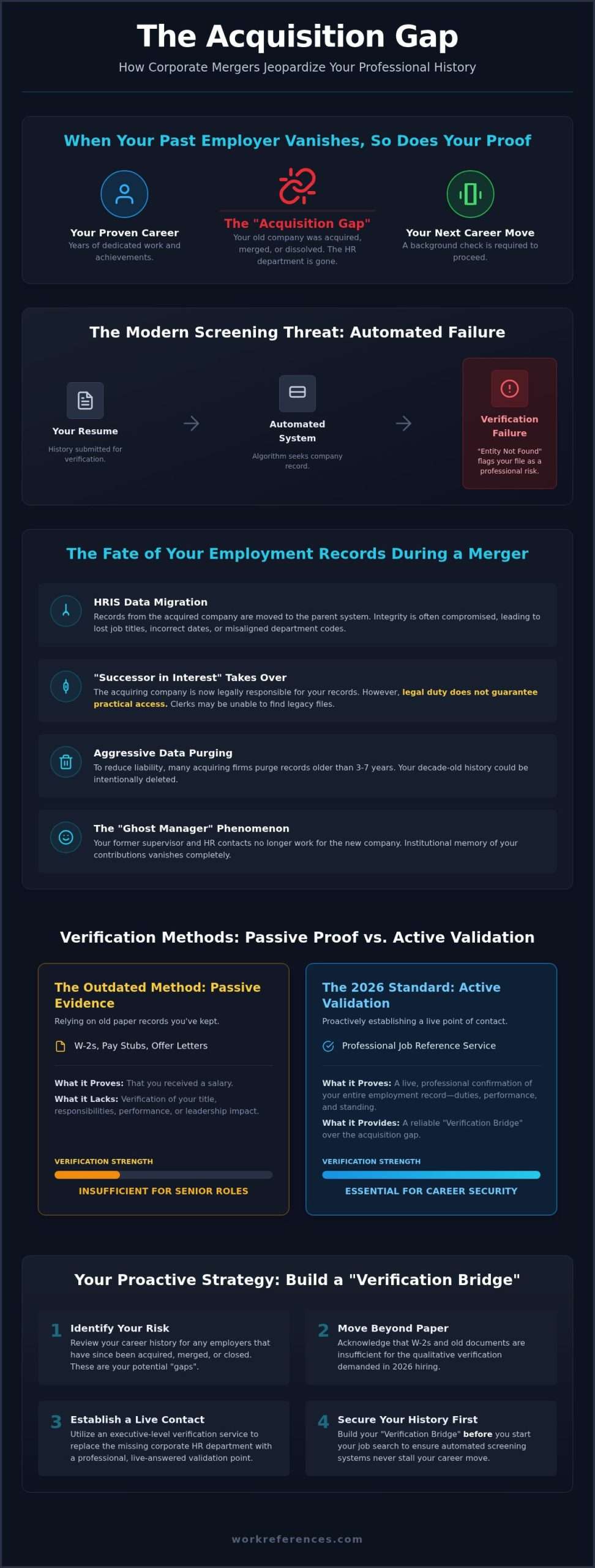
The “Acquisition Gap” represents a precarious period in a professional’s career where their documented history becomes untethered from its source. When corporate mergers and acquisitions occur, the legal entity you once worked for may be dissolved or rebranded. Your professional credibility remains static, but the corporate identity required to validate it has shifted. This creates a disconnect that modern screening systems aren’t designed to handle. In 2026, background check algorithms are programmed for speed and binary results. If a system returns an “Entity Not Found” status, it doesn’t just result in a delay. It often triggers a red flag that suggests a candidate’s history is fraudulent or unverifiable. Mastering employment verification after company acquisition is no longer an optional task; it’s a career necessity.
While the acquiring company is technically the “Successor in Interest” and bears the legal responsibility for record maintenance, actual accessibility is a different story. Legal ownership doesn’t guarantee that a clerk in a different state will be able to locate your file from five years ago. The stakes are high. An “unverifiable” status can lead directly to a rescinded job offer, as employers are increasingly risk-averse in a high-compliance hiring environment.
Why Corporate Mergers Break the Background Check Process
Mergers often involve massive HRIS migrations where data from the acquired company is moved into the parent organization’s system. During these transitions, record integrity is frequently compromised. Fields for specific job titles, start dates, or department codes can be lost or misaligned. Additionally, the downsizing of local HR teams means the institutional memory of your tenure vanishes. When an automated screening tool attempts to reach a defunct HR department, the resulting “dead end” creates immediate suspicion. Employment verification after company acquisition requires more than just a paper trail. It requires a living point of contact that can confirm your professional standing without the friction of a broken corporate database.
The Shift from Passive to Active Verification
Relying on passive evidence like W-2s or old pay stubs is no longer sufficient for senior-level roles. While a tax document proves you received a salary, it fails to verify your specific responsibilities, performance, or leadership impact. Hiring managers in 2026 demand qualitative verification. They want to confirm that you actually performed the duties listed on your resume. This is where a professional job reference service becomes an essential safeguard. It provides a structured, professional bridge between your past achievements and your future opportunities. By establishing a “Verification Bridge,” you ensure that your work history isn’t erased by a corporate merger.
The Mechanics of Merger Records: Where Your Work History Goes
The legal framework of corporate transitions is often opaque to the employees caught in the middle. When your employer is acquired, your professional record becomes a line item in a massive data migration. The entity that now holds your history is known as the “Successor in Interest.” Successor in Interest is the entity legally responsible for your past data. However, legal responsibility doesn’t always translate to operational efficiency. Many acquiring firms have strict data retention policies that result in purging records older than three to seven years to reduce liability. This creates a significant hurdle for employment verification after company acquisition when you’re applying for a role a decade later.
Decentralized records are the primary enemy of the modern job seeker. Your old HR files might reside on a legacy server in one state, while the new parent company’s payroll operates in another. This fragmentation leads to the “Ghost Manager” phenomenon. This occurs when your former supervisor is no longer with the acquiring firm, leaving no one with first-hand knowledge of your contributions. If you’re worried about your records being lost in a merger, you can speak with a career advocate to ensure your history remains accessible and verified.
Identifying the New Custodian of Records
Tracking the current owner of your work history requires an understanding of how the deal was structured. In a stock purchase, the acquiring company typically assumes all records and liabilities seamlessly. However, an asset purchase is different; the buyer may only “cherry-pick” certain parts of the business, often leaving legacy HR records in a legal limbo with a shell company. Understanding the Form I-9 requirements in mergers is a good starting point for seeing how corporate liability shifts. Effective employment verification after company acquisition depends on knowing exactly where your data landed and who has the keys to the digital archive.
Common Data Migration Errors to Anticipate
Even when records transfer, they rarely do so perfectly. You should expect and prepare for several common migration failures that can damage your credibility during a background check:
- System Resets: Automated migrations often “reset” hire dates to the date of the acquisition, making a ten-year veteran look like a six-month new hire.
- Title Mapping: If the new company uses a different internal grading scale, your “Senior Director” title might be downgraded to a generic “Manager” role in the new system.
- Lost Commendations: Performance reviews and disciplinary clearances are often the first things deleted during a migration to save server space.
These errors aren’t just technical glitches. They’re threats to your professional narrative that require proactive management before you enter the interview room.
Verification Methods: Comparing Self-Service Proof vs. Professional Validation
When you face the challenge of employment verification after company acquisition, the tools you choose will determine your professional fate. Many candidates attempt a self-service approach by gathering old tax forms and pay stubs. While these documents offer a baseline of proof, they’re increasingly insufficient in a high-stakes hiring environment. Recruiters in 2026 are trained to look beyond mere proof of income. They require validation of your specific title, your exact tenure, and your professional conduct. Relying on automated databases like The Work Number can also be a strategic error. After a merger, these systems often suffer from significant data lags or conflicting entries that can stall your background check for weeks.
Static evidence is rarely enough for leadership roles. If an automated system returns a “no record found” message due to a database migration error, the burden of proof falls entirely on you. This is why many senior professionals are moving away from passive documentation toward active, managed validation. Utilizing references for closed companies provides a centralized solution that replaces the missing HR department with a professional, authoritative voice.
The Limits of Documentation
Paper documents are silent. They cannot answer a recruiter’s live questions about your leadership style or the circumstances of a department’s restructuring during a buyout. If you present old W-2s without a live point of contact, you risk appearing defensive or unprepared. Automated verification databases are also prone to carrying outdated information that doesn’t reflect your final role before the acquisition. You need a verification method that can adapt to the narrative of your career rather than just providing a snapshot of your salary history.
Third-Party Professional Verification vs. Peer References
Professionalism is the cornerstone of a successful background check. Providing a recruiter with a former colleague’s personal cell phone number often carries less weight than a dedicated verification service. Peer references are notoriously unreliable; a former coworker might miss the “crucial call” or provide an informal response that undermines your executive standing. Consistency is your greatest asset during this phase. You must ensure your resume and reference consistency is ironclad across all platforms. A third-party professional service acts as a strategic partner, ensuring that your employment verification after company acquisition is handled with procedural integrity and speed. This proactive approach eliminates the risk of a “Ghost Manager” failing to validate your hard-earned experience.
Step-by-Step: Securing Your Professional Credibility Post-Acquisition
Securing your professional history requires a proactive strategy that begins long before you submit your next application. When a corporate entity dissolves or merges, the burden of proof shifts from the employer to you. You can’t rely on a fractured HR department to tell your story accurately. Instead, you must build a robust “Verification Bridge” that connects your past achievements to your future goals. This process involves auditing your records, managing recruiter expectations, and ensuring a live point of contact is always available to validate your tenure. Taking these steps ensures that employment verification after company acquisition becomes a routine procedural hurdle rather than a career-ending roadblock.
Building Your Professional Evidence File
Phase one of your strategy is the immediate audit of your “Proof of Service” portfolio. You should gather every digital and physical document that validates your career progression. This includes original offer letters, formal promotion notices, and annual performance reviews. These documents serve as secondary evidence if a primary database fails. Additionally, you should secure LinkedIn recommendations from your direct supervisors while they are still reachable and their professional transition is fresh. You should create a comprehensive “M&A Fact Sheet” that outlines the timeline of the acquisition, the name of the successor entity, and the last known contact details for the legacy HR department to assist background investigators.
Managing the Recruiter’s Expectations
Phase two and three involve controlling the narrative. You must communicate the acquisition context to recruiters proactively. This isn’t about making excuses; it’s about projecting professional transparency. We recommend the “Pre-emptive Strike” approach. Rather than waiting for a background investigator to hit a dead end, provide the verification contact information upfront during the final interview stage. This demonstrates that you’re prepared for the complexities of 2026 screening standards.
- Verify the Entity: Ensure the company name on your background check form matches the “new” corporate reality or clearly denotes the “formerly known as” status.
- Update Your Timeline: Align your resume dates with the legal acquisition dates to prevent automated “discrepancy” flags.
- Provide a Solution: Offer a direct path to verification before the recruiter encounters a “Ghost Manager” scenario.
The final phase is leveraging professional services to handle the live verification calls. Automated systems and unresponsive successor companies are the primary causes of rescinded offers. By using a dedicated service, you ensure that every inquiry is met with a professional, authoritative response. If you’re ready to secure your history against corporate instability, you can contact our team today to establish your professional verification bridge.
Strategic Safeguards: How WorkReferences Bridges the M&A Verification Void
Corporate restructuring is a force of nature that individual professionals cannot control. When your former employer is swallowed by a conglomerate, your work history enters a digital void where automated systems often fail. WorkReferences acts as the permanent “HR Voice” for your career, stepping into the professional space once occupied by your defunct or acquired employers. We provide the stability that modern hiring managers demand. Our service ensures that your employment verification after company acquisition is never left to the chance of a broken database or an unresponsive successor firm.
Speed and accuracy are the two most critical variables in a background check. If a recruiter can’t reach a human being to confirm your tenure, they’ll move to the next candidate. We solve this through live phone answering, ensuring you never miss a verification window. This active approach creates total alignment between your professional employment references and your actual career goals. Ensuring your employment verification after company acquisition is handled by experts eliminates the stress of the “Ghost Manager” phenomenon. It transforms your history from a liability into a verified asset that withstands the scrutiny of any 2026 screening algorithm.
Professional Reference Packages for Any Career Stage
We recognize that the stakes vary depending on your professional level. Our Basic Reference Package provides essential verification for entry-to-mid-level roles, offering the foundational security needed for standard background checks. For senior leaders caught in the complexities of M&A fallout, the Executive Reference Package offers a high-touch, sophisticated verification process. This tier is designed to handle qualitative inquiries about leadership and strategic impact. While some view professional documentation fees as an added cost, they’re a necessary investment in your long-term career security. Securing your reputation is far less expensive than losing an executive-level salary to an “unverifiable” status.
Your Next Step Toward Career Security
Don’t let a corporate merger or a messy acquisition stall your professional momentum. The “Verification Void” is a real risk, but it’s one you can easily bridge with the right strategic partner. You can start with a comprehensive verification audit today to identify potential gaps in your history before a recruiter finds them first. Our team understands the hidden hurdles of the hiring world and acts as your vigilant advocate throughout the screening process. Contact the career advocates at WorkReferences to secure your history.
Take Command of Your Professional Narrative
Corporate instability shouldn’t dictate the trajectory of your career. The “Verification Void” created by mergers and acquisitions is a significant hurdle that requires a proactive, strategic response. You can no longer rely on the fragmented records of a successor firm or the silence of a defunct HR department to tell your story. Success in the 2026 hiring market depends on your ability to provide a living, authoritative point of contact that validates your hard-earned experience. Effectively managing employment verification after company acquisition is about more than just showing paperwork; it is about ensuring your professional credibility remains beyond reproach during every background screening.
With 20+ years of experience in career documentation, WorkReferences provides the specialized support you need for closed and acquired companies. Our live phone answering service ensures your background check integrity is never compromised by a missed connection or a database error. Don’t let your past achievements become “unverifiable” liabilities that stall your professional momentum. Secure your professional future-contact us for expert verification support. You have built a remarkable career, and we are here to ensure your next employer recognizes its full value.
Frequently Asked Questions
How do I list a company on my resume if it was acquired?
List the original company name followed by the acquiring company in parentheses, such as “Company A (Acquired by Company B).” This approach maintains the integrity of your history while providing the recruiter with the current entity responsible for verification. It’s essential to use the name that matches your tax records and the name that will appear in a background check to avoid automated discrepancy flags.
Can a background check fail because the company no longer exists?
Yes, a background check can return an “unverifiable” status if the screening agency cannot find a surviving HR department or a digital record of the entity. While this isn’t a “failure” in the sense of a criminal hit, it can lead to a rescinded offer if the employer requires 100% verification. Taking control of the employment verification after company acquisition ensures you have a professional alternative ready when these automated systems hit a dead end.
What documents can I use to prove employment if HR records are lost?
You should rely on primary financial and legal documents like W-2 forms, final pay stubs, and original signed offer letters. While these prove you were on the payroll, they don’t verify your job duties or performance. For senior roles, you’ll also need to provide promotion notices or performance reviews to substantiate the qualitative aspects of your tenure that basic tax documents simply cannot convey.
Who should I list as a reference if my old manager was laid off during a merger?
You should attempt to locate that manager through professional networks like LinkedIn, but if they’re unavailable, a professional verification service is your most secure option. Listing a peer is risky as they may lack the authority a recruiter expects. A dedicated service can act as your “HR voice,” providing a consistent and professional response that replaces the missing institutional memory of your former supervisor.
Is it legal for an acquiring company to lose my employment records?
While “Successors in Interest” have a legal duty to maintain certain records like Form I-9s for specific periods, data migrations often result in the loss of non-essential files. There’s rarely a legal penalty for a company losing your specific job description or commendations. This reality makes it your responsibility to maintain a personal evidence file to safeguard your professional credibility against corporate administrative failures.
How do I find the ‘successor in interest’ for my former employer?
You can track the lineage of a company by searching Secretary of State business registries or using financial news databases to find merger announcements. Look for “Press Releases” or “Investor Relations” pages of the suspected parent company. Identifying the correct legal entity is the first step in resolving issues with employment verification after company acquisition, as it tells you where the digital archive of your tenure likely resides.
Should I tell the recruiter my former company was acquired before the background check starts?
Yes, you should proactively disclose the acquisition context during the final interview phase to prevent surprises. Providing a brief “M&A Fact Sheet” with the names of both the legacy and parent companies shows professional transparency and preparedness. This preemptive move allows the recruiter to adjust their expectations for the background check turnaround time and helps them navigate potential “Entity Not Found” errors without alarm.
Can I use a professional verification service if I can’t find my old supervisor?
Absolutely, this is one of the primary reasons professionals utilize third-party verification services. When a supervisor is unreachable or has moved on, a professional service provides a stable, live-answered point of contact for recruiters. It replaces the “Ghost Manager” with a structured, authoritative response that validates your work history, ensuring your career progression isn’t stalled by another person’s professional transition.
Article by
William Schmidt
William Schmidt is a former Fortune 500 recruiter and founder of WorkReferences.com, a pioneering employment verification and professional reference service established in 2009. With extensive experience working alongside hiring managers, recruiters, and background screening agencies, he helps job seekers overcome career obstacles through credible, third-party verification solutions that strengthen resumes and restore confidence in the hiring process