

What if your most powerful professional advocate isn’t the manager who rarely saw your work, but the colleague who sat in the trenches with you every day? You’ve likely reached a point where a former supervisor is unreachable or a previous employer has gone out of business. In these high-stakes moments, you might find yourself questioning, can a coworker be a reference when the traditional hierarchy fails you. We understand the inherent anxiety of these career transitions. It’s a vulnerability that feels like it could derail an offer you’ve worked months to secure.
This guide provides the tactical roadmap you need to leverage peer references as high-authority witnesses to your daily impact. You’ll discover how to present a colleague in a way that satisfies corporate compliance and maintains your professional legitimacy. We will examine the specific strategies for selecting the right peers and the exact protocols for ensuring they pass rigorous background checks. It’s time to move from concern regarding your professional setbacks to a state of prepared confidence in your career safeguards.
Key Takeaways
- Learn why modern recruiters accept peer references and the specific high-stakes scenarios where they carry the most professional weight.
- Understand the strategic nuances of can a coworker be a reference to ensure your candidacy remains secure when former supervisors are unreachable.
- Discover the rigorous protocol for preparing your colleague to deliver a high-authority testimony that aligns with your resume’s technical details.
- Identify how to avoid the “friend trap” and other common pitfalls that can undermine your credibility during the verification process.
- Explore how a Professional Reference Package provides an essential safeguard through live phone answering and third-party work history validation.
Can a Coworker Be a Reference? The 2026 Short Answer
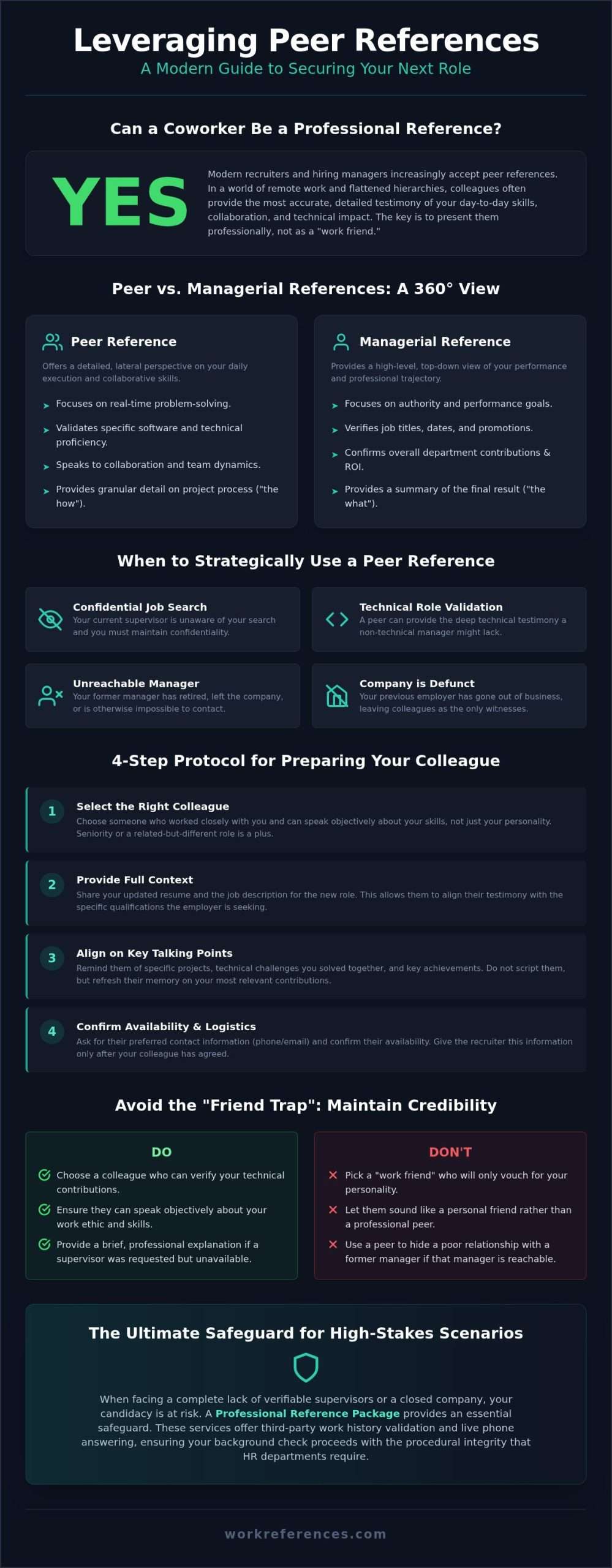
Yes, a coworker can legally and professionally serve as a reference. This is the definitive answer for professionals navigating a landscape where traditional reporting lines have fractured. Whether your former manager has retired or your previous employer has shuttered its doors, the hiring world has evolved to accommodate these realities. Recruiters increasingly accept peer references, provided they are presented with the correct context and professional authority.
The critical distinction lies in the nature of the relationship. A “work friend” who simply likes your personality is a liability; a “professional colleague” who can verify your technical contributions is a strategic asset. When you evaluate the question, can a coworker be a reference, you must ensure they can speak objectively about your skills, work ethic, and specific project outcomes. They shouldn’t just vouch for your character. They must act as a witness to your professional performance.
The Difference Between Peer and Managerial References
Managerial references typically focus on high-level metrics. They verify your dates of employment, your job title, and whether you achieved your annual performance goals. They provide a top-down view of your professional trajectory. In contrast, peer references offer a lateral perspective that is often more detailed regarding your daily technical execution. This 360-degree view is becoming the standard in 2026 as companies look for cultural fit and technical depth.
- Managers: Focus on authority, promotions, and overall department ROI.
- Peers: Focus on collaboration, specific software proficiency, and problem-solving in real-time.
Hiring managers realize that a direct supervisor might only see the final result. A peer sees the process. This granular detail is often more persuasive in technical or collaborative roles where the “how” matters as much as the “what.”
When HR Specifically Requests a Supervisor
What happens when an application portal strictly demands a supervisor’s contact information? This is a high-stakes moment, but it shouldn’t be a dead end. If you must use a peer, provide a brief, professional explanation. State clearly that your former manager is unreachable or that the company has ceased operations. Transparency protects your credibility more than a vague substitution ever could.
For those facing a complete lack of verifiable supervisors, a Professional Reference Package can bridge the gap. These services ensure that your work history is validated through professional channels, providing the procedural integrity that HR departments require. Using a peer is a tactical move; using a verification service is a strategic safeguard for your career advancement.
Strategic Scenarios for Choosing a Peer Reference
While a supervisor is often the default choice, specific career obstacles make a peer reference the only viable path to a job offer. In high-stakes transitions, the question isn’t just can a coworker be a reference, but rather, is a coworker the best witness to your current capabilities? For many, the answer is a resounding yes. This is particularly true when your current supervisor is unaware of your search and confidentiality is your primary safeguard. You cannot risk your current livelihood to secure a future one.
Technical roles also demand a level of granular validation that managers often lack. If you are applying for a position that requires deep mastery of emerging 2026 technologies, a peer who worked alongside you on specific builds can provide the technical testimony a recruiter needs to see. They verify the daily execution that a high-level manager might overlook. When you consider can a coworker be a reference, look for those who can speak to your technical proficiency with precision.
Navigating the ‘Closed Company’ Challenge
When a business goes defunct, the traditional chain of command disappears. This creates a significant hurdle for background checkers who require third-party verification of your tenure and performance. In these instances, former colleagues become your most vital link to your professional past. They serve as the remaining witnesses to your contributions when the corporate entity no longer exists.
To handle this effectively, you must provide recruiters with a clear context. Explain the company’s status and offer a colleague who can speak to your specific role during that time. For a deeper look at managing these complexities, see our guide on References for Closed Companies: How to Secure Your Work History. This ensures your background check doesn’t stall due to administrative gaps.
Avoiding Toxic Managers and Negative References
Not every manager-employee relationship is productive. If you fear a toxic manager might provide an unfair or biased assessment, choosing a peer reference is a protective measure for your career. It allows you to present an objective view of your work from someone who actually observed your daily performance. This isn’t about hiding your past; it’s about ensuring your future is judged on merit rather than personality conflicts.
The key is maintaining procedural integrity. Your peer should focus on collaborative achievements rather than personal grievances against the former manager. They must avoid the “friend trap” by using industry-standard language to describe your impact. If you are unsure how to present this transition to a potential employer, you can consult with our team to ensure your strategy is airtight. This approach moves you from a state of worry to one of prepared confidence.
How to Prepare Your Colleague for the Reference Call
Preparation transforms a casual conversation into a professional endorsement. You’ve already determined that the answer to can a coworker be a reference is a tactical “yes,” but that choice requires a rigorous follow-up. A peer who is caught off guard or lacks specific details about your current goals can inadvertently damage your credibility. You must equip your advocate with the information they need to withstand a recruiter’s scrutiny.
Follow these five steps to ensure your peer reference is ready for the high-stakes verification process:
- Step 1: Formally request permission. Never assume a colleague is willing to stake their professional reputation on your behalf. A formal ask allows them to opt-out if they don’t feel they can give a strong recommendation.
- Step 2: Provide your updated resume and the specific job description. Your reference needs to know exactly which skills they should emphasize to align with the hiring manager’s needs.
- Step 3: Remind them of two or three key projects you completed together. Concrete examples of collaboration provide the “on-the-ground” evidence that makes a peer reference so valuable.
- Step 4: Conduct a mock reference call. This helps identify potential red flags or hesitation in their voice. It’s better to find a weakness in your strategy now than during the actual check.
- Step 5: Confirm their availability for live phone answering. A missed call from a recruiter can signal a lack of professionalism or reliability, potentially stalling your offer.
Aligning the Narrative with Your Resume
Consistency is the bedrock of professional legitimacy. If your resume claims you led a project but your peer describes you as a secondary contributor, the recruiter will flag the discrepancy. You must ensure your advocate is clear on your official titles, exact dates of employment, and primary responsibilities. For a detailed breakdown of how to synchronize these elements, consult The Critical Guide to Resume and Reference Consistency. Maintaining this procedural integrity is essential for passing modern background checks.
Briefing Your Reference on Potential Questions
Recruiters often pivot their questioning when speaking to a peer rather than a supervisor. They’ll likely ask about your daily reliability, your ability to handle technical challenges, and how you resolve interpersonal conflicts within a team. Your colleague should be prepared to discuss your “areas for growth” in a way that is honest but doesn’t undermine your candidacy. They must maintain a formal, professional tone. If they sound too casual, it reinforces the “friend trap” and suggests they are biased rather than objective.
Risks of Peer References and How to Mitigate Them
While the answer to can a coworker be a reference is technically affirmative, the execution of this strategy determines your ultimate success. A poorly handled peer reference can signal a lack of professional judgment to a recruiter, potentially derailing your candidacy at the final stage. The primary danger is the “Friend Trap.” If your reference sounds too casual or overly biased, it undermines the legitimacy of their testimony. They must move beyond personal affinity and focus on objective performance data that a hiring manager can verify.
Lack of authority is another significant concern. If a peer cannot verify your salary, exact dates of employment, or promotion history, the recruiter may view their input as incomplete. Some HR departments maintain strict internal policies that forbid peer references entirely, requiring a formal supervisor or a verified third party. To mitigate these risks, you should select peers with higher seniority or impressive professional titles. Their perceived authority lends significant weight to your candidacy and provides the procedural integrity that background checkers expect.
Maintaining Professional Distance
Your reference must use the language of corporate compliance to be effective. Phrases like “deliverables,” “KPIs,” and “cross-functional collaboration” should replace vague descriptors like “great colleague” or “hard worker.” If a recruiter asks how you met, the answer should focus on the professional onboarding process or a specific project team rather than social interactions. Focusing on tangible outcomes ensures the conversation remains high-stakes and professional. This distance protects your credibility and ensures the recruiter views the peer as a reliable witness to your work history.
When a Peer Reference Isn’t Enough
There are moments when a peer reference simply won’t suffice to secure an offer. If you notice a recruiter repeatedly asking for a direct supervisor or if the background check process stalls, these are critical red flags. Never fall into the trap of thinking references are a mere formality. For an industry insider’s look at this, read Do Jobs Actually Call References? The 2026 Reality. They absolutely do, and they are trained to spot inconsistencies in peer testimonies. If you’re concerned about your manager’s absence or a peer’s ability to represent you with authority, contact our career advocates to secure your professional reputation through our specialized verification services.
WorkReferences: Ensuring Your Career Credibility
Navigating a job search in 2026 requires more than just a polished resume; it demands a bulletproof verification strategy. You have explored the nuances of whether can a coworker be a reference, and you understand the tactical benefits of using a peer advocate. However, relying solely on a colleague’s availability and performance during a high-stakes call introduces significant variables. A missed call or an overly casual response can undermine months of effort. WorkReferences acts as your vigilant career advocate, providing the procedural integrity necessary to bridge these gaps.
Our solutions are designed for professionals who cannot afford to leave their future to chance. Whether your former manager is unreachable or your previous company has shuttered its doors, our Professional Reference Package ensures your work history is validated with authority. We provide live phone answering services that guarantee a professional, consistent response to every recruiter inquiry. This eliminates the “friend trap” and replaces it with the language of corporate compliance.
Why Use a Professional Reference Service?
Relying on a busy coworker is a risk that grows as the hiring process reaches its final stages. A peer might be in a meeting, traveling, or simply unprepared for the rigorous questioning of a modern background checker. Our service provides a stable, third-party confirmation of your work history that satisfies HR departments. This is especially critical for those coming from defunct organizations where no official supervisor remains. You can explore WorkReferences services to find the specific package that aligns with your seniority and career goals.
Secure Your Next Offer with Confidence
The difference between a basic peer check and our professional verification lies in the meticulous alignment of your narrative. We perform consistency checks between your resume and your references to ensure no red flags emerge during the screening process. From our Basic Reference Package to the more comprehensive Executive Reference Package, we offer a safeguard that protects your professional reputation. We understand the inherent anxieties of these transitions, and we are here to move you toward a state of prepared confidence. Don’t let an unavailable supervisor or an unpolished peer response cost you the offer you deserve. Contact WorkReferences today to secure your professional future and navigate your next career move with total certainty.
Mastering Your Professional Narrative
Transitioning from career anxiety to professional action requires a tactical shift in how you view your network. You now understand that the answer to can a coworker be a reference is a strategic yes, provided you maintain procedural integrity throughout the process. By selecting peers who can verify your technical impact and preparing them for the rigors of a background check, you protect your candidacy from the risks of unavailable supervisors or defunct companies.
Success in the modern hiring landscape demands more than just hope; it requires an airtight verification strategy. With over 20 years of career documentation expertise, WorkReferences provides the expert career consulting and live phone answering for all verification calls that your next job offer requires. Don’t let an administrative gap or a missing manager derail your professional advancement. Secure your professional references today and step into your next role with total confidence. Your career history is too valuable to leave to chance.
Frequently Asked Questions
Is it better to have no reference or a coworker reference?
A coworker reference is significantly better than having no reference at all. A complete lack of professional advocates often signals a major red flag to recruiters, suggesting a lack of impact or unresolved interpersonal conflict. Providing a peer ensures that your candidacy remains active while offering the necessary validation to keep your job offer moving forward through the final screening stages.
Can a coworker verify my employment dates and salary?
While a colleague can confirm your general tenure, they often lack the official authority to verify precise salary data or benefit structures. Recruiters typically look to HR departments or direct supervisors for financial verification. If your supervisor is unavailable, a Professional Reference Package provides the third-party confirmation needed to validate these specific and sensitive data points with professional integrity.
How many coworker references should I provide?
You should ideally provide no more than one peer reference unless the hiring manager specifically requests a peer-heavy list. Most employers expect a balanced selection consisting of two former supervisors and one colleague. Utilizing too many peers can create the impression that you are intentionally avoiding managerial oversight or that you lacked a productive relationship with your previous leadership teams.
What if my company has a policy against giving references?
You should pivot to a personal professional reference or a specialized verification service if corporate policy forbids official endorsements. Many modern companies only confirm dates and titles to mitigate legal risks. In these high-stakes cases, a peer reference provides the qualitative detail about your technical skills and work ethic that an official HR response will naturally omit during the process.
Can I use a former coworker who is now at a different company?
Yes, using a former colleague who has moved to a new organization is often a strategic advantage for your candidacy. It demonstrates that your professional network remains strong across different companies and industries. Their current professional title adds a layer of external credibility to the question of can a coworker be a reference when you are undergoing a rigorous background check.
What should a coworker say in a professional reference letter?
A coworker should focus on your technical proficiency, collaborative spirit, and specific project contributions. They must use professional industry-speak to describe how you solved complex problems or met specific KPIs. Avoiding overly personal or social anecdotes ensures the letter maintains the serious tone required for executive roles. This focus on deliverables reinforces your legitimacy as a high-performing candidate.
Do background check companies call the company or the individual?
Background check firms typically attempt to contact the company HR department first for basic data verification. However, for performance-based reference checks, they will call the specific individuals you have listed on your application. Ensuring your advocates are available for live phone answering is essential. This prevents administrative delays that could potentially stall your employment offer or raise concerns about your reliability.
How do I list a coworker reference on my resume or application?
List the individual’s full name, current professional title, and their specific relationship to you, such as “Senior Analyst (Former Colleague at XYZ Corp).” Clearly identifying the relationship prevents any confusion regarding their level of authority. This transparency helps recruiters understand exactly why the peer is testifying to your professional capabilities and ensures the question of can a coworker be a reference is answered clearly.
Article by
William Schmidt
William Schmidt is a former Fortune 500 recruiter and founder of WorkReferences.com, a pioneering employment verification and professional reference service established in 2009. With extensive experience working alongside hiring managers, recruiters, and background screening agencies, he helps job seekers overcome career obstacles through credible, third-party verification solutions that strengthen resumes and restore confidence in the hiring process