
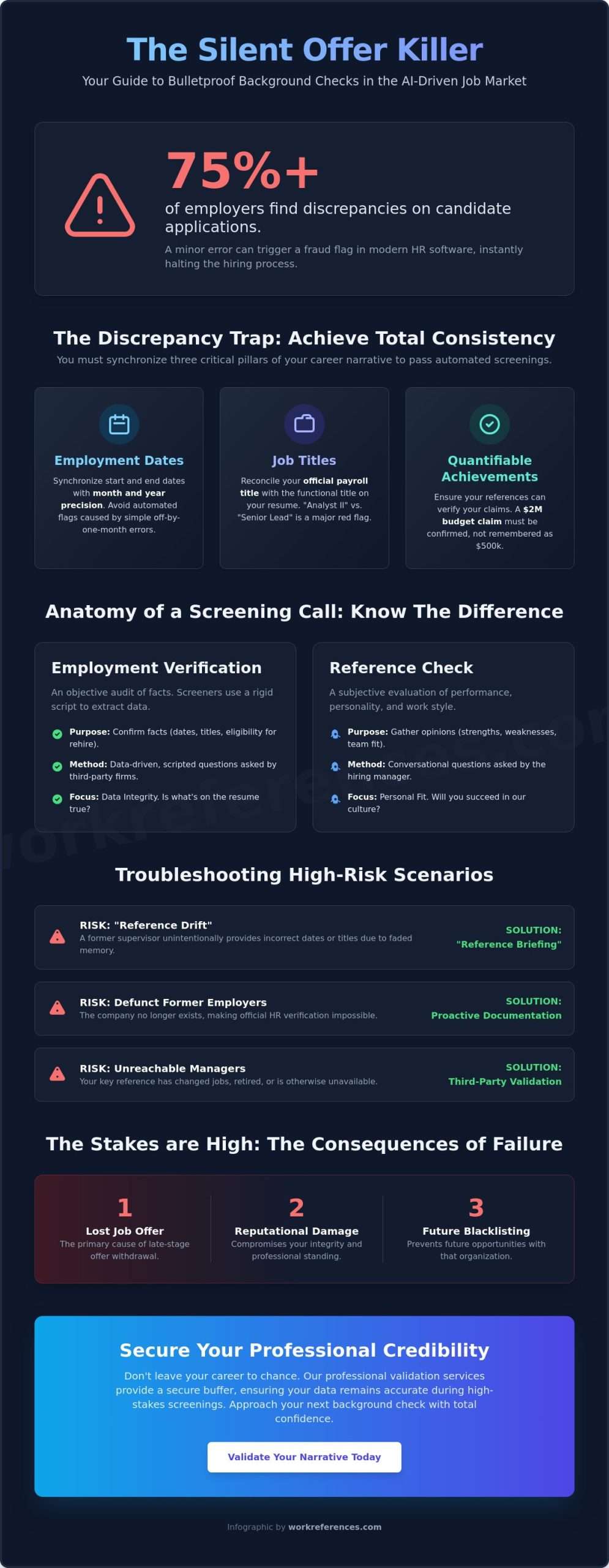
Over 75% of employers worldwide now discover discrepancies on candidate applications during the background screening process. It’s a sobering reality that a single clerical error or a slight title mismatch can halt a promising career transition in its tracks. Achieving absolute resume and reference consistency is no longer just a formatting choice; it’s a critical compliance requirement. You’ve likely felt the anxiety of wondering if a former supervisor’s memory aligns with your records or how a defunct company might impact your verification. This uncertainty isn’t just stressful. In a 2026 job market dominated by AI-driven screening, it’s a significant professional risk.
We understand the high stakes of these final hurdles and the pressure to appear flawless. This guide will teach you how to synchronize your career documentation with your professional references to survive even the most forensic background checks. You’ll learn the exact steps to transform potential liabilities into a bulletproof narrative. We’ll walk through the mechanics of creating verification-ready documentation and show you how to approach your final screening phase with total, unshakeable confidence.
Key Takeaways
- Learn why a minor date mismatch can trigger a fraud flag in modern HR software and how to audit your history for total resume and reference consistency.
- Discover the specific “verification script” used by third-party firms to distinguish between standard reference checks and formal employment verification.
- Master the “Reference Briefing” technique to align your contacts with your resume narrative without compromising their professional integrity.
- Implement strategic solutions for troubleshooting high-risk scenarios; this includes defunct former employers or managers who are no longer reachable.
- Understand how professional validation services provide a secure buffer to ensure your professional data remains accurate during high-stakes screenings.
The Silent Offer Killer: Why Resume and Reference Consistency is Non-Negotiable
In the current high-stakes hiring environment, “close enough” is no longer a viable strategy for career advancement. Resume and reference consistency is the precise alignment of your employment dates, job titles, and core responsibilities across every piece of documentation you submit. It’s the foundation of your professional credibility. To achieve this, you must synchronize three critical pillars:
- Employment start and end dates with month and year precision.
- Official payroll titles versus the functional titles used on your resume.
- Quantifiable achievements that your references can actually verify.
When these elements don’t match, you fall into the “Discrepancy Trap.” A simple three-month error in your start date can trigger a fraud flag in modern HR software, leading to an immediate halt in the hiring process. This isn’t an exaggeration. A 2025 study by HireRight found that more than 75% of employers worldwide discovered discrepancies on candidate applications. In 2026, hiring standards have evolved to prioritize data integrity over vague personal testimonials. Achieving resume and reference consistency is now a mandatory step for any professional serious about securing a new role.
The cost of a verification failure is devastating. It’s not just about the lost salary or the wasted weeks of interviewing. It’s the reputational damage that follows you through the industry. When an offer is rescinded due to a lack of consistency, you’re often blacklisted from that organization’s future opportunities. Our Professional Reference Package is designed to prevent these catastrophic setbacks by ensuring your narrative is validated before the screener ever picks up the phone.
The High Stakes of Professional Discrepancies
Modern Applicant Tracking Systems (ATS) now perform automated cross-referencing between your resume and the data returned from background check reports. The era of the “character reference” is effectively over in corporate America. Recruiters are no longer looking for a former colleague to say you’re a “great person.” They’re conducting a “verification of fact” to confirm you actually held the authority and tenure you claimed. Verification failure is the primary cause of late-stage offer withdrawal.
Beyond the Basics: What Consistency Actually Looks Like
True consistency requires a level of detail that many candidates overlook. It starts with job titles. You must reconcile your internal payroll title with the external-facing title used in a standard resume format. If your official record says “Analyst II” but you’ve listed “Senior Strategic Lead,” you’ve created a red flag. Chronological synchronization is equally vital. Using a month and year format is now the industry standard to avoid automated flags. Finally, your employment reference must be prepared to validate the specific achievements you’ve highlighted. If you claim to have managed a $2 million budget, but your reference recalls it as $500,000, your integrity is immediately compromised.
The Anatomy of a Verification Call: How Screeners Spot Inconsistencies
Understanding the mechanics of a professional inquiry is vital for maintaining resume and reference consistency. Most candidates conflate a reference check with employment verification, but they serve distinct purposes in a 2026 background screening. Employment verification is an objective audit of facts, such as dates and titles. A reference check is a subjective evaluation of performance. Professional screeners are trained to identify “Reference Drift,” a common phenomenon where a former supervisor unintentionally provides incorrect dates or titles simply because their memory has faded over time. This lack of alignment doesn’t just look sloppy; it signals a potential integrity risk to the hiring committee.
Third-party screening firms follow a rigid “verification script” designed to extract specific data points without leading the witness. They look for red flags like long pauses, vague date ranges, or job titles that don’t exist in the company’s HR database. Recruiters are increasingly sophisticated in how to spot fake references or embellished histories by cross-referencing verbal testimony with digital records. If your manager’s account of your tenure deviates by even a few months from what you’ve documented, the software flags the entry for manual review, which often leads to a deeper, more intrusive investigation. If you’ve ever wondered do jobs actually call references in today’s hiring environment, the answer is a resounding yes — and the methods they use have become far more sophisticated than a simple phone call.
Protecting your reputation requires proactive management of your professional network. If you’re concerned that a past employer might inadvertently provide conflicting information, it’s a good idea to reach out for a professional consultation to ensure your narrative remains synchronized.
What Background Checkers Ask Your References
During a standard call, screeners prioritize three primary data points: exact start and end dates, final job titles, and eligibility for rehire. They also verify core responsibilities to see if your resume bullet points match the supervisor’s recollection. “Ghosting” is another significant risk. In 2026, many firms have a 48-hour window for reference responses. If your contact is unreachable within that timeframe, the screener may mark the verification as “unable to complete,” which can be just as damaging as a negative review.
The Technology Behind the Screening
The landscape of verification has shifted toward automated databases like The Work Number, which provide instant access to payroll data. Simultaneously, AI-driven screening tools now compare resume text against reference interview transcripts to detect linguistic patterns of deception or inconsistency. While these digital tools provide speed, manual phone verification remains the gold standard for high-level roles because it allows a human screener to capture the nuance and context that an automated database might miss. Ensuring resume and reference consistency across both digital records and human testimony is the only way to guarantee a smooth transition into your next executive role.
Strategic Narrative Alignment: Mapping Resume Bullets to Reference Talking Points
Achieving total resume and reference consistency requires more than just matching calendar dates; it demands a unified narrative. While the previous sections focused on objective data like titles and tenure, this phase addresses the “story” of your career. If your resume claims you led a digital transformation that saved $1 million, but your former supervisor remembers it as a minor software update, your credibility vanishes instantly. You aren’t just providing a list of names; you’re orchestrating a synchronized testimony of your professional value.
Conducting a formal “Reference Briefing” is the most effective way to protect your professional integrity. This isn’t about “coaching” your contacts to lie. It’s about refreshing their memory on the specific metrics and outcomes you’ve highlighted in your documentation. Managers are often busy and may forget the granular details of a project from three years ago. Providing them with context ensures they don’t inadvertently downplay your contributions during a high-stakes verification call. Utilizing a resume optimization service ensures your documents aren’t just aesthetically pleasing, but fully verification-ready by aligning your claims with verifiable facts.
Contradictory exit stories are a major red flag for HR compliance officers. You must synchronize your “Reason for Leaving” across all platforms. If you told your interviewer you left for “new challenges,” but your reference mentions a “departmental downsizing,” the discrepancy suggests a lack of transparency. Ensure that both you and your references are prepared to offer a consistent, professional explanation for your transition to avoid triggering a late-stage audit.
Creating a Unified Professional Story
Success starts with mapping your resume “Success Verbs” to specific projects your reference managed. If your resume uses words like “orchestrated” or “pioneered,” your reference should be able to speak to your leadership in those specific instances. Accuracy regarding your “Scope of Authority” is equally critical. Ensure your reference confirms the exact number of direct reports and budget sizes you’ve listed. Even small deviations in these figures can suggest embellishment, damaging the resume and reference consistency you’ve worked to build.
The Reference Prep Checklist
Don’t leave your reputation to chance. Use this checklist to ensure your references are fully equipped to support your candidacy:
- Provide your reference with the exact version of the resume you submitted to the employer.
- Identify the “Key Three” achievements you want them to emphasize if asked about your performance.
- Highlight the specific “soft skills,” such as crisis management or cross-functional collaboration, that the new employer prioritizes.
- Confirm the reference’s current official title and contact information to prevent “Title Mismatch” errors in the background report.
By taking these methodical steps, you transform your references from passive contacts into active advocates who reinforce every claim on your resume.
Troubleshooting Discrepancy Risks: Gaps, Defunct Companies, and Unavailable Managers
Professional paths are rarely linear. Companies dissolve and supervisors transition to new roles, often leaving behind a vacuum of information that can compromise your resume and reference consistency. This volatility creates a high risk for verification failures. If a background screener cannot verify your tenure because the entity no longer exists, the burden of proof shifts entirely to your shoulders. You must proactively bridge these information gaps to ensure your narrative remains seamless and unassailable during the final screening phase.
Employment gaps require particular care to avoid triggering red flags. If your resume lists a sabbatical for “professional development” but your reference describes it as a “layoff,” the discrepancy triggers an immediate integrity audit. You and your contacts must explain the gap identically to maintain credibility. Similarly, managing “Reference Burnout” is essential. When a manager is overwhelmed by multiple calls, they’re more likely to provide hurried, inaccurate data. Providing them with a concise summary of your tenure helps mitigate the risk of accidental contradictions.
Securing References for Closed Companies
A company’s “defunct” status is never an excuse for data discrepancies in a modern background check. In 2026, screeners utilize alternative verification methods such as tax records, W-2s, and professional verification services to confirm your history. You should establish a permanent verification trail for short-lived startups by keeping digital copies of performance reviews and official offer letters. If you’re struggling to validate a role from a closed firm, speak with our specialists today to secure your professional history and prevent a verification stall.
Handling Supervisor Turnover
When your former manager has moved on, corporate HR departments often act as a “Neutral Reference.” They typically verify hard data like dates and titles but rarely offer performance insights. In these cases, the “Colleague Verification” strategy can be used safely if you coordinate with HR first to ensure there’s a record of the peer’s authority to speak on your behalf. It’s risky to use “unofficial” references without this coordination because it often leads to conflicting accounts of your responsibilities. Maintaining resume and reference consistency during these transitions requires a methodical approach to documentation and clear communication with your remaining professional network.
Securing Your Professional Credibility: The Role of Third-Party Reference Validation
The final phase of a high-stakes hiring process is often the most volatile. After weeks of interviews, your professional future rests on the testimony of others. This is where professional reference services act as a critical buffer to ensure 100% data consistency. By utilizing a structured validation process, you transform your career history from a collection of unverified claims into a “Verified Asset.” This status provides hiring committees with the procedural integrity they demand in 2026, removing the friction that often leads to rescinded offers. Integrating professional job reference services into your strategy isn’t just about preparing for a call; it’s about securing your professional legacy against the risks of human error and administrative oversight.
Live phone answering remains a vital component of this security. When a background screener reaches a dedicated, professional line rather than a distracted manager’s voicemail, it signals legitimacy and stability. This level of responsiveness is essential for surviving the rigorous audits typical of executive and high-level corporate roles. Achieving total resume and reference consistency means ensuring that every touchpoint a recruiter encounters reinforces the same factual narrative without deviation or delay.
Why DIY Verification Often Fails
Many candidates rely on the goodwill of former supervisors, unaware of the danger of “Unintended Disclosure.” When a manager answers a verification call while preoccupied, they may inadvertently mention details that contradict your resume or reveal protected information. These slips, however minor, can trigger a compliance red flag. Professional services provide a more stable verification experience than individual cell phones, which are often prone to missed calls and unreliable connectivity. In the 2026 corporate landscape, relying on a “best effort” response from a busy contact is a risk you don’t need to take. Ensuring your career documentation meets modern compliance standards requires a more methodical, protected approach.
Taking Control of Your Career Narrative
Adopting the “Vigilant Career Advocate” approach means auditing your own references before the employer does. You wouldn’t submit a resume without proofreading it; you shouldn’t submit a reference list without validating its accuracy. This proactive stance allows you to identify and resolve potential resume and reference consistency issues before they become terminal offer-killers. Your final steps should involve reviewing your services options to lock in your next opportunity with absolute certainty. Don’t leave your professional future to chance. Secure your career trajectory and move forward with unshakeable confidence by choosing a WorkReferences package today.
Protect Your Professional Future with Total Verification
The transition to a new executive role shouldn’t be jeopardized by administrative inconsistencies or the fading memory of a former supervisor. You’ve learned how modern background screeners exploit narrative gaps and why resume and reference consistency is the only way to safeguard your offer in 2026. By aligning your success metrics with a prepared network of advocates, you move from a state of concern to a position of prepared confidence. You’ve worked too hard to let a clerical error or a defunct company’s silence stall your momentum.
Our team provides the essential safeguard your career deserves. We provide expert resume alignment and optimization, live phone answering for all verification calls, and 100% compliance with rigorous corporate screening standards. Don’t leave your reputation to chance when you can secure it with professional validation. Secure Your Career Narrative with a Professional Reference Package today. You’re ready for this next step; we’re here to ensure nothing stands in your way.
Frequently Asked Questions
What is the most common reason for a resume and reference discrepancy?
Memory fade, often called “Reference Drift,” is the leading cause of these errors. Managers often forget exact start or end months after several years have passed. This lack of resume and reference consistency isn’t usually malicious, but it triggers automated flags in HR software. You should refresh your contact’s memory by providing a brief summary of your tenure before the screening begins.
Can a job offer be rescinded if a reference provides a different job title?
Yes, a job offer can be rescinded for title mismatches. Employers view title embellishment as a serious integrity violation. If your resume says “Director” but HR records say “Manager,” the discrepancy suggests you’ve misrepresented your level of authority. Ensuring your documents align with official payroll records is essential to protecting your professional reputation and passing rigorous corporate audits.
How do I ensure my resume matches my references if the company is closed?
You must rely on objective documentation like W-2 forms, tax records, or signed offer letters. Since a live HR department isn’t available to verify your claims, these documents serve as your primary evidence. Professional reference services can also provide a stable point of contact to validate your history when the original entity has dissolved and no longer maintains a physical office.
Does the background check company call the number on my resume or the company HR?
Background screening firms typically contact the official HR department for factual verification of dates and titles. However, for qualitative performance checks, they will call the specific direct dial numbers you provided. It’s critical that the data provided by both sources remains identical to avoid triggering a manual audit of your application or a late stage offer withdrawal.
What should I do if my reference forgets the exact dates of my employment?
You should provide your reference with a copy of the resume you submitted. This ensures they have the exact dates in front of them during the call. Most managers appreciate this “Reference Briefing” because it saves them from digging through old files or guessing. Guessing often leads to accidental inconsistencies that can damage your candidacy during the final verification phase.
Is it legal for an employer to check references I did not provide?
It’s generally legal for employers to conduct “backdoor” reference checks through their own professional networks. Hiring managers frequently use LinkedIn to find mutual connections who can speak to your performance. This makes maintaining resume and reference consistency across all platforms, including your social media profiles, a mandatory step for any professional navigating a high stakes career transition.
How many years back do most employers check for resume and reference consistency?
Most corporate background checks look back seven years for employment history. For executive or high security positions, this window often extends to ten years or more. Regardless of the timeframe, the data you provide for these older roles must match the records held by those previous employers to pass modern compliance audits and ensure your professional history remains unassailable.
Can I use a professional reference service to fix a bad reference?
You can’t change what a person says, but you can utilize a professional reference package to ensure your side of the story is verified. These services provide a stable, professional response that adheres to corporate standards. This acts as a safeguard, ensuring that one negative or inconsistent voice doesn’t derail your entire career progression or result in a rescinded offer. To better understand the full scope of how employers verify your history today, review the 2026 reality of whether jobs actually call references and what that means for your screening strategy.
Article by
William Schmidt
William Schmidt is a former Fortune 500 recruiter and founder of WorkReferences.com, a pioneering employment verification and professional reference service established in 2009. With extensive experience working alongside hiring managers, recruiters, and background screening agencies, he helps job seekers overcome career obstacles through credible, third-party verification solutions that strengthen resumes and restore confidence in the hiring process