
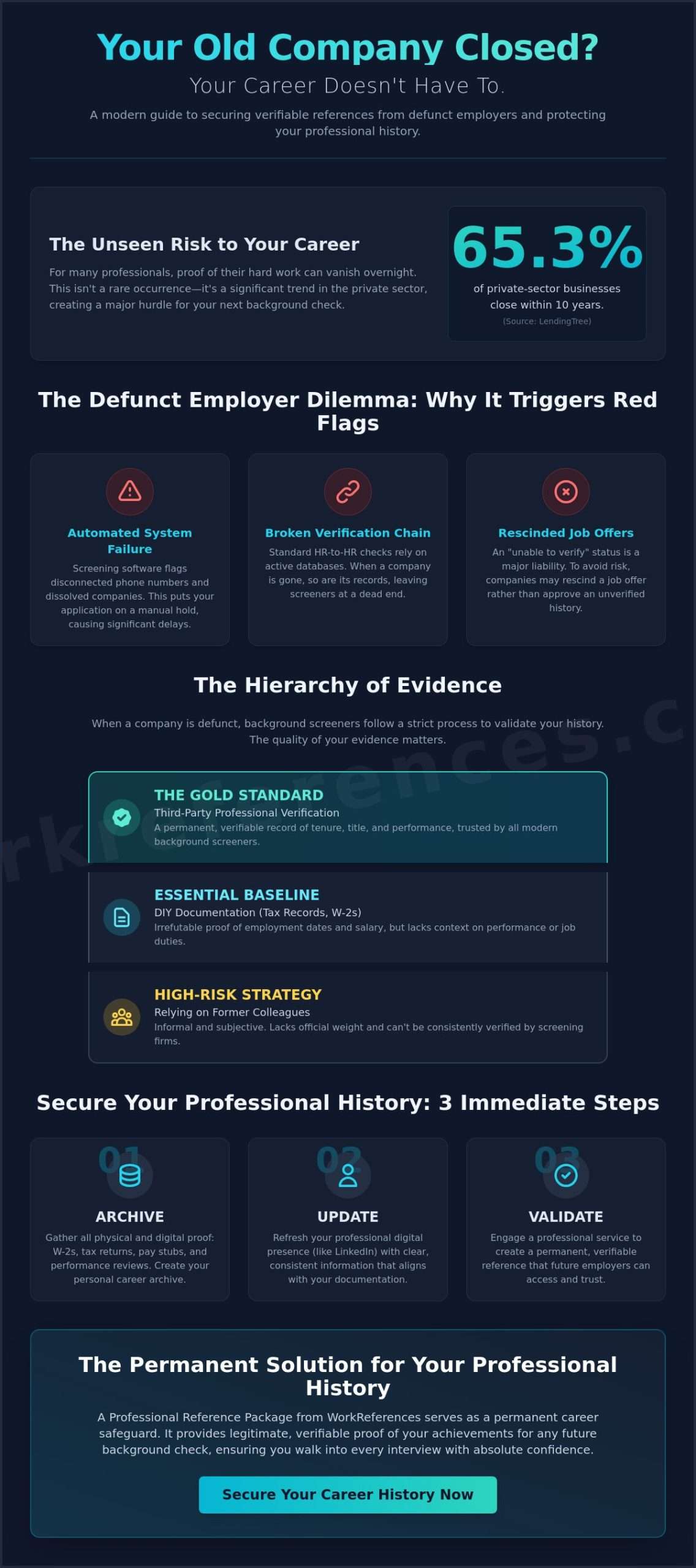
Did you know that 65.3% of private-sector businesses close within ten years? This staggering statistic from LendingTree means that for many professionals, the proof of their hard work can vanish overnight. You likely worry that a dead contact number will make you look dishonest during a background check or that years of expertise will simply disappear because a former employer is no longer in operation. It’s a high-stakes situation where your professional integrity and future earning potential are on the line.
Securing references for closed companies doesn’t have to be a source of constant anxiety. You’ve earned your experience, and you deserve a verifiable way to prove it even when the original source is gone. This article provides the roadmap you need to validate your history using 2026’s modern verification standards and professional alternatives. We’ll explore how to leverage historical tax documentation and explain how a Professional Reference Package can provide the third-party validation modern recruiters demand, ensuring you walk into your next interview with absolute confidence.
Key Takeaways
- Understand why automated screening systems flag defunct employers and learn how to preemptively address these procedural red flags.
- Discover the hierarchy of evidence, including tax records and W-2s, that modern background screeners prioritize when a company no longer exists.
- Learn why relying on former colleagues is a high-risk strategy and how to secure references for closed companies through professional third-party verification.
- Identify the immediate steps required to document your history, from gathering physical evidence to updating your professional digital presence.
- Explore how a Professional Reference Package serves as a permanent career safeguard by providing legitimate, verifiable proof of your professional achievements.
The Critical Challenge of Providing References for Closed Companies
In the 2026 job market, the “Defunct Employer Dilemma” is a significant hurdle for seasoned professionals. When a company shuts its doors, it doesn’t just stop operations; it effectively erases the traditional infrastructure of your professional identity. Obtaining references for closed companies requires a shift from passive reliance on HR departments to an active strategy of documentation and personal verification. Automated screening systems are programmed to identify anomalies. A disconnected phone number or a dissolved corporate entity is a primary trigger for a manual hold. It’s no longer enough to list a former supervisor’s name if the company’s legal existence has been terminated.
Beyond the technical hurdles, there’s a profound emotional toll. You’ve invested years of hard work and achieved measurable results, only to find your professional network fragmented by corporate bankruptcy or market shifts. Standard reference checking assumes a living, breathing entity exists to answer a phone. When that entity is gone, the burden shifts to you. Securing references for closed companies is a unique challenge because it forces you to bypass standard corporate channels. This is why the employment verification process becomes significantly more complex for those coming from defunct startups, retail chains, or mid-sized agencies. You are effectively forced to become your own archivist and advocate.
Why Traditional HR Verification Fails for Defunct Firms
The standard HR-to-HR verification chain relies on a functional database or a staffed office to confirm dates and titles. When a firm closes, these assets vanish instantly. Large automated databases like The Work Number often lack historical data for small to mid-sized firms that have ceased operations. If a background screener hits a “dead end” contact, they won’t just give you the benefit of the doubt. This is why “Company Out of Business” notes on a resume often trigger intensive manual reviews rather than automated approvals. Instead, they mark the entry as “unable to verify,” which immediately signals a lack of transparency to the hiring manager. This breakdown in communication can stall your application indefinitely.
The Risks of Unverified Gaps in Your Career Timeline
Relying on the explanation that “it wasn’t my fault the company closed” is rarely sufficient in high-stakes hiring environments. Recruiters face immense pressure. They can’t simply bypass a verification step because it’s difficult. An unverified gap of several years is often enough for a firm to rescind a job offer to avoid potential liability or compliance issues. The professional risk of unverified defunct history is the permanent loss of career momentum due to a perceived lack of verifiable legitimacy in your professional narrative.
How Modern Background Screeners Verify Defunct Employment
In the current hiring climate, background screening firms like Sterling or First Advantage are trained to expect business volatility. They don’t simply discard an entry if the employer is defunct. Instead, they shift into a rigorous “Alternative Verification” phase. This process follows a strict hierarchy of evidence designed to confirm your professional timeline. While digital artifacts are helpful, screeners prioritize a combination of financial records and live testimony to ensure the information provided is accurate. If you are providing references for closed companies, you must understand that the burden of proof shifts directly to the candidate.
Relying solely on paper trails can be a strategic error. Even if you provide evidence of your tenure, a recruiter still needs to understand your performance metrics and character. You should review what questions do employers ask references to understand the depth of information screeners are seeking. They aren’t just looking for start and end dates. They want to verify your reliability, which is why references for closed companies must provide more than just a confirmation of existence. A “dead” phone number is often the first sign of a potential discrepancy in the eyes of a meticulous screener.
The Role of Tax Records and W-2 Documents
Locating your old W-2s is your first line of defense. These documents serve as an irrefutable baseline for your employment dates. If you’ve lost your physical copies, you can request an official IRS work history to bridge the gap. Financial records prove you were on the payroll, but they are silent regarding your professional contributions. A pay stub cannot describe your leadership during a crisis or your ability to hit quarterly targets. This is why you must supplement these records with professional character references who can speak to your actual work quality and achievements during your tenure.
When “No Record Found” Becomes a Hiring Obstacle
Modern recruitment software uses an automated “Yellow Flag” system. When a primary source is unreachable, the system triggers a manual review that can stall your hiring timeline by days or even weeks. This delay is often where promising candidates lose their leverage. If a competitor’s background check clears in 48 hours while yours is stuck in a manual queue, the hiring manager’s attention may shift. You need a proactive solution ready before the check begins to keep the process moving. Many candidates are surprised to learn just how consistently jobs actually call references in 2026, making a live, reachable contact more critical than ever when your former employer no longer exists. If you’re concerned about how your defunct history appears to screeners, you can speak with a career advocate to explore your verification options.
DIY Solutions vs. Professional Reference Services: A Comparison
When you’re tasked with providing references for closed companies, you might be tempted to follow informal advice found on public forums. Some suggest using a former peer or a personal friend to act as a placeholder for a defunct HR department. This DIY approach is fraught with risk. While a friend might be well intentioned, they often lack the professional “industry-speak” and procedural knowledge required to satisfy a modern background investigator. In a high-stakes environment, a casual or inconsistent testimonial can lead a recruiter to question your entire professional history.
The danger of using fake references has never been higher than it is in 2026. Background screening tools now use AI-driven data mining to cross-reference your claims against historical corporate filings and automated payroll databases. If a discrepancy is found, it isn’t just a minor error; it’s a character red flag that can lead to permanent blacklisting. Utilizing a centralized reference service provides a layer of institutional legitimacy. It transforms a “dead” contact into a verifiable asset, offering a professional alternative to a personal cell phone number that might go straight to voicemail.
The Pitfalls of Using Retired or Unreachable Supervisors
The “Retired Manager” scenario is a common hurdle for those seeking references for closed companies. What happens when your only contact is traveling, has changed industries, or simply stops answering their phone? If a background screener can’t reach your contact within a tight 48-hour window, your application is often moved to the bottom of the pile. Furthermore, a former supervisor might misremember your exact start dates or job titles. Relying on a single individual creates a single point of failure for your career, where one missed call or one memory lapse can derail a life-changing job offer.
The Advantage of a Dedicated Career Advocate
A professional service acts as a sophisticated guide through the hurdles of the hiring world. These services ensure a 100% answer rate for screening calls, eliminating the “Yellow Flag” delays that occur when primary sources are unreachable. Dedicated career advocates understand the nuances of corporate compliance. They speak the language that HR professionals expect to hear, focusing on legitimacy and speed. Our meticulous process ensures that every detail shared with a screener remains perfectly consistent with the professional narrative presented on your resume.
Steps to Documenting Your History with a Defunct Employer
Securing your professional narrative after a business closure requires a proactive, five-step protocol. You can’t afford to wait for a background investigator to stumble upon a disconnected line. Instead, you must curate a verification dossier that leaves no room for doubt. This process begins with gathering physical evidence. Collect every W-2, final pay stub, and offer letter you have. These documents are your primary defense against automated “Yellow Flags” in modern screening software. They provide the raw data that proves you were on the payroll, even when the office doors are locked.
Next, you must update your digital presence. Your LinkedIn profile should clearly state the company’s status to prevent confusion. Once your digital footprint is corrected, you must secure a permanent point of contact. This is why many high-level professionals choose to establish references for closed companies through a third-party service. This step ensures a recruiter always reaches a live professional who can verify your history. Finally, prepare a “Defunct Company Brief.” This is a concise summary of the closure, your role, and how to verify your tenure. Aligning your resume documentation with this verified data ensures that your story remains consistent throughout the entire hiring cycle.
Framing the Narrative During the Interview
Discussing a company closure during an interview is a delicate balancing act. You should never sound defensive or negative about the organization’s fate. Instead, treat the closure as a neutral business event. Focus on the measurable achievements you delivered during your tenure. If you led a team or hit revenue targets while the company was struggling, those are high-value stories. Proactive disclosure is usually the best policy. Telling a recruiter early that a company has closed demonstrates your transparency and professional integrity. It shows you’re prepared for the references for closed companies check before it even begins.
Aligning Your Resume for Maximum Credibility
Formatting your CV for defunct companies requires precision. Avoid using vague labels that might confuse an automated system. Instead of just listing the company name, you might add “(Operations Ceased 2025)” next to the company header. This prevents a recruiter from wasting time on a dead phone number. It’s also critical to ensure your job titles match your verification source exactly. Maintaining resume and reference consistency is essential — if your W-2 lists you as a “Senior Analyst” but your resume says “Lead Strategist,” a screener may flag it as a discrepancy. If you’re unsure how to align your history for a background check, contact our career advocates for a professional consultation on your documentation strategy.
WorkReferences: The Permanent Solution for Your Professional History
Your career history is too valuable to leave to chance. When a former employer dissolves, the resulting silence can be interpreted as a lack of transparency by even the most well intentioned recruiters. WorkReferences operates as a sophisticated safeguard for your professional legacy. We act as your strategic partner, ensuring that the years of hard work you invested in a defunct firm remain a verifiable asset rather than a liability. By utilizing our specialized services, securing references for closed companies is no longer a manual burden that you must carry alone.
Our tiered solutions, including the Professional Reference Packages, are specifically designed to bridge the gap left by corporate closures. We don’t just provide a placeholder; we offer a robust verification infrastructure. This includes meticulous documentation of your roles and achievements, ensuring that every detail aligns perfectly with your resume. Thousands of professionals trust our methodology because we prioritize procedural integrity and speed, two factors that are critical in the high-stakes 2026 job market.
Live Phone Answering for Background Check Integrity
Voicemails are red flags. In a modern background check, an unanswered call or a generic automated message triggers immediate skepticism. Our team provides a live, authoritative response that mirrors the formal register expected by corporate compliance departments. We understand the specific questions recruiters ask about closed companies. We handle these inquiries with professional “industry-speak” that reinforces your legitimacy. Knowing that your history is always reachable provides a level of prepared confidence that DIY methods simply cannot match. It transforms a potential “dead end” into a smooth, professional handoff.
Securing Your Career Future Today
Proactive verification is the standard for success in a competitive environment. Waiting until you have a job offer on the table to address references for closed companies is a high-risk strategy. Instead, you can choose a package tailored to your specific career level, from our Basic Reference Package to our Executive Reference Package. This ensures your professional narrative is locked in and ready for scrutiny before the first interview even begins. Don’t let a former employer’s bankruptcy dictate your future potential. Secure your professional references today and take control of your professional verification process.
Secure Your Professional Legacy Today
Your work history represents years of dedication and measurable achievement. It shouldn’t vanish simply because a former employer ceased operations. We’ve explored the necessity of maintaining a robust paper trail of tax records and the critical role of proactive disclosure during interviews. However, a paper trail is only half the solution. Recruiters in 2026 require live verification to confirm your character and performance metrics. Securing references for closed companies through a sophisticated third party ensures your background check never hits a dead end. Since 2005, WorkReferences has specialized in defunct company verifications, providing the live professional phone answering that automated systems and human screeners demand. This strategic safeguard replaces uncertainty with procedural integrity, allowing you to focus on your next career milestone with absolute peace of mind. Your reputation is your most valuable asset. Take the necessary steps to protect it before your next high-stakes interview begins.
View Our Professional Reference Packages
Frequently Asked Questions
What do I do if the company I worked for no longer exists?
You must immediately take control of your professional narrative by gathering secondary evidence of your tenure. Collect your W-2 forms, final pay stubs, and any performance reviews you have saved. Once you have these documents, you should secure a verifiable third-party point of contact to act as a surrogate for the defunct HR department. This proactive step ensures that a recruiter can actually confirm your history rather than hitting a dead end.
How do background check companies verify employment for closed businesses?
Screening firms shift to “Alternative Verification” methods when a primary corporate source is unreachable. They typically request candidate-provided documentation, such as year-end tax forms or bank statements showing payroll deposits. Additionally, they may attempt to contact listed professional references who can testify to your role and dates of service. Without these alternatives, your background check may stall, leading to a “Yellow Flag” in the hiring system.
Can I use a former co-worker as a reference if the company is closed?
You can use a peer, but relying on a personal cell phone number carries significant professional risk. Peers often lack the “industry-speak” and procedural knowledge required to satisfy formal compliance checks. A professional service provides a more legitimate, centralized point of contact that background investigators find more credible. This level of institutional legitimacy is often the difference between a cleared check and a rescinded offer.
Is it legal to use a professional reference service for a defunct employer?
Yes, it is entirely legal to utilize a professional entity to verify your work history and achievements. These services act as an administrative bridge, providing factual data about your tenure and responsibilities. It is a standard practice for individuals seeking references for closed companies to ensure their history remains verifiable and compliant with the sophisticated data-mining tools used by modern recruiters.
What documents should I keep if I think my company might close?
You should immediately secure copies of your original offer letter, all performance reviews, and your final three years of W-2 forms. Retaining these physical records is essential in the 2026 job market, where automated screening relies heavily on documented proof. Having these files organized and ready prevents significant delays when a recruiter initiates an intensive manual review process due to a business closure.
How do I list a closed company on my resume?
List the company name followed by a brief, transparent parenthetical note such as “(Operations Ceased 2025).” This clarity prevents recruiters from wasting time on disconnected phone numbers and failing the initial verification attempt. Ensure your job titles match your tax records exactly. Any discrepancy between your resume and your documented history can be flagged as a character red flag by AI-driven tools. Understanding the importance of resume and reference consistency is essential to surviving forensic background checks in today’s hiring environment.
Will a closed company on my resume hurt my chances of getting hired?
A closed company itself is not a red flag, but an unverifiable history is a major obstacle. If you cannot provide a reliable way for the recruiter to confirm your experience, they may rescind the offer to avoid potential liability. Using a Professional Reference Package eliminates this danger by providing the live, authoritative response that hiring managers require to move forward with confidence.
What happens if a background checker cannot reach my former employer?
The screener will typically mark the entry as “unable to verify,” which triggers a manual hold on your application. This delay can lead to a lost opportunity if another candidate’s check clears more quickly. Having a proactive verification solution in place ensures the screening process moves forward without friction. It protects your career momentum and ensures your hard-earned experience isn’t discarded due to administrative silence.
Article by
William Schmidt
William Schmidt is a former Fortune 500 recruiter and founder of WorkReferences.com, a pioneering employment verification and professional reference service established in 2009. With extensive experience working alongside hiring managers, recruiters, and background screening agencies, he helps job seekers overcome career obstacles through credible, third-party verification solutions that strengthen resumes and restore confidence in the hiring process