What if your dream job offer is currently hanging by the thread of a single phone call to a supervisor who no longer works at a company that no longer exists? The final screening phase is often the most stressful part of a career transition, especially when you’re unsure if your professional history will be validated correctly. You’ve likely felt the sting of anxiety wondering how do companies verify references when your past employers have gone silent or your records are buried in a defunct human resources department.
We understand that these administrative hurdles feel like personal threats to your livelihood. This guide pulls back the curtain on the 2026 screening landscape, revealing the exact technologies and forensic methods employers use to audit your credibility. You’ll discover the difference between basic employment verification and high-stakes reference checks, along with the specific red flags that can trigger a rejected application. We will provide you with a clear roadmap to handle “impossible” reference situations and ensure your background stands up to the most rigorous scrutiny; this knowledge is your best defense in securing the offer you’ve earned.
Key Takeaways
- Distinguish between administrative employment verification and qualitative performance audits to understand the full scope of modern screening.
- Gain an insider perspective on how do companies verify references using a hybrid of direct human outreach and automated verification software.
- Recognize the specific technical red flags, such as personal email addresses or unverifiable office lines, that lead HR to flag your application as high-risk.
- Develop a proactive plan to document your history when former employers have closed or supervisors are no longer reachable.
- Learn why utilizing a Professional Reference Package acts as a vital safeguard for maintaining the integrity of your professional narrative during high-stakes transitions.
What is Reference Verification and Why is it Happening Now?
Reference verification is the formal process of auditing a candidate’s claims about their past performance and professional conduct. In the current 2026 hiring climate, this stage has evolved from a courtesy call into a rigorous forensic examination. Employers are no longer satisfied with a simple nod of approval; they seek documented evidence of your contributions. Understanding how do companies verify references is the first step in ensuring your professional narrative remains intact during this high-stakes scrutiny.
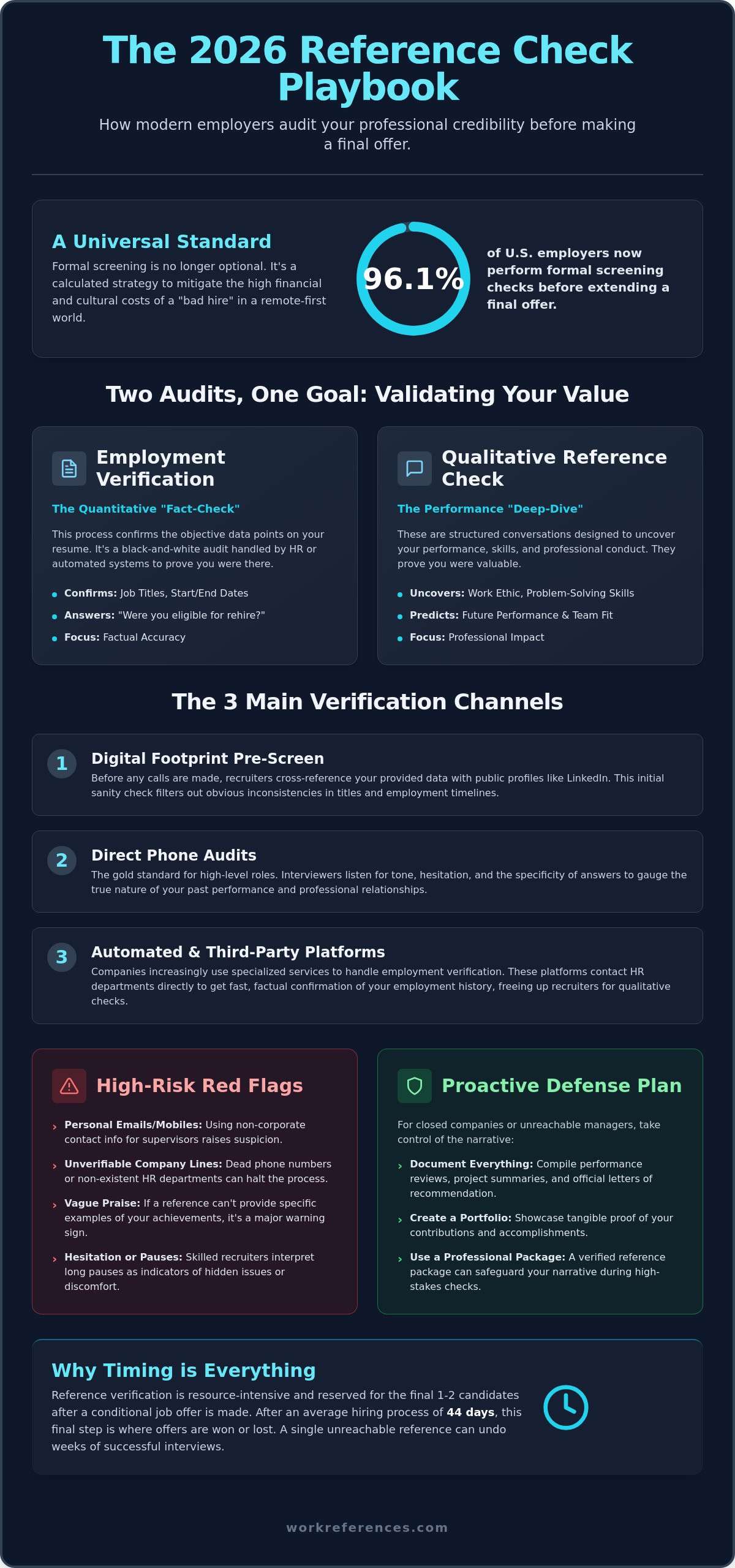
The shift toward more stringent, third-party audits is largely driven by the complexities of remote and hybrid work. When managers cannot physically observe their teams, they rely heavily on the word of previous supervisors to gauge reliability and self-management. According to current research, 96.1% of U.S. employers now perform formal screening checks before making a final offer. This isn’t just bureaucracy. It’s a calculated attempt to mitigate the massive financial and cultural costs of a “bad hire” that can disrupt entire departments.
The Difference Between Verification and Reference Checks
Many candidates confuse these two distinct processes, but they serve very different purposes in an employment background check. Employment verification is a quantitative audit. It confirms objective data points like your start and end dates, job titles, and your eligibility for rehire. It’s a “yes or no” process often handled by HR departments or automated databases that focus strictly on the facts of your tenure.
Reference checks are qualitative. These are deep-dive conversations or structured surveys designed to uncover your work ethic, problem-solving abilities, and interpersonal dynamics. While verification proves you were there, reference checks prove you were valuable. Companies use these insights to predict your future performance based on your past behavior. If you’ve ever wondered how do companies verify references for soft skills, it’s through these targeted, open-ended questions that go beyond your resume’s bullet points.
Why Companies Wait Until the Final Stage to Verify
Reference verification is resource-intensive. With the average time to fill a position reaching 44 days in 2026, HR teams can’t afford to vet every applicant. Instead, they reserve this forensic audit for the final one or two candidates. This usually occurs after a “conditional offer” has been extended. The offer is legally contingent on the successful completion of the screening process.
Waiting until the end allows companies to focus their investigative tools on the most promising talent. If you’ve reached this stage, the job is essentially yours to lose. This is why ensuring your references are prepared and reachable is critical. A single administrative red flag or a missing supervisor can halt the momentum of a weeks-long interview process, resulting in a rescinded offer and a frustrating return to the job search.
The 3 Main Ways Companies Verify Your Professional References
Understanding how do companies verify references requires a look at the specific tools and tactics used by modern HR departments. The method chosen often depends on the company’s size and the level of the role you’re pursuing. Regardless of the format, the goal remains the same: to confirm that your resume isn’t just a collection of claims, but a factual record of your professional value. Before reaching out, many recruiters now perform a “digital footprint” check. They cross-reference your provided contact data with LinkedIn profiles to ensure the person you’ve listed actually holds the title you’ve claimed. This initial layer of scrutiny filters out inconsistencies before the formal audit even begins.
Direct Phone Audits: What the Recruiter is Listening For
The traditional phone interview remains the gold standard for high-level positions. Recruiters use these conversations for an objective evaluation of an applicant’s past job performance. They aren’t just listening to the words your reference says; they’re listening for what isn’t said. Long pauses, hesitant answers, or overly generic praise can be interpreted as subtle warnings. A skilled interviewer will ask about your specific contributions to projects and how you responded to constructive criticism. If a reference can’t provide concrete examples of your work, the recruiter may doubt the depth of your professional relationship.
Digital and Automated Survey Methods in 2026
For mid-level and high-volume roles, companies increasingly rely on automated platforms like SkillSurvey or Xref. These systems send a secure link to your references, asking them to complete a structured assessment of your skills. It’s a highly efficient model. Research indicates that automated platforms boast an 85-90% response rate, far higher than the 40-50% rate seen with traditional phone calls. These digital checks are typically completed within 24 to 48 hours. While this speeds up your hiring timeline, it also means your references are answering standardized questions that leave little room for nuanced explanation. The data is then aggregated into a “candidate report” that HR uses to rank your suitability against other finalists.
Third-Party Verification: The Role of External Agencies
Many corporations now outsource the entire screening process to specialized third-party firms to ensure legal compliance and procedural integrity. These agencies treat reference checking as a forensic audit rather than a casual chat. They have the resources to verify that the office number provided is a legitimate business line and not a personal cell phone. They focus on speed and accuracy, often operating with a clinical detachment that can feel intimidating to unprepared references. If you’re concerned about how these professional auditors will interpret your work history, it’s wise to consult with a career advocate to ensure your professional documentation is consistent and ready for review.
HR departments operate as forensic auditors of your professional past. They aren’t merely scanning for positive feedback; they’re actively hunting for inconsistencies that suggest a lack of integrity. When you consider how do companies verify references, you must realize that the process is designed to expose “shell” references or friends posing as former managers. A single mismatch between your documentation and their findings can result in an immediate disqualification.
One of the most effective tools in an HR toolkit is email domain verification. In 2026, using a personal Gmail or Outlook address for a corporate supervisor is an immediate red flag. Most enterprise-level screening software automatically flags non-corporate domains. This suggests to the recruiter that the reference may not be official or that the supervisor is trying to bypass company records. Legitimate supervisors typically use their professional handles to maintain a clear audit trail and ensure the communication remains within the scope of corporate compliance.
Common Red Flags That Trigger Deeper Investigation
Recruiters are trained to spot behavioral cues during phone audits. If a reference provides overly generic praise without citing specific KPIs or project names, the auditor will dig deeper. Other red flags include references who answer the phone with a simple “Hello” instead of a professional greeting, or those who seem unfamiliar with the specific dates of your tenure. These small lapses suggest the relationship is personal rather than professional. In many cases, an auditor will ask a trick question about a project that never happened to see if the reference “plays along,” which is a definitive sign of an unreliable source.
The Risk of Using Non-Professional Contact Information
Managing Difficult Scenarios: Closed Companies and Missing Managers
Professional transitions are rarely perfect; few scenarios trigger more anxiety than a missing link in your employment history. If you’ve spent years building a career at a firm that has since shuttered its doors, you might feel like your achievements have vanished into thin air. When candidates ask how do companies verify references for defunct organizations, they’re often met with vague advice about tax records. While a W-2 proves you were on the payroll, it does nothing to validate your performance or character. You need a proactive strategy to bridge this credibility gap before a recruiter flags your application as unverifiable.
The burden of proof falls on you to maintain the integrity of your professional narrative. This requires a methodical approach to documentation and a strategic selection of secondary sources. Follow these steps to ensure your history remains an asset rather than a liability:
- Step 1: Document the closure. Gather public records, such as Secretary of State filings or news articles, that confirm the company’s dissolution. This provides an objective “why” for the lack of a corporate switchboard.
- Step 2: Identify secondary references. Reach out to former colleagues, clients, or vendors who can speak to your daily contributions. These peer-level insights are vital when a direct supervisor is no longer available.
- Step 3: Leverage professional support. Utilize a professional job reference service to provide a stable, live point of contact for auditors. This ensures that when a recruiter calls, they reach a professional who can confirm your work history with consistency.
- Step 4: Align your documentation. Ensure your resume dates and titles match your verification data exactly. Any discrepancy during a forensic audit can trigger a red flag, regardless of the company’s status.
How to Provide References for a Company That No Longer Exists
When a company closes, the traditional verification path disappears. You should proactively inform the recruiter about the closure before they begin their audit. Provide them with a “verification folder” that includes your final performance review and the contact information for a high-ranking colleague who can vouch for your tenure. This transparency demonstrates professional maturity and prevents the recruiter from reaching a dead end in their investigation.
What to Do When Your Former Supervisor is Unreachable
Supervisors move on, retire, or simply fall out of contact. If you cannot locate a former manager, don’t leave a blank space on your reference list. Instead, provide the contact details for a different department head or a long-term client who observed your work closely. If you’re struggling to find a reliable contact who will answer the phone during business hours, it is essential to consult with a career advocate to secure a Professional Reference Package that guarantees a live response for your potential employer.
Securing Your Career with WorkReferences Professional Solutions
You’ve already seen the forensic depth of the 2026 screening process. Leaving your professional destiny to the chance of a missed phone call or an uncooperative HR department is a risk you cannot afford to take. When you consider how do companies verify references, it’s clear that they value consistency and accessibility above all else. At WorkReferences, we adopt the role of a Vigilant Career Advocate. We act as your strategic partner to ensure that the audit of your professional past doesn’t derail your future. Our mission is to transform your state of concern into one of prepared confidence by providing a verified, professional bridge between your history and your next employer.
The Professional Reference Package is designed specifically to address the administrative red flags that trigger offer rescissions. We provide a legitimate, third-party source for candidates with complex work histories; this is especially critical for those whose former companies have closed or whose supervisors have moved into unreachable roles. By aligning your documentation and providing a stable point of contact, we eliminate the friction that often stalls the hiring process in its final hours. This isn’t just about answering a phone; it’s about maintaining the integrity of your professional narrative under the most rigorous scrutiny.
Live Phone Answering: The WorkReferences Advantage
Recruiters in 2026 are working on tighter timelines than ever before. If a reference check takes more than 48 hours to complete, your application’s momentum begins to fade. Our live phone answering service ensures that when an auditor calls, they reach a professional who is prepared to verify your tenure and contributions immediately. This eliminates the “tag” game that often leads recruiters to move on to the next candidate. We provide the third-party confirmation of work history that HR departments require, ensuring that your data matches your resume perfectly. This level of reliability projects an image of professional stability that individual supervisors often cannot provide.
Selecting the Right Bundle for Your Career Level
Every career transition has unique requirements. We offer tiered solutions to match the specific stakes of your job search. Our Basic Reference Package provides the essential verification needed for entry-level or mid-market roles. For those in leadership positions, the Executive Reference Package offers a deeper level of support tailored to high-stakes forensic audits. Additionally, we provide Resume Writing and Editing services to ensure your initial application is as polished as your final verification. By choosing a structured partner, you ensure that how do companies verify references becomes a question with a positive, definitive answer for your career.
Secure Your Offer Through Strategic Verification
The screening landscape of 2026 demands more than just a list of names; it requires a bulletproof strategy for professional validation. You’ve learned that the answer to how do companies verify references involves a complex mix of automated surveys, digital footprint audits, and forensic phone interviews. Whether you’re dealing with a supervisor who has moved on or a company that has closed its doors, the burden of proof rests entirely on your shoulders. Leaving this final gatekeeping stage to chance can result in a rescinded offer and a damaged professional reputation.
Don’t let a single administrative gap derail your career momentum. With over 20 years of experience in career verification, WorkReferences provides the specialized support you need to navigate closed companies and unreachable managers. Our live professional phone answering ensures that recruiters get the consistent, credible data they need to finalize your hire. It’s time to move from a state of anxiety to one of prepared confidence. Secure your job offer with a Professional Reference Package today. You’ve worked hard to earn your next role; let’s ensure your history stands up to the scrutiny.
Frequently Asked Questions
Do employers actually call references for every candidate?
No, most employers reserve reference verification for the final one or two candidates. While approximately 80% of corporate employers conduct these checks, they don’t invest the time or resources until a conditional offer is imminent. This stage is a high-stakes gatekeeping process designed to confirm that the finalist is as capable as their interview performance suggests. If you’ve reached this phase, the company is seriously considering your start date.
Can I use a coworker as a professional reference instead of a manager?
You can use a coworker, but it is typically viewed as a secondary reference rather than a primary one. Managers provide a top-down audit of your performance and accountability, which is what most recruiters prioritize. If your former supervisor is unreachable, a peer can vouch for your daily collaboration and technical skills. However, you should always explain the context to the recruiter to ensure the peer reference carries sufficient weight during the audit.
What happens if a reference gives a bad review or doesn’t answer?
A non-responsive reference is often interpreted as a red flag that can stall your hiring process for days. If a reference provides a negative review, it frequently leads to a rescinded job offer due to concerns over professional conduct or performance. This is why understanding how do companies verify references is so critical; you must ensure your contacts are both reachable and prepared to provide a consistent, professional account of your tenure.
Is it illegal for a company to check references without my permission?
Formal background and reference checks require your written consent under federal and state regulations. Most employers include a consent clause in the initial application or the conditional offer letter. While “back-channel” references through a recruiter’s personal network are a growing trend, official third-party audits cannot proceed without your explicit authorization. Consent remains the legal cornerstone of the professional screening landscape in 2026.
How long does the reference verification process typically take in 2026?
Digital reference checks are typically completed within 24 to 48 hours, while traditional manual phone calls can take between 4 and 10 days. Automated platforms have significantly reduced the time-to-fill, which currently averages 44 days across most industries. The speed of the process often depends on how quickly your references respond to outreach. Delays in this stage can create administrative friction that makes recruiters anxious about your candidacy.
What questions are companies legally allowed to ask my references?
Companies can legally ask about your job titles, dates of employment, performance metrics, and eligibility for rehire. However, the legal landscape has become more restrictive regarding personal data. For instance, as of July 2026, Virginia prohibits employers from seeking wage or salary history. Recruiters focus on objective performance data and professional conduct rather than personal traits or protected information to maintain compliance with evolving labor laws.
How do companies verify work history for companies that went out of business?
When a firm is defunct, auditors rely on tax documentation like W-2s and third-party confirmation from surviving professional colleagues. They look for objective proof of your tenure since a corporate switchboard is no longer available. This is a common pain point where how do companies verify references becomes a forensic exercise. Providing a documented “verification folder” with performance reviews can help bridge this gap and maintain your credibility.
Can a background check company tell if a reference is a friend?
Professional auditors use email domain verification and “switchboard tests” to distinguish between professional and personal references. If you provide a Gmail address for a corporate supervisor, it’s flagged as an immediate risk. They often call the main office of your former employer to confirm the supervisor actually works there in the capacity you’ve claimed. These forensic methods are designed to expose “fake” references and protect the integrity of the hiring decision.
Article by
William Schmidt
William Schmidt is a former Fortune 500 recruiter and founder of WorkReferences.com, a pioneering employment verification and professional reference service established in 2009. With extensive experience working alongside hiring managers, recruiters, and background screening agencies, he helps job seekers overcome career obstacles through credible, third-party verification solutions that strengthen resumes and restore confidence in the hiring process