
What if your dream job offer vanished not because of your performance, but because a company you worked for five years ago simply stopped answering its phones? It is a chilling reality in a market where background screening has become increasingly automated and expensive. You have likely spent weeks navigating the interview process, only to face the sudden anxiety of an unverified gap in your history. Learning how to provide employment verification for a past job is no longer just an administrative task. It is a critical layer of career security that protects your professional reputation from system errors and unresponsive former employers.
You aren’t alone in feeling frustrated by incomplete data in systems like The Work Number or the rising pass-through fees that now exceed $130 for certain verifications. This guide provides a strategic roadmap to help you secure your next role with total confidence. We will examine how to handle defunct companies, manage unavailable supervisors, and leverage professional solutions to ensure your background check is seamless. You’ll gain the tools to validate every line on your resume, regardless of how much time has passed or how many corporate offices have closed their doors.
Key Takeaways
- Understand why a failed verification leads to automatic rejection in 2026 and how to audit your work history for hidden risks.
- Learn exactly how to provide employment verification for a past job when standard corporate departments are unresponsive or automated databases contain incomplete records.
- Implement specific procedural safeguards to validate experience at defunct companies, ensuring a closed business doesn’t compromise your professional standing.
- Discover how professional reference packages utilize live phone answering and third-party confirmation to secure your next offer against verification failures.
What is Employment Verification and Why Does It Matter?
Employment verification is the rigorous process by which a prospective employer confirms your professional history. It is no longer just a casual phone call to a former boss. In 2026, this involves a deep dive into job titles, exact start and end dates, and salary history. For many candidates, the challenge isn’t the quality of the work they performed, but rather how to provide employment verification for a past job when corporate records are messy or incomplete. A failed verification is often viewed as a character flaw rather than an administrative error. This perception leads to an immediate withdrawal of your job offer, regardless of your interview performance.
Modern background screening has shifted toward aggressive automation. Systems like The Work Number aggregate payroll data to provide instant snapshots of your tenure. However, these databases often miss the qualitative context of your role. They might show you were a “Level 4 Associate” when your actual day-to-day responsibilities were those of a “Senior Project Manager.” This discrepancy can trigger a “red flag” during the screening phase, forcing you to defend your resume against a computer-generated report. In 2026, the cost of these checks has surged. Some pass-through fees for USA Employment Verifications now reach $130.69. Because companies are paying these premiums, they expect absolute accuracy and have little patience for discrepancies.
The Role of the Fair Credit Reporting Act (FCRA)
You have specific legal protections under the Fair Credit Reporting Act. This federal law requires employers to obtain your written consent before conducting a background check and gives you the right to dispute inaccurate information. Third-party verification services must adhere to these compliance standards to ensure the data they report is both accurate and current. Transparency is your strongest asset here. By proactively identifying potential errors in your file, you can address them before they reach a hiring manager’s desk. It’s about taking control of your data before the system does it for you.
Common ‘Red Flags’ That Trigger Deeper Audits
Background investigators are trained to look for inconsistencies that suggest “job stretching” or omitted tenures. Certain patterns will almost always trigger a manual audit, which can delay your start date or jeopardize the offer entirely. These include:
- Employment gaps exceeding 90 days: Investigators often assume these gaps hide undisclosed terminations or legal issues.
- Title discrepancies: If your resume lists a title that doesn’t match official HR records, it looks like an intentional fabrication.
- The ‘Ghost Manager’ problem: When a listed supervisor is no longer with the company, it creates a verification dead end.
Understanding how to provide employment verification for a past job involves anticipating these hurdles before the screening process begins. If you know a former manager is unreachable, you must have a strategic alternative ready. Utilizing a Professional Reference Package can bridge these gaps, providing the live confirmation that automated systems and defunct HR departments cannot offer.
Standard Methods vs. Third-Party Employment Verification Services
The traditional route of “calling the main office” is rapidly becoming a relic of a slower era. While this method offers a layer of official legitimacy, it is often plagued by bureaucratic delays. Large HR departments may take days to respond, and their feedback is usually limited to a cold confirmation of dates and titles. For many candidates, figuring out how to provide employment verification for a past job through these channels is an exercise in frustration. If your former employer has outsourced their records to an automated database, you are at the mercy of a system that doesn’t know your name, only your data profile.
Automated platforms like The Work Number provide speed, but they frequently lack precision for non-enterprise roles. If you worked for a boutique firm, a private startup, or a family-owned business, your data likely won’t exist in these massive repositories. This creates a “data gap” that can make you look like you’re hiding information. When the automated check returns a “no record found” result, the burden of proof shifts entirely back to you. You are then forced to provide tax documents or pay stubs, which adds unnecessary friction and a lack of privacy to the hiring process.
Professional reference services have emerged as a strategic bridge for these high-stakes scenarios. Instead of a rigid database, you get a human-centric solution that aligns with your professional narrative. Evaluating the cost-to-risk ratio is simple. A DIY approach might save a few dollars upfront, but the risk of a rescinded offer due to a verification delay or a “no record” result is a far more expensive outcome. Investing in a professional safeguard ensures that your history is validated by a live person who understands the nuances of your career path.
When a Basic Reference Package is Sufficient
For mid-career professionals or those coming from stable, existing companies, a Basic Reference Package is often the ideal solution. This tier focuses on ensuring your dates and titles are perfectly aligned with what the screening company expects to hear. It provides a foundational layer of security for standard roles where the verification is a “check-the-box” exercise. If you are confident in your history but want to ensure the phone is answered professionally, this is your starting point.
Executive Reference Needs: High-Stakes Validation
High-level leadership roles demand a more sophisticated approach. At the C-suite or VP level, a simple date confirmation isn’t enough to satisfy a discerning board of directors or an executive search firm. These roles require qualitative narrative support. Our Executive Reference Package provides live phone answering and a professional narrative that contextualizes your achievements. This is essential for leaders with complex career paths, including mergers, acquisitions, or roles at entities that have since rebranded. If you have concerns about high-stakes screening, consult with our team to secure your professional reputation.
Solving the ‘Impossible’ Verification: Defunct Companies and Gaps
The “Defunct Company” dilemma is one of the most stressful hurdles in a modern job search. When a former employer shutters its doors, they don’t just stop operations; they often take your verifiable history with them. For candidates, this creates a vacuum where a background investigator sees a “dead end.” It is exactly why references for closed companies remains a high-priority concern for professionals. Without a central HR office to answer the call, your years of hard work risk being dismissed as unconfirmed.
You cannot rely on a recruiter’s empathy. They operate on checklists and compliance. If you are struggling with how to provide employment verification for a past job that no longer exists, you must move beyond verbal explanations. You need a strategy that replaces “trust me” with “here is the validated proof.” Third-party services act as a credible repository, stepping in to serve as the point of contact that the defunct business can no longer provide. This transforms an “impossible” verification into a professional, closed-loop process.
Documenting Your History When HR is Gone
When the HR department is gone, your primary defense lies in your financial records. These documents serve as the bedrock of your claim. However, simply handing over a pile of tax forms to a new employer can feel invasive. A professional service validates these documents on your behalf, acting as your “Vigilant Career Advocate.” We confirm the details to background agencies while shielding your sensitive financial data. Useful alternative proofs include:
- W-2 forms from the relevant tax years.
- Social Security Administration (SSA) earnings records.
- Original offer letters or official termination notices.
- Bank statements showing recurring direct deposits from the employer.
This procedural integrity ensures you meet the screening requirements without compromising your privacy. It positions you as a prepared professional who understands the mechanics of corporate compliance.
Handling Employment Gaps with Integrity
Employment gaps are often viewed with suspicion by automated screening systems, but they don’t have to be. Whether a gap was due to a company closure or a personal transition, the key is maintaining resume and reference consistency. If you spent that time consulting or engaged in professional development, a third-party validator adds a layer of corporate legitimacy to your narrative. It moves the conversation from a defensive explanation of “why I wasn’t working” to a proactive validation of what you achieved. Understanding how to provide employment verification for a past job during these gaps is about aligning your documented history with your professional references. This eliminates the friction that causes background checks to stall and keeps your job offer secure.
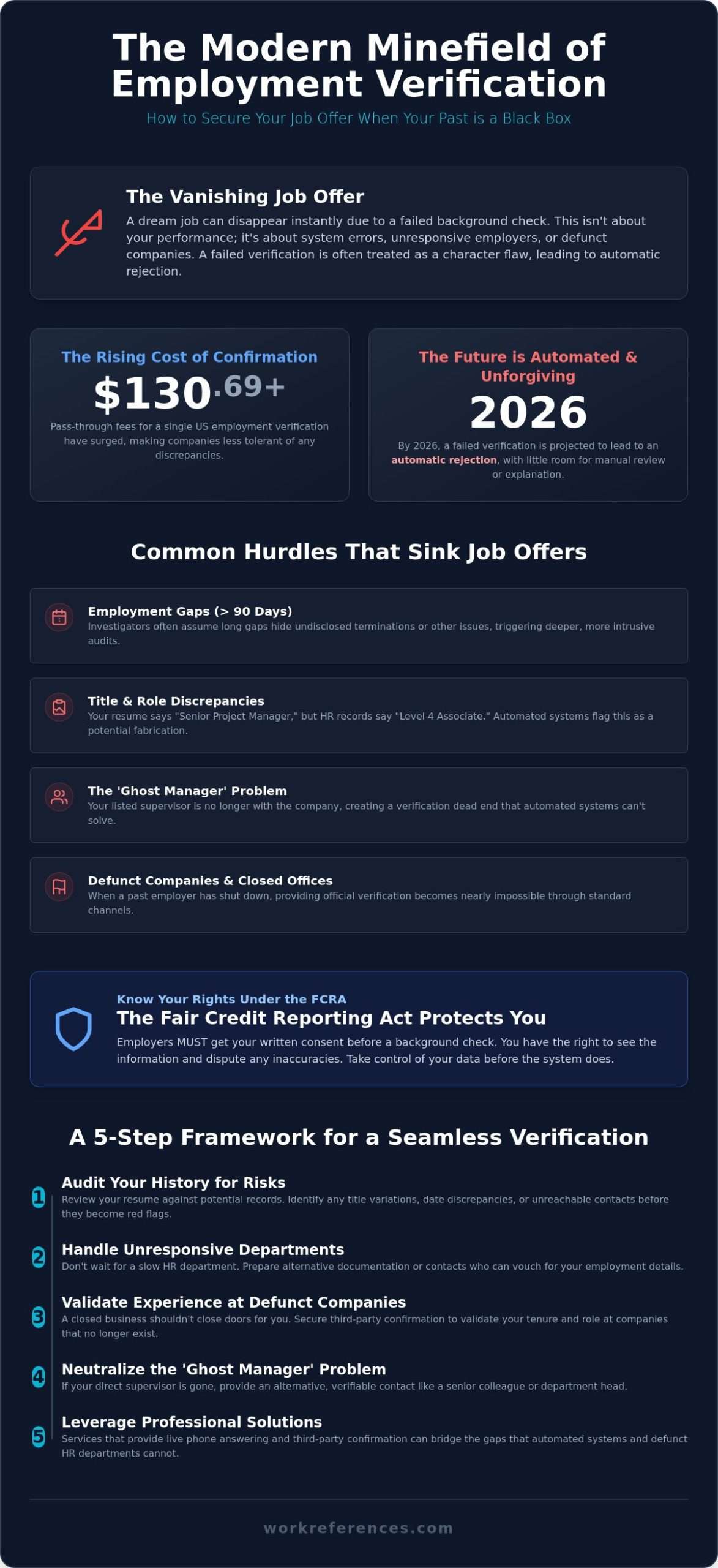
How to Provide Employment Verification: A 5-Step Framework
Securing a new role requires more than just a successful interview. It demands a proactive defense of your professional record. When you are determining how to provide employment verification for a past job, you cannot wait for the background check agency to find a problem. You must lead the process. This 5-step framework is designed to eliminate ambiguity and provide recruiters with a friction-free path to confirming your credentials.
- Audit your own history: Start by viewing your record through the lens of a professional investigator. Understand the 2026 reality of employment verification to see exactly what data points are visible to third-party screeners.
- Identify ‘at-risk’ entries: Pinpoint specific roles where a supervisor has left the company or the local office has closed. These are the points where automated systems will fail.
- Select your verification tier: Match your support level to the seniority of the role. An entry-level position may only require basic date confirmation, while leadership roles demand executive-level qualitative validation.
- Align your documentation: Ensure your resume titles, LinkedIn profile, and official HR records are identical. Discrepancies in job titles are the most common cause of “flagged” reports.
- Provide a ‘Clean Path’: Instead of giving a general HR number, provide the recruiter with a direct, professional contact who is prepared to verify your history immediately.
Step 1: The Pre-Verification Audit
You shouldn’t be surprised by what a background check reveals. Contact your former HR departments yourself to confirm what information they are authorized to disclose. Many large corporations now only provide dates and titles through automated systems like The Work Number. If your data is missing or incorrect in these repositories, you have found a critical failure point. Flagging these discrepancies before the recruiter finds them allows you to provide a pre-emptive explanation, maintaining your status as a transparent and honest candidate.
Step 2: Securing Your Professional Reference Package
Once you have identified the gaps, you must fill them with a legitimate solution. Choosing between the Basic, Professional, or Executive tiers at WorkReferences allows you to customize your defense. After selecting a package, you will provide your validated work history and documentation to our team. We then establish a live phone answering protocol. This ensures that when a recruiter calls to verify your past, they reach a professional who can confirm your history with authority. Don’t leave your reputation to an unanswered office line. If you are ready to secure your professional future, reach out to our advocates today for a strategic consultation.
Following this methodical approach ensures you are never caught off guard. Knowing exactly how to provide employment verification for a past job transforms a stressful administrative hurdle into a demonstration of your professional integrity and preparation.
Securing Your Job Offer with WorkReferences
In a recruitment environment where automated screening fees have soared and state-level mandates like the Indiana FAIRNESS Act are increasing scrutiny, leaving your professional reputation to chance is a high-stakes gamble. You’ve worked hard to build your career. Allowing a defunct startup or an unresponsive HR department to derail your next offer isn’t just a setback; it’s a preventable failure. When you are determining how to provide employment verification for a past job, you need a partner who understands the procedural integrity required to satisfy modern background check agencies. WorkReferences acts as your Vigilant Career Advocate, ensuring that your history is validated with the level of professional authority that recruiters demand.
We specialize in bridging the gap for candidates with non-traditional backgrounds, employment gaps, or experience at companies that no longer exist. Our tiered packages provide a sophisticated shield against the “no record found” results that trigger automatic rejections. By aligning your resume data with our live phone answering services, we provide a consistent, credible narrative that automated databases like The Work Number often fail to capture. This isn’t just about passing a one-time check. It’s about securing your professional standing for the long term.
Why Professional Services Trump ‘Fake’ References
The temptation to use “placeholder” or fabricated references is a dangerous path that often leads to permanent blacklisting. Investigators in 2026 are trained to spot these inconsistencies using cross-referenced tax data and digital footprints. We encourage you to read The Truth About Fake References to understand the severe legal and professional risks involved. WorkReferences offers a legitimate, third-party confirmation service that adheres to corporate compliance standards. We provide the documentation and live validation necessary to prove your history without resorting to high-risk deceptions. This builds genuine career credibility that follows you from one executive role to the next.
Ready to Verify? Next Steps
Don’t wait for a background investigator to flag your file. Take control of your professional narrative before the screening process begins. If you are uncertain about how to provide employment verification for a past job that has missing records or unavailable supervisors, our team is ready to assist. Your next steps are clear:
- Visit our services page to compare our Basic, Professional, and Executive packages.
- Select the tier that matches the seniority and stakes of your target role.
- Consult with our career advocates to conduct a high-stakes situation audit of your work history.
The hiring process is stressful enough without the fear of a verification failure. By choosing a professional validation partner, you ensure your next job offer isn’t just made, but fully secured. Reach out to us at WorkReferences today to protect the career you’ve spent years building.
Secure Your Professional Future Today
The landscape of background screening is more rigorous than ever. You now have the strategic framework to manage complex history, from defunct startups to lengthy employment gaps. By auditing your own history and aligning your documentation, you eliminate the “red flags” that trigger automatic rejections. Understanding how to provide employment verification for a past job is the final step in transforming a job offer into a signed contract. It is the difference between a stalled career and a successful transition.
Don’t leave your professional reputation to the mercy of an automated database or an unanswered office line. Our services provide the security you need through professional live phone answering and third-party work history validation. Whether you require executive-tier career support or basic alignment, we act as your dedicated advocate during the high-stakes screening phase. We ensure that your narrative remains consistent and your credentials remain beyond reproach.
Secure your career history with a Professional Reference Package and move forward with total confidence. Your hard-earned reputation deserves a professional defense, and we are here to provide it. Take control of your background check today and step into your next role with the certainty of a verified professional.
Frequently Asked Questions
Can a third-party service legally provide my employment verification?
Yes, it is entirely legal under the Fair Credit Reporting Act for third-party entities to confirm your professional history. These services act as an authorized agent for the candidate, ensuring that prospective employers receive accurate data based on validated documentation. The process maintains high standards of procedural integrity, providing a compliant solution that protects your privacy while meeting the rigorous demands of modern background screening agencies.
What happens if a background check company can’t reach my past employer?
If a background check agency fails to reach a former employer after several attempts, they typically flag the entry as unverified. This status is a major red flag that can lead to a rescinded job offer. Without a professional verifier to step in, you are often forced to provide sensitive tax documents or pay stubs directly to the recruiter, which creates unnecessary friction and privacy concerns during the hiring phase.
Is it better to use a former colleague or a professional verification service?
A professional verification service is generally superior because it provides a layer of corporate legitimacy that a personal colleague cannot match. While a colleague can offer a character reference, they often lack the authority to provide official administrative validation of titles and dates. A professional service ensures consistency and reduces the risk of errors that occur when a personal contact provides unofficial or conflicting information.
How much does a professional employment verification service cost in 2026?
The cost of professional verification services varies based on the complexity of your work history and the level of support required. Tiered packages are typically structured to match different career stages, from entry-level roles to high-stakes executive positions. You should evaluate these services as a strategic investment in your career security. The price of a professional package is significantly lower than the financial impact of losing a high-value job offer.
Can WorkReferences verify my employment if the company went bankrupt?
Yes, we specialize in providing verification for defunct or bankrupt companies by acting as a credible repository for your validated work history. We use your secondary documentation, such as tax records and original offer letters, to provide the live confirmation that a closed HR department can no longer offer. This ensures you aren’t unfairly penalized for corporate closures or business failures that were beyond your control.
Will my new employer know I am using a professional reference service?
Prospective employers typically interact with the service as they would with any professional HR department or third-party verification entity. The process is handled with a high degree of professional industry-speak and administrative decorum. Our goal is to provide a seamless experience that reinforces your professional image. We focus on the factual confirmation of your tenure and role, ensuring the verification process remains standard and unremarkable.
How long does the employment verification process typically take?
The timeline for verification usually ranges from 48 to 72 business hours. This depends largely on the responsiveness of the screening agency and the complexity of the records involved. Using a professional service often speeds up this process because we provide a clean path with live phone answering. This eliminates the common delays associated with navigating automated phone trees or waiting for a busy HR manager to return a call.
What should I do if I have a large employment gap on my resume?
You must address large gaps with transparency and documented consistency to pass a modern background check. Learning how to provide employment verification for a past job often involves reframing these periods as consulting or professional development. A professional service can help validate these activities, ensuring that your resume alignment remains intact and that the gap doesn’t trigger a negative screening result or an automatic rejection from the recruiter.
Article by
William Schmidt
William Schmidt is a former Fortune 500 recruiter and founder of WorkReferences.com, a pioneering employment verification and professional reference service established in 2009. With extensive experience working alongside hiring managers, recruiters, and background screening agencies, he helps job seekers overcome career obstacles through credible, third-party verification solutions that strengthen resumes and restore confidence in the hiring process