
What if the greatest threat to your next job offer isn’t your past performance, but your former employer’s silence? With U.S. employers announcing 108,435 planned layoffs in January 2026 alone, the market is crowded with talented professionals struggling to prove their value through the fog of corporate restructuring. You likely feel the anxiety of a neutral reference policy or an unresponsive manager, fearing that a background check discrepancy might derail your momentum. It’s a valid concern in a high-stakes hiring environment where procedural integrity is everything.
Understanding how to get a reference from a company that laid you off requires a shift from passive requests to a strategic verification protocol. You need a way to bypass institutional silence and secure a narrative that validates your work history. This article details exactly how to identify hidden allies and protect your professional reputation against automated screening hurdles. We will outline the specific steps to build a list of verifiable advocates and navigate the 96.1% background check requirement with absolute confidence. By the end, you’ll have a clear, low-friction path to ensuring your next career transition is secured by facts rather than corporate red tape.
Key Takeaways
- Distinguish between simple employment verification and professional references to ensure your background check aligns perfectly with your resume.
- Master how to get a reference from a company that laid you off by identifying strategic allies, such as former supervisors or clients, who can bypass restrictive HR policies.
- Implement a “Soft Reach Out” protocol to validate existing relationships and ensure your former manager is prepared to support your candidacy before an offer is made.
- Align your layoff narrative with your references to eliminate narrative discrepancies that could trigger red flags during the background screening process.
- Utilize professional reference packages as an essential safeguard when corporate silence or unresponsive managers threaten to derail your next career transition.
Navigating the Post-Layoff Reference Landscape in 2026
The 2026 job market is defined by volume and velocity. With over 108,000 layoffs announced at the start of the year, recruiters are no longer looking for flowery “praise letters” that lack substance. They prioritize rigid verification. You must understand that a layoff is a structural realignment, not a reflection of your professional worth. Gaining clarity on Understanding Employment Separation helps reframe the event as a business decision. When you focus on how to get a reference from a company that laid you off, you aren’t asking for a favor; you’re securing a factual record of your contributions.
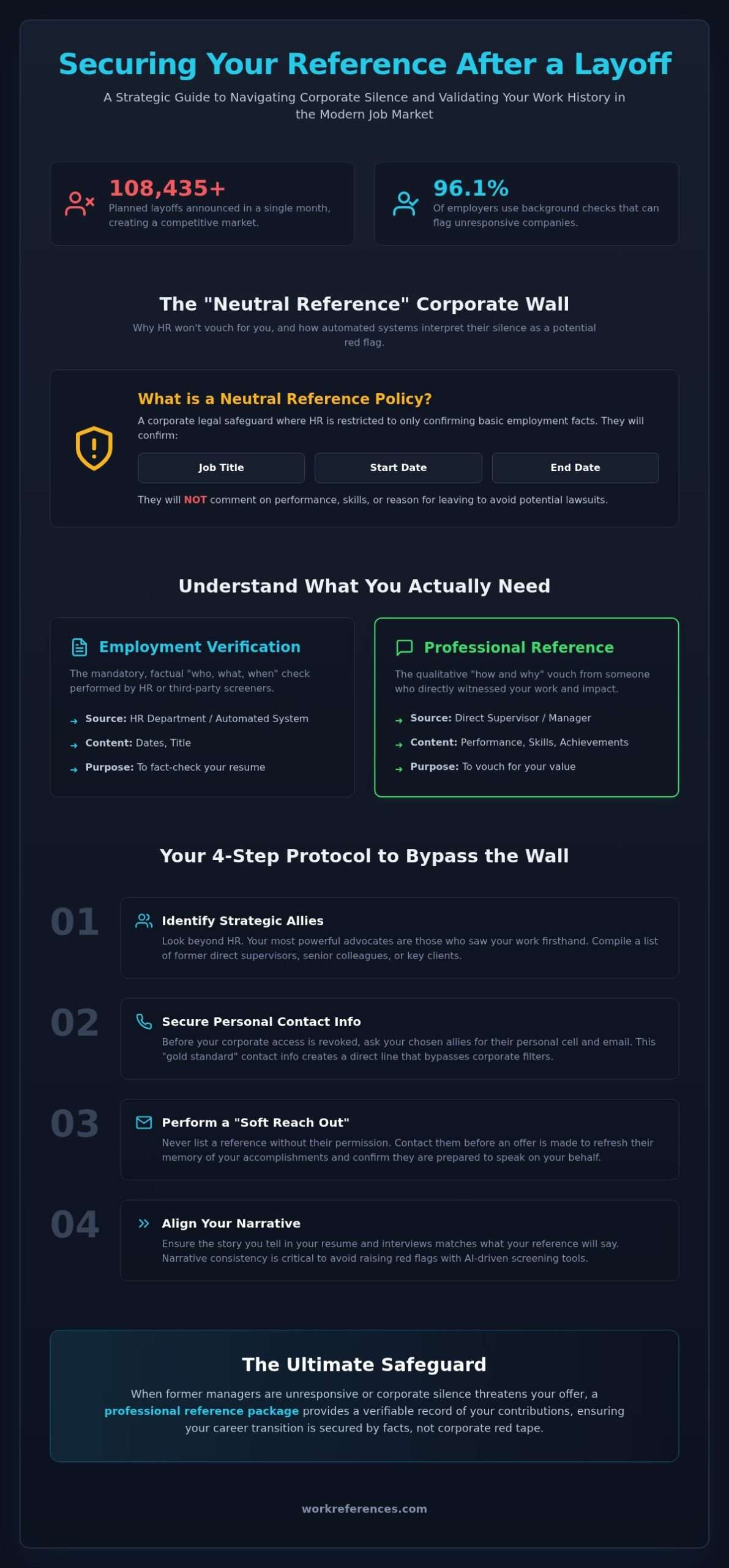
Recent data shows that 96.1% of employers now utilize background check protocols that flag unresponsive former companies. If your previous employer has gone silent or moved to a skeleton crew, your candidacy is at risk. Silence is often interpreted as a lack of performance by automated systems. You need a proactive strategy to ensure your history isn’t erased by corporate restructuring.
Reference vs. Verification: What You Actually Need
Employment verification is the mandatory “fact check” performed by HR departments or third-party screeners. It confirms your start date, end date, and job title. In contrast, a professional reference is a qualitative “vouch” from a direct supervisor who can speak to your specific performance and skills. Most corporations today implement a Neutral Reference Policy, which is a legal safeguard designed to prevent defamation lawsuits by only confirming basic employment dates and titles. Knowing this distinction is the first step in learning how to get a reference from a company that laid you off that actually moves the needle.
The 2026 Background Check Reality
Modern hiring relies heavily on AI-driven screening tools. These systems are programmed to identify gaps or “no comment” responses from former employers. When a former manager is unresponsive, the algorithm doesn’t see a busy executive; it sees a potential performance issue. You need a backup plan for when HR is outsourced or entirely automated. Consistency in your narrative is vital. If your resume claims a specific achievement but your reference only confirms your title, it creates a red flag. Maintaining a verifiable professional narrative is an essential safeguard in this high-stakes environment. Those who fail to prepare for this procedural integrity often find their offers rescinded at the final stage.
Overcoming the ‘Neutral Reference’ Corporate Wall
Why does HR refuse to say you were a star performer? It’s rarely a personal slight. In the modern corporate environment, human resources departments are bound by strict risk-mitigation protocols. They fear that a positive reference for one employee could lead to a discrimination claim from another, or that any subjective statement could trigger a defamation suit. This neutral reference wall is a standard corporate safeguard. If you want to know how to get a reference from a company that laid you off, you must first accept that HR is not your source for qualitative praise. They are a data point for verification, nothing more.
Identifying this policy early is critical for your transition. Check your employee handbook or ask HR directly during your exit interview about their disclosure policy. If they confirm they only provide dates and titles, you know immediately that you must pivot to the “Supervisor Loophole.” In 2026, personal cell numbers have become the gold standard for professional validation. They allow a direct line to the person who actually saw your work, bypassing the automated corporate filters that sanitize your history. Securing a verifiable narrative is the only way to solve the puzzle of how to get a reference from a company that laid you off when the official channels are blocked.
Bypassing HR via Personal Connections
Your direct manager is your most strategic ally during a reduction in force. Even if they were also part of the layoff, their professional “vouch” carries more weight with a hiring manager than a generic HR email. Request their personal contact information before your access is revoked. A personal reference exists outside the corporate HR system, making it a powerful tool for proving your performance. It’s perfectly ethical to use personal contact info if the individual has explicitly consented to act as a reference. This relationship-based approach ensures that your professional narrative remains intact even when the company’s official stance is silence.
Leveraging Severance for Documentation
The moment of layoff is also a moment of leverage. When negotiating your exit package, you can request a performance-based “Letter of Service” or a signed recommendation as a non-monetary benefit. Ensure your separation agreement doesn’t contain clauses that prohibit managers from providing personal references. This is a common hurdle that many professionals overlook until it’s too late. You can Learn about our Professional Reference Packages to see how we help document these critical career milestones. Securing these documents early provides a verifiable trail of your success before the corporate memory fades. If you find yourself struggling to reach a former supervisor, you should speak with a career advocate to ensure your background check doesn’t become a roadblock to your next offer.
Strategic Allies: Who to Ask When HR Won’t Help
If HR has retreated behind a wall of silence, your next move is to identify the individuals who aren’t bound by corporate gag orders. You need to look beyond the human resources department to find advocates who can speak to your professional impact. Learning how to get a reference from a company that laid you off involves mapping out your internal and external network to find those who can provide verifiable evidence of your performance. These allies are your primary defense against the “neutral reference” trap. They provide the qualitative depth that automated HR systems intentionally omit.
External validation is a particularly potent tool in 2026. Clients and vendors are much harder for a former employer to silence because they exist outside the internal chain of command. If a client can testify that your work saved them money or solved a critical problem, that carries immense weight. Recruiters value these perspectives because they represent the “result” of your efforts in a real-world context. When you’re navigating the complexities of how to get a reference from a company that laid you off, these external voices can often bypass the corporate bureaucracy that blocks your path.
The Hierarchy of Reference Credibility
- Priority 1: Direct reporting manager. This is the “Decision Maker” perspective. They are the most critical link in your verification chain because they oversaw your daily output and professional growth.
- Priority 2: Cross-functional leads. This is the “Collaborator” perspective. If your direct manager is unavailable, these leads can validate your ability to execute complex projects across different departments.
- Priority 3: Clients or long-term vendors. This is the “Result” perspective. These individuals provide a unique, high-stakes endorsement of your professional reliability and value-add.
Managing Defunct or Unreachable Teams
Mass layoffs often result in entire departments being dissolved, leaving you with a ghost network. If your manager has moved to a competitor or exited the industry, you must track them down via professional networks. Most professionals are more willing to speak freely once they are no longer under the immediate thumb of the company that initiated the layoff. If you find yourself in a situation where the entire corporate structure has collapsed, you should review References for Closed Companies: How to Secure Your Work History to understand how to maintain your professional narrative.
Public-facing verification layers like LinkedIn Recommendations also serve as a vital safeguard. While they don’t replace a live phone interview, they provide immediate social proof to recruiters. This public record creates a “narrative anchor” that is difficult for a former employer to contradict later. By securing these public endorsements early, you create a layer of protection that stays with you regardless of changes in corporate policy or personnel.
The Step-by-Step Protocol for Securing Your Professional Narrative
Securing a reference isn’t a one-time request; it’s a methodical process of narrative management. When you’re determining how to get a reference from a company that laid you off, you must treat your former manager as a strategic partner. This protocol ensures that your story remains consistent from the initial application to the final background check. By following these four steps, you eliminate the risk of “ghost references” or contradictory statements that could jeopardize your offer.
- Step 1: The ‘Soft Reach Out’. Before making a formal request, validate the relationship. Send a brief message to check on their current professional status. This re-establishes rapport without the immediate pressure of a favor.
- Step 2: The ‘Narrative Alignment’. You must ensure you both tell the same story. Confirm that they will describe your departure as a tactical reduction in force (RIF) or restructuring rather than a performance-based termination.
- Step 3: The ‘Reference Toolkit’. Don’t expect them to remember your every win. Provide an updated resume and a bulleted list of your key accomplishments during your tenure.
- Step 4: The ‘Verification Check’. Confirm their preferred contact method. In 2026, many managers prefer personal emails or cell numbers to avoid corporate monitoring.
The ‘Ask’ Script for 2026
Your request should be direct and outcome-focused. Avoid sounding defensive about the layoff. Instead, frame it as a procedural necessity for your next career move. You can View our Pricing for Executive Support if you require a more tailored approach for senior-level transitions. Use a script similar to this:
“Hi [Name], I’m currently in the final stages of an offer and wanted to ensure our narrative regarding the recent restructuring is aligned. Would you be comfortable confirming that my departure was part of the tactical RIF? I’ve attached my latest resume to ensure my dates of service match your records exactly.”
Preparing Your Reference for the Call
A well-prepared reference is your best defense against automated screening hurdles. Provide your ally with a “Cheat Sheet” featuring your top three accomplishments. This ensures they speak with specificity rather than vague generalities. It’s also vital to warn them about the specific background check firm the new employer uses, as these agencies often ask highly structured questions. Consistency between your resume dates and their memory is non-negotiable. If you’re concerned about a former supervisor’s availability or willingness to participate, you should contact a career advocate today to secure your professional narrative before the screening begins.
When Corporate Silence Jeopardizes Your Next Offer: Professional Solutions
What happens when a background check agency calls your former employer and receives no response? This is the “Ghost Reference” trap. It is a high-stakes failure that often leads to rescinded job offers. In an era where 96.1% of employers require rigorous background verification, an unresponsive former company is a major red flag. If you are struggling with how to get a reference from a company that laid you off because the office has closed or the HR department is skeletal, you need a procedural safeguard. Corporate silence shouldn’t be the reason you lose a life-changing opportunity.
WorkReferences bridges this critical gap by acting as your representative during the verification process. We provide live phone answering services that ensure employment history is validated even when former supervisors are unreachable. This human element is vital. Automated portals often fail to provide the context required for high-level roles. By securing your career documentation now, you prevent future verification hurdles that could stall your professional momentum for months.
Professional Reference Packages as a Safeguard
We offer specialized solutions tailored to your specific career stage. Our Basic Reference Package provides the essential verification needed for individual contributors to pass standard screenings. For senior leaders navigating the fallout of complex reductions in force, the Executive Reference Package offers a more sophisticated narrative alignment. Every package is designed with procedural integrity in mind. We ensure that your work history is confirmed through legitimate, verifiable channels that satisfy the most stringent compliance standards. This isn’t about circumventing the system; it’s about ensuring the system reflects the reality of your professional success.
Taking Control of Your Career Narrative
Leaving your professional reputation in the hands of a neutral HR department is a significant risk. These departments are designed to protect the company, not your career. You deserve a partner who understands the hidden hurdles of the 2026 hiring world. As a Vigilant Career Advocate, we provide the peace of mind that comes from knowing your references are ready when the call comes. You have worked too hard to let a “no comment” policy dictate your future. It’s time to move from a state of concern to a feeling of prepared confidence. Secure your professional references today with WorkReferences and ensure your next job offer is protected by a verifiable professional narrative. Knowing how to get a reference from a company that laid you off is only half the battle; having a verified solution in place is what secures the win.
Securing Your Professional Future Beyond the Layoff
A layoff is a temporary market shift, not a permanent stain on your career. By identifying strategic allies and aligning your narrative, you transform a corporate setback into a verifiable story of success. You’ve learned that bypassing neutral HR policies is essential for modern background checks. Mastering how to get a reference from a company that laid you off ensures that your hard-earned reputation remains intact even when the company itself is silent.
Don’t let institutional unresponsiveness or defunct departments block your next job offer. We provide expert live phone answering for reference checks and third-party employment verification to bridge the gap. Our team offers specialized support for defunct companies, ensuring your work history is validated with procedural integrity. This isn’t just a service; it’s an essential safeguard for your career advancement in a high-stakes market.
Secure your professional narrative-Contact WorkReferences today. You have the skills and the history; now it’s time to ensure they are properly verified. Your next chapter is waiting, and we’re here to help you turn the page with absolute confidence.
Frequently Asked Questions
Can I get a reference if my company has a ‘neutral’ reference policy?
Yes, you can. While HR may be restricted to verifying dates and titles, you can seek personal references from former supervisors or peers who are willing to speak outside of official corporate channels. These individuals provide the qualitative performance data that HR policies intentionally omit to mitigate legal risks. It’s a common strategy for professionals to maintain these personal connections as a safeguard against corporate silence.
What should I do if my former manager was also laid off?
You should still use them as a primary reference. A manager who was laid off is often more willing to speak candidly about your achievements since they’re no longer bound by immediate corporate oversight. Ensure you have their personal contact information to bypass defunct company email systems. This allows you to maintain a direct, verifiable line for future background checks despite the organizational changes.
How do I explain a layoff to a recruiter without sounding negative?
Frame the layoff as a tactical business decision rather than a reflection of your individual performance. Use objective language such as “structural realignment” or “reduction in force due to market shifts.” This approach demonstrates professional maturity and ensures the recruiter focuses on your skills. It shifts the conversation away from the circumstances of your departure and toward the value you bring to a new role.
Is it okay to use a colleague as a reference if my boss is unavailable?
It is acceptable, but you must clarify the relationship. A peer can validate your collaboration and technical skills, which is better than having no reference at all. However, prioritize cross-functional leads or senior stakeholders who can provide a broader perspective on your impact if your direct supervisor is completely unreachable. This ensures your verification package remains robust and carries the necessary professional weight.
How do I prove I was laid off if the company no longer exists?
You can use secondary documentation like your separation agreement or final pay stubs. If you’re unsure how to get a reference from a company that laid you off when it has shuttered, third-party verification services can validate your history through alternative data sources. This ensures your professional narrative remains verifiable even if the original corporate entity has completely collapsed or moved its records into deep storage.
What happens if a potential employer can’t reach my references?
An unreachable reference often creates a “Ghost Reference” red flag that can stall your hiring process. If the recruiter cannot make contact, they may ask for alternative references or require you to provide additional proof of employment. Utilizing a live phone answering service ensures that every verification attempt is met with a professional response, preventing automated screening tools from flagging your application as incomplete or suspicious.
Can a company legally refuse to give me a reference after a layoff?
Yes, most companies aren’t legally required to provide a qualitative reference. They’re generally only obligated to provide factual data for employment verification. This is why learning how to get a reference from a company that laid you off through personal connections is vital. It allows you to bypass restrictive corporate policies and secure a positive vouch from someone who directly witnessed your professional contributions and impact.
How long do background check companies try to reach a reference?
Most background check firms typically attempt to reach a reference three to five times over a period of three to five business days. If they receive no response after these attempts, they’ll flag the reference as “unreachable” in their final report to the hiring manager. Having a prepared backup plan or a professional verification service in place prevents this outcome from derailing your offer at the final stage.
Article by
William Schmidt
William Schmidt is a former Fortune 500 recruiter and founder of WorkReferences.com, a pioneering employment verification and professional reference service established in 2009. With extensive experience working alongside hiring managers, recruiters, and background screening agencies, he helps job seekers overcome career obstacles through credible, third-party verification solutions that strengthen resumes and restore confidence in the hiring process