

What if the only thing standing between you and your first corporate salary isn’t your lack of experience, but your inability to prove your potential through a third party? For many candidates, the search for references for entry level jobs feels like a humiliating exercise in reaching back to high school teachers or family friends. You know you’re capable of the work; yet the fear of failing a modern background check because you lack a traditional supervisor’s name can be paralyzing. It’s a high-stakes hurdle that makes you feel like an outsider before you’ve even stepped into the office.
We understand that the transition into a new career in 2026 is fraught with these procedural anxieties. This guide will show you exactly how to build a professional reference list from scratch that satisfies corporate background checks and secures your first major job offer. We’ll explore strategic ways to verify your work ethic and character through credible channels that HR departments actually respect. You’ll learn how to present a list that projects legitimacy and ensures you move through the screening process with the confidence of a seasoned professional.
Key Takeaways
- Learn why references serve as a critical proxy for professional reliability when you’re navigating the transition into your first major role.
- Identify high-impact sources for references for entry level jobs, including academic mentors and volunteer coordinators, to validate your potential.
- Bridge the “credibility gap” by prioritizing professional advocacy over casual character endorsements that often fail to satisfy modern HR standards.
- Use a Reference Alignment Strategy to ensure your resume and reference claims match perfectly, eliminating red flags during background checks.
- Discover how professional advocacy services provide an essential safeguard, ensuring every inquiry is handled with corporate-level procedural integrity.
The Experience Paradox: Why Reference Checks Matter for Entry-Level Roles
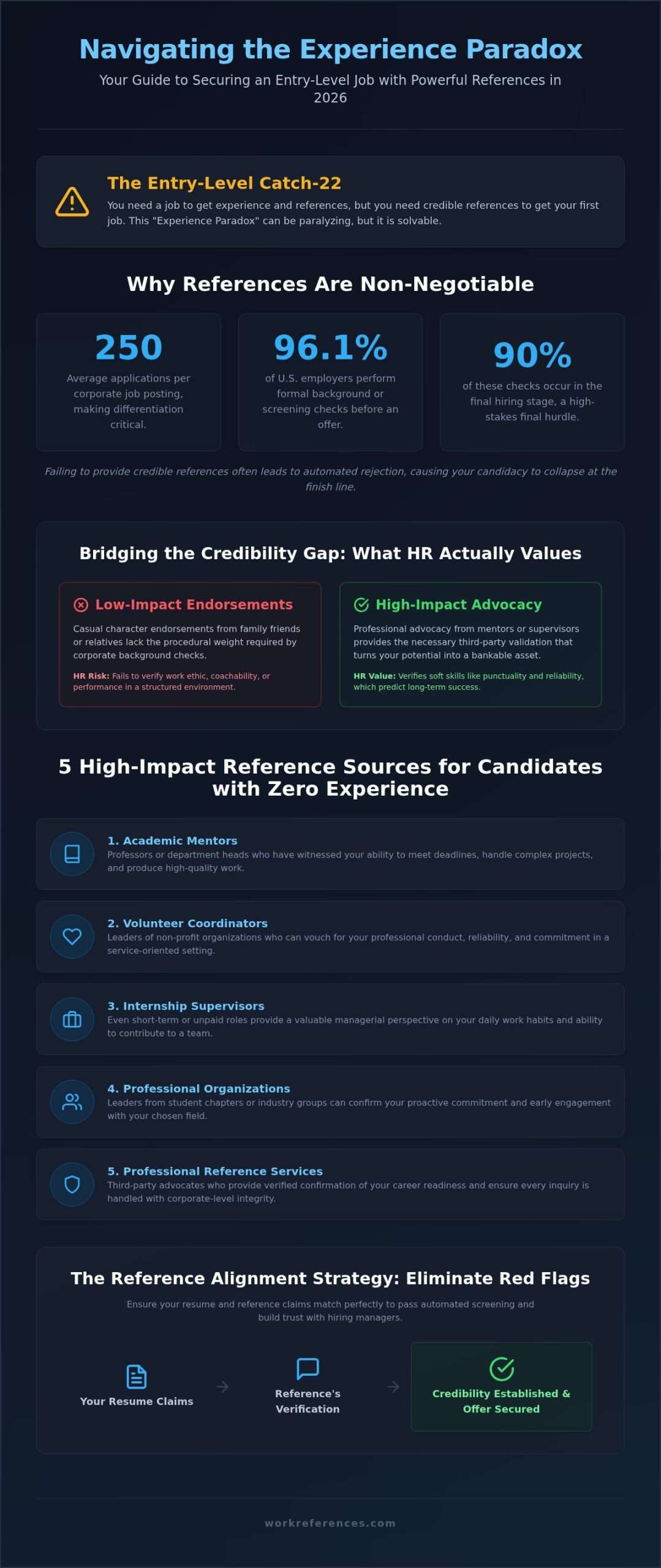
The “Experience Paradox” is the ultimate career Catch-22; you need a role to build a reputation, yet you need a reputation to secure the role. In the 2026 labor market, where employers receive an average of 250 applications per posting, hiring managers rely on references as a critical proxy for professional reliability. Without a documented work history, your potential is just a claim on a resume. References provide the necessary third-party validation that transforms your potential into a bankable asset. They act as the “proof of concept” for your career, showing that you can thrive in a structured environment.
Recent data indicates that 96.1% of U.S. employers perform formal background or screening checks before extending a final offer. This employment background check is no longer a formality. It is a rigorous verification of your character and work ethic. If you fail to provide references for entry level jobs, automated systems often flag your application as “incomplete,” leading to immediate rejection. Because 90% of employers conduct these checks in the final stage of the hiring process, a lack of credible names can cause your candidacy to collapse at the finish line.
The Role of References in Modern Background Screening
Today’s hiring environment uses sophisticated software to filter candidates. While simple verification confirms dates and titles, qualitative reference checks explore your soft skills. In 2026, many companies use digital platforms like SkillSurvey to generate a candidate score based on reference feedback. If you don’t have a supervisor to call, you must find alternative ways to provide this data. Employers prioritize soft skill validation, such as punctuality and coachability, because these traits predict long-term success more accurately than technical skills alone for new entrants.
Why Your “Entry-Level” Status Does Not Exempt You
Many students and recent graduates believe they are exempt from these requirements. This is a dangerous misconception. Leaving the reference section blank signals a lack of preparation or, worse, a lack of anyone willing to vouch for you. Even for internships, a professional endorsement is expected. A robust list of references for entry level jobs can actually give you a competitive edge. A candidate with a slightly less impressive resume but glowing professional advocacy will often beat out a more experienced applicant whose references are lukewarm or non-existent. You can explore specialized Professional Reference Packages to ensure your list meets these high corporate standards, providing the security you need to move forward.
5 High-Impact Reference Sources for Candidates with Zero Experience
The absence of a traditional supervisor doesn’t mean your professional reputation is a blank slate. In the current hiring market, the strategy for building references for entry level jobs relies on identifying advocates who have overseen your performance in high-stakes environments. You need individuals who can speak to your reliability, coachability, and output. While friends and family offer character support, they lack the procedural weight required by corporate background checks. To build a list that satisfies modern HR standards, you must look toward structured environments where your work was measured and managed.
- Academic Mentors: Professors or department heads who have witnessed your ability to meet deadlines and handle complex projects.
- Volunteer Coordinators: Leaders of non-profit organizations who can vouch for your professional conduct in a service-oriented setting.
- Internship Supervisors: Even short-term or unpaid roles provide a managerial perspective on your daily work habits.
- Professional Organizations: Leaders from student chapters or industry groups who can confirm your commitment to your chosen field.
- Professional Reference Services: Third-party advocates who provide verified confirmation of your career readiness and professional potential.
Academic Sources: Moving Beyond the Classroom
When selecting an academic reference, don’t just choose the professor from the class where you earned the highest grade. Prioritize the instructor who witnessed your “output” during a difficult semester or a collaborative lab project. Teaching Assistants (TAs) are often a more strategic choice; they typically have more direct contact with your work and can provide the granular detail that hiring managers crave. If you participated in research, the project leader can vouch for your technical competency and attention to detail. Understanding when to provide references is a critical part of this process, ensuring you protect these valuable academic relationships until the final hiring stage.
The Power of Volunteer and Community Leadership
Volunteer work is often hidden professional experience. If you coordinated a food drive or managed a community event, you weren’t just “helping out.” You were performing project management and logistics. A reference from a non-profit board member or a community leader carries significant weight because it demonstrates your ability to function within a formal hierarchy. When asking for these references for entry level jobs, frame your request around your specific contributions. Remind the coordinator of the “projects” you managed so they can speak confidently about your results during a screening call. If you’re struggling to identify which of these sources will most effectively bridge your credibility gap, consult with a professional advocate to tailor your list to your target industry.
Character vs. Professional References: Identifying the Most Credible Options
The “Credibility Gap” is a silent killer in many entry-level applications. Many candidates mistakenly believe that a glowing character endorsement from a family friend carries weight. It doesn’t. In 2026, corporate background checks are increasingly data-driven and designed to filter out inherent bias. If your reference shares your last name or a purely social history, it triggers an immediate red flag. HR departments prioritize “Professional Advocacy” over “Character Endorsement.” They want evidence that you can function within a corporate hierarchy, not just that you’re a pleasant person to be around.
Reliability is measured in a specific hierarchy that every candidate must understand. A direct manager remains the gold standard, followed by professional colleagues and academic mentors. Personal references sit at the bottom of this list, often disregarded entirely by sophisticated screening software. If you lack traditional supervisors, you must bridge this gap strategically. Utilizing professional job reference services provides a high-integrity solution. This ensures your references for entry level jobs meet the rigorous demands of modern screening protocols by providing a verified, third-party confirmation of your professional potential.
The Danger of Using Personal Friends and Family
Family references represent an inherent conflict of interest. Background checkers assume these individuals will provide a positive review regardless of your actual performance or work ethic. This perceived bias can damage your professional image. It makes you look like you’re hiding a lack of experience or, worse, that you’re unprepared for the realities of the workplace. While a personal reference might be acceptable for character-heavy roles like caregiving, they are a significant liability for corporate positions. In a high-stakes hiring environment, appearing biased is almost as damaging as having no reference at all.
Professionalizing Your Non-Work References
If you’re using a mentor or professor, you must coach them to speak the language of management. A typical professional reference call in 2026 lasts between 10 and 20 minutes. During this time, your advocate shouldn’t just talk about your personality. They need to focus on business outcomes. Encourage them to use “industry-speak.” Instead of saying you’re “hardworking,” they should describe you as “highly coachable” or “consistently meeting project milestones.” They should also be prepared for the critical “eligible for rehire” question, which is a key indicator of your professional standing. This shift ensures your references for entry level jobs sound like professional evaluations rather than casual chats, giving the hiring manager the proof they need to move forward.
The Protocol: How to Request and Prepare Your References for 2026 Hiring
Preparing references for entry level jobs requires more than just a list of names; it requires a coordinated communications plan. In the 2026 hiring environment, the procedural execution of the reference check is where many candidates lose their momentum. You must implement a Reference Alignment Strategy to ensure that every claim on your resume is mirrored by your advocate’s testimony. Discrepancies in dates, titles, or core responsibilities are high-risk red flags that can lead to a rescinded job offer. Reference Alignment is the synchronization of career dates, titles, and duties across all verification points.
When managing references for entry level jobs, the “Warm Hand-off” ensures your advocate isn’t caught off guard by a high-stakes inquiry. Alert your reference the moment you move to the final stage of hiring. A surprised reference is often an unpersuasive one. Don’t leave their response to chance. Provide them with a “Cheat Sheet” highlighting your top three professional achievements. This ensures their narrative aligns with the value proposition you presented during the interview. Additionally, establish a backup plan. People get busy or become unavailable; having a fourth name ready prevents a delay in your background screening.
Crafting the Perfect Reference Request
A successful request contains three essential elements: Gratitude, Context, and Guidance. Start by expressing appreciation for their past mentorship or supervision. Then, provide context about the specific role you’re pursuing. Finally, offer guidance on which skills they should emphasize. Always ask the qualifying question: “Do you feel comfortable providing a positive and professional reference for me?” If they hesitate, thank them and move to your backup plan immediately.
- Gratitude: Acknowledge the value of their time and previous support.
- Context: Explain the job requirements and the company culture.
- Guidance: Remind them of specific projects or milestones you achieved together.
Professional Request Template:
Subject: Professional Reference Request – [Your Name]
Dear [Name], I am currently in the final stages of interviewing for a [Job Title] role at [Company]. Given our work together on [Project/Class], I’d be honored if you would serve as a professional reference. Would you feel comfortable providing a positive and professional endorsement of my work ethic and technical skills? I’ve attached my current resume and a brief overview of the role for your convenience. Best regards, [Your Name]
Reference Alignment: Avoiding Background Check Red Flags
Inconsistencies between your resume and reference check can lead to offer rescission. Employers use automated tools to compare your submitted history against the qualitative data gathered during calls. Ensuring Resume and Reference Consistency is not a luxury; it’s a defensive necessity. If you’re unsure if your volunteer or academic history will withstand this level of scrutiny, speak with a career advocate today to audit your strategy and secure your professional future.
Professional Advocacy: Bridging the Credibility Gap with WorkReferences
The “Experience Paradox” ends here. While academic mentors and volunteer coordinators are valuable, they often lack the registered corporate infrastructure that modern background screening software requires. WorkReferences acts as a sophisticated bridge, providing the third-party confirmation of your professional readiness that HR departments demand. By utilizing specialized Reference Packages, you shift the narrative from your lack of history to your verified potential. This isn’t just about getting a job; it’s about establishing a foundation of professional integrity that satisfies even the most rigorous corporate scrutiny. You no longer have to feel like an outsider trying to prove your worth with personal favors.
Moving from an anxious applicant to a verified professional requires more than just a resume. It requires a strategy that anticipates the hurdles of the 2026 hiring landscape. When you provide references for entry level jobs through a professional advocacy service, you’re signaling to employers that you understand corporate compliance. You’re presenting yourself as a candidate who is already “vetted” and ready to contribute. This transition is essential for securing high-stakes roles where the cost of a bad hire can reach $4,700 or more. We act as your vigilant career advocate, ensuring your first major job offer isn’t lost to a procedural technicality.
Third-Party Verification: A Modern Hiring Essential
In an era where 96.1% of employers perform formal screening, a casual character endorsement is no longer sufficient. WorkReferences validates your career documentation by providing registered phone numbers and professional emails that background check software recognizes as legitimate. The most critical advantage is our live phone answering service. When a recruiter calls, they don’t reach a voicemail or a busy student; they reach a professional entity that confirms your potential with procedural accuracy. This level of verification is significantly more reliable than a personal reference, as it removes the “bias” red flag that often triggers an automated rejection. It ensures that your references for entry level jobs meet the “gold standard” of live phone validation.
Securing Your Future: Next Steps for New Entrants
Securing your first major role shouldn’t be a source of anxiety. Whether you’re a recent graduate or transitioning fields, choosing the right service bundle is your first step toward career security. Our tiered options, including the Professional Reference Package and Basic Reference Package, are designed to scale with your ambitions. Having a verified professional history from day one ensures that you aren’t just another applicant; you’re a candidate with a validated reputation. You can move forward with the prepared confidence of an industry insider who knows the hidden hurdles are already handled. To begin building your credible advocacy list, contact WorkReferences to secure your professional references today.
Take Command of Your Professional Narrative
Navigating the transition into a corporate role requires more than just technical skill; it requires a strategy for overcoming the “Experience Paradox.” You’ve seen how shifting from personal endorsements to professional advocacy can bridge the credibility gap. Building a list of references for entry level jobs is a high-stakes process that demands absolute alignment between your resume and your verification sources. In a marketplace where background checks are increasingly automated and rigorous, leaving your reputation to chance is a risk you don’t need to take.
WorkReferences acts as your vigilant advocate, providing the procedural integrity required to secure your first major offer. We offer Live Phone Answering for All Verification Checks and Expert Career Documentation Alignment, ensuring every inquiry reflects your true potential. Our Proven Success in High-Stakes Corporate Hiring means you can enter the screening process with prepared confidence rather than anxiety. It’s time to turn your potential into a verified professional asset. Secure Your Professional Career History Today and step into your new career with the security you deserve.
Frequently Asked Questions
Can I use a friend as a reference if I have no work experience?
Using a personal friend is generally discouraged for corporate roles because it signals a “bias red flag” to HR professionals. Background checkers seek objective proof of your work ethic and reliability rather than social popularity. If you lack traditional experience, you should prioritize academic mentors or professional advocacy services that provide a verified, third-party perspective on your career potential.
How many references do I need for my first job?
Standard corporate protocols typically require a list of three professional references to satisfy verification requirements. This number allows hiring managers to establish a consistent pattern of behavior and performance across different environments. When preparing references for entry level jobs, ensure you have at least one backup name ready in case your primary contact becomes unavailable during the screening window.
Do employers actually call references for entry-level positions?
Yes, approximately 90% of employers conduct reference checks as the final deciding factor before extending a formal offer. In a competitive market, these calls serve as a critical tie-breaker between top candidates. Employers use these conversations to validate soft skills and ensure you’re eligible for rehire according to their internal compliance standards and risk management policies.
What should I do if a professor or mentor does not respond to my reference request?
If you don’t receive a response within three to five business days, you must move to your secondary list immediately. Professional momentum is vital during the hiring cycle, and delays in providing contact information can make you look unprepared. If academic sources remain silent, consider a professional reference package to ensure your verification process continues without a damaging interruption.
Is it legal to use a professional reference service for my resume?
It’s entirely legal to utilize professional advocacy and third-party verification services to bridge your experience gap. These entities act as a legitimate proxy for candidates who lack traditional supervisors or have unavailable mentors. By providing a registered corporate infrastructure for verification, these services ensure your career documentation meets the technical requirements of modern background screening software.
What happens if a background check company cannot reach my references?
Failure to reach a reference often results in an “incomplete” flag on your background report, which can lead to a rescinded job offer. Employers view unreachable references as a lack of professional preparation on the candidate’s part. Ensuring your advocates are alerted and ready for the call is a critical defensive step that protects your career advancement from procedural failure.
Can I use a family member as a character reference?
Avoid using family members for corporate positions because HR departments view these endorsements as inherently biased. While a character reference might be acceptable for some community-based roles, corporate hiring managers require professional advocacy. They need to hear from someone who can objectively discuss your ability to meet deadlines and function within a professional hierarchy without personal conflict.
How do I list references on my resume if I have no experience?
You shouldn’t list your references for entry level jobs directly on your resume document. Instead, prepare a separate, professional sheet that matches the formatting of your cover letter and resume. This document should include the reference’s name, title, company, and a brief sentence explaining your professional relationship. Present this list only when the hiring manager requests it during the final interview stage.
Article by
William Schmidt
William Schmidt is a former Fortune 500 recruiter and founder of WorkReferences.com, a pioneering employment verification and professional reference service established in 2009. With extensive experience working alongside hiring managers, recruiters, and background screening agencies, he helps job seekers overcome career obstacles through credible, third-party verification solutions that strengthen resumes and restore confidence in the hiring process