
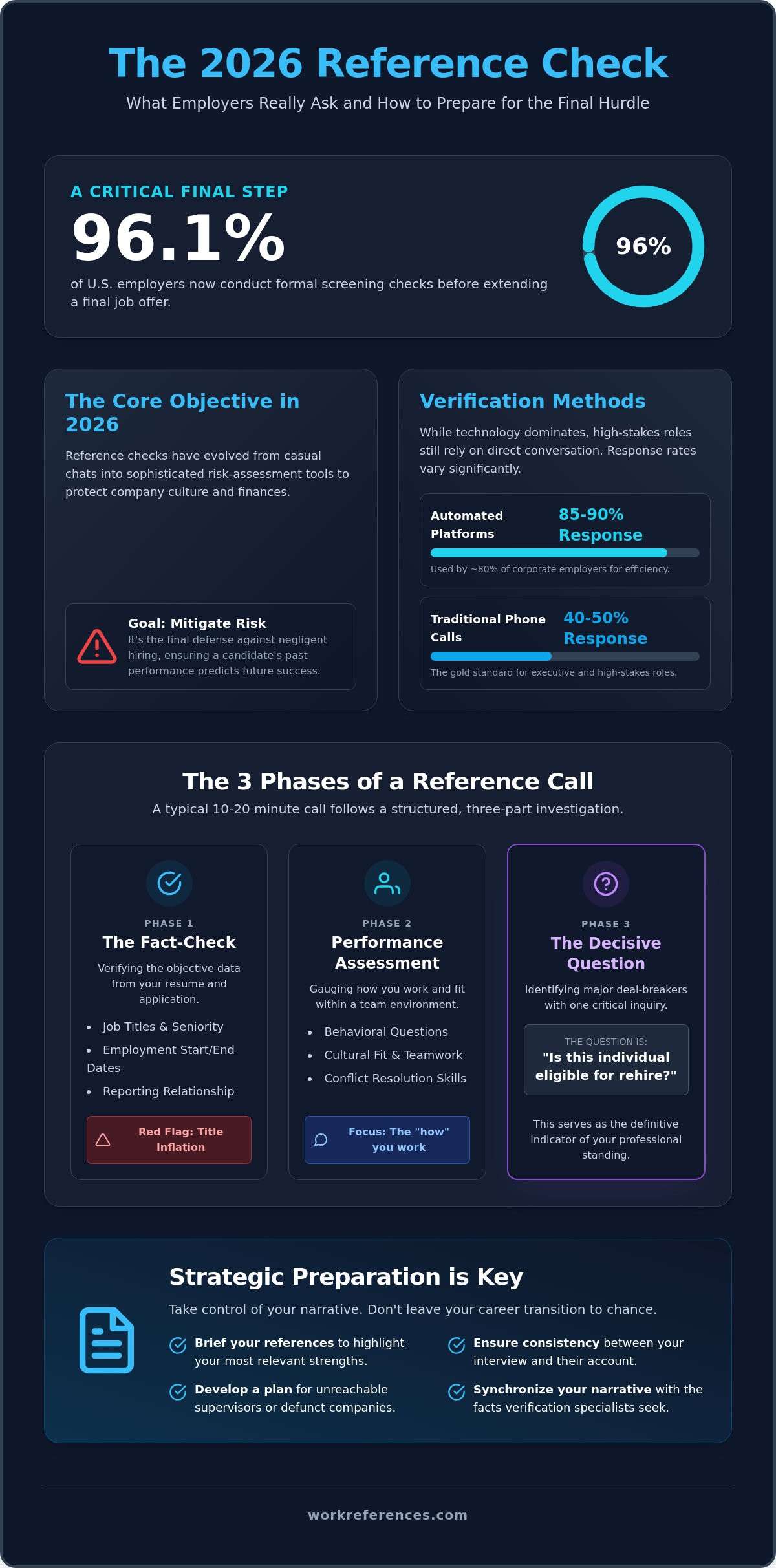
Recent data reveals that 96.1% of U.S. employers now conduct formal background or screening checks before making a final job offer. You’ve navigated the grueling interview rounds successfully, but now the high-stakes reality of the verification phase sets in. It’s common to feel a sense of dread about what do employers ask when they call references, especially if your past supervisor has moved on or your previous company no longer exists. You aren’t alone in fearing that a single inconsistent detail or an unreachable contact could derail your professional advancement.
This guide provides the strategic clarity you need to move from concern to prepared confidence. You’ll discover the specific performance-based questions hiring managers prioritize in 2026 and learn how to ensure your professional history is verified with total accuracy. We will break down the most likely inquiry list, offer proven strategies for managing defunct employers, and show you how to secure your reputation through professional verification safeguards. Your career transition is too important to leave to chance; it’s time to take control of your narrative.
Key Takeaways
- Recognize how the 2026 hiring landscape treats reference checks as strategic performance audits. You’ll learn to synchronize your professional narrative with the facts that verification specialists seek.
- Gain insight into exactly what do employers ask when they call references, focusing on the behavioral questions that reveal your cultural fit and conflict-resolution skills.
- Prepare for the high-stakes “eligible for rehire” question, which often serves as the definitive indicator of your professional standing and future potential.
- Develop a tactical plan for handling unreachable supervisors or defunct companies, ensuring your career trajectory isn’t stalled by administrative gaps.
- Learn how to brief your references strategically so they can highlight the specific strengths and achievements that matter most to your prospective employer.
The Core Objective: Why Employers Conduct Reference Checks in 2026
In 2026, a reference check is no longer a casual chat between industry peers. It has morphed into a sophisticated risk-assessment tool designed to protect a company’s culture and bottom line. While an employment background check typically focuses on the “what” (dates, titles, and criminal records), the reference call investigates the “how.” Hiring managers use these conversations to determine if your past performance predicts future success or if you represent a liability. It’s the final layer of defense against negligent hiring, a legal concept that holds employers accountable for the actions of their staff.
Technology has accelerated this process significantly. Approximately 80% of corporate employers now conduct these checks, often utilizing automated platforms that yield an 85-90% response rate compared to the 40-50% seen with traditional phone calls. However, for high-stakes or executive roles, the live phone call remains the gold standard. When considering what do employers ask when they call references, you must understand the psychological state of the person on the other end. They’ve invested weeks in the recruitment process and are likely looking for confirmation that you’re the right choice. Yet, the fear of a “bad hire” makes them vigilant for any deal-breakers that didn’t surface during the interview.
Confirmation vs. Investigation
Most hiring managers enter the reference phase hoping to validate their “best-case” version of you. They’ve already decided you have the technical skills; now they need to know if those skills translate to a real-world environment. To avoid legal bias and ensure procedural integrity, many organizations have shifted toward structured reference interviews. These are standardized sets of questions asked of every candidate’s references to ensure fairness. A critical part of this investigation is the role of consistency. If your interview answers regarding a specific project conflict with your supervisor’s account, it creates a red flag that no amount of charisma can overcome. The objective is to see if the person you described in the interview matches the person who showed up to work every day.
The Timeline of the Call
When in the hiring cycle does this happen? In 2026, these calls typically occur after the final interview but before the formal offer letter is signed. It’s the final hurdle in a methodical progression toward employment. You might wonder, do jobs actually call references every time? The answer is increasingly yes, as companies seek to mitigate the costs of high turnover. A professional reference conversation usually lasts between 10 and 20 minutes. This is just enough time for a recruiter to dig past surface-level praise and get into the mechanics of your work habits. Understanding what do employers ask when they call references during this window allows you to prepare your contacts so they can speak with precision rather than vague generalities.
The ‘Fact-Check’ Phase: Verifying Titles, Dates, and Duties
The initial minutes of a professional reference call are dedicated to objective data verification. Hiring managers use these administrative questions to establish the legitimacy of the reference and ensure the candidate’s self-reported history holds up under scrutiny. When considering what do employers ask when they call references, expect a rigorous focus on job titles and tenure. Title inflation, the practice of embellishing a previous role’s seniority, is a significant red flag that often surfaces during this phase. If your resume lists you as a “Senior Manager” but your supervisor confirms you were an “Associate,” the discrepancy can terminate your candidacy instantly.
Recruiters also meticulously cross-reference start and end dates. In 2026, employment gap analysis has become more precise as companies look for stability in a volatile market. Beyond dates, the caller will confirm the nature of your reporting relationship. They want to know if the person on the line was your direct supervisor with oversight of your output, or merely a peer. If you’re concerned about how a former employer might represent these administrative details, it’s wise to consult with a professional advocate before the call is made.
Validating Core Responsibilities
Once the basics are confirmed, the conversation shifts toward your daily impact. Employers ask about the specific technical requirements of your role and your level of autonomy. They want to hear examples of your decision-making power and how you handled projects without constant oversight. Recruiters often transition into performance-based questions to see if your past successes are repeatable. Resume Alignment is the precise synchronization between the professional narrative on your CV and the factual account provided by your supervisors, serving as a critical factor for verification success. Without this alignment, your credibility is compromised.
Salary and Compensation Queries
As of July 2026, the legal landscape regarding compensation has shifted dramatically. With 20 states now enforcing salary history bans, including new regulations in Virginia and Maine, employers are largely prohibited from asking about your past wages. Instead, they use “level of responsibility” as a proxy for your previous compensation structure. They might ask your reference about the size of the budgets you managed or the number of direct reports you oversaw. While they won’t ask for a dollar amount, they’re assessing whether your previous seniority matches the pay grade of the new role. Honesty remains the only viable strategy; any attempt to misrepresent your previous level will likely be exposed through these indirect inquiries.
Assessing Performance: Behavioral Questions That Matter Most
Once the caller satisfies the administrative requirements, the conversation shifts from verifying your history to predicting your future. This is the psychological heart of the inquiry. When you consider what do employers ask when they call references, you must prepare for questions that probe your behavioral consistency. Hiring managers aren’t just looking for a list of strengths; they’re looking for evidence of how you function under pressure. They will ask your former supervisor to describe your response to workplace conflict or a missed deadline. These questions are designed to reveal the “soft skills” that a resume can only hint at, such as your emotional intelligence and stress tolerance.
Reliability remains a non-negotiable metric for employers in 2026. Expect the caller to dig into your attendance patterns and your ability to manage complex project timelines. They might ask, “Can you describe a time when this candidate was under significant stress, and how did it affect their output?” This is a high-stakes moment for your candidacy. While there are boundaries regarding what employers can legally ask, questions about your professional conduct and dependability are entirely fair game. Your reference’s ability to provide specific, positive examples here can be the difference between a job offer and a rejection.
Quantifying Impact and Results
In a data-driven hiring environment, vague praise is insufficient. Recruiters will ask your references to validate the specific KPIs or metrics you claimed in your interview. They want to hear a supervisor describe your growth trajectory: did you take on more responsibility over time, or did you plateau? A particularly revealing tactic is the “Comparison Question.” The caller may ask your reference where you rank among the peers they have managed in similar roles. Being described as “top 5%” carries far more weight than being called “a good worker.” This phase ensures that your reported accomplishments are backed by third-party confirmation.
Soft Skills and Emotional Intelligence
Cultural fit is often the final hurdle in the reference check process. Employers ask about your communication style and how effectively you collaborated within a team. They are especially interested in your coachability. A common question is, “How does this candidate respond to critical feedback?” If a reference suggests you are defensive or resistant to change, it signals a significant risk to the hiring manager. Ultimately, what do employers ask when they call references regarding “fit” is a search for harmony. They need to know that adding you to their ecosystem will enhance the team dynamic rather than disrupt it.
Identifying Red Flags: The ‘Eligible for Rehire’ Question
“Would you rehire this person?” This inquiry is the most critical component of the entire verification process. While previous sections detailed what do employers ask when they call references regarding technical skills and duties, this question serves as the ultimate litmus test for your professional character. A “yes” validates everything you’ve claimed; a “no” or a hesitant response can instantly disqualify you, regardless of your technical prowess. Experienced hiring managers are trained to listen for the “pregnant pause”, that brief silence before a reference answers, which often speaks louder than the words that follow. They’re also adept at probing for weaknesses, asking supervisors to identify areas where you struggled or required excessive oversight.
Recruiters understand that a candidate’s past behavior is the best predictor of their future performance. If a former manager expresses reluctance to bring you back onto their team, it creates a risk profile that few companies are willing to accept. This is especially true in 2026, where the costs of turnover and cultural misalignment are at an all-time high. To protect your career trajectory, you must ensure that your references are prepared to answer this question with absolute conviction.
Interpreting Corporate Policy
Many modern organizations adopt a strict “Neutral Reference” policy, where HR departments only confirm job titles and dates of employment. While this might seem protective, it can inadvertently create suspicion. Recruiters often read between the lines. They know that a supervisor who’s genuinely enthusiastic will frequently find ways to praise a candidate despite restrictive policies. If you’re coming from a defunct organization, the challenge is even greater. You must proactively manage your narrative by understanding References for Closed Companies to ensure your history remains verifiable. A lack of data is often interpreted as a hidden red flag by vigilant recruiters.
Managing Negative Feedback
What happens if a former supervisor provides a mixed review? If you anticipate a difficult reference, you should address the situation during the interview phase rather than letting it surface as a surprise later. Provide context for past conflicts without being defensive. Utilizing a third-party verification service can mitigate the impact of “bad” references by providing a balanced, professional account of your work history that adheres to corporate compliance standards. This layer of security ensures that one person’s subjective opinion doesn’t overshadow years of documented success. If you’re unsure how your past supervisors will respond, it’s vital to reach out for a professional assessment before you submit your reference list.
Strategic Preparation: Securing Your Professional Reputation
Understanding what do employers ask when they call references is only half the battle. The other half is ensuring your contacts are equipped to answer those questions with precision and authority. You can’t leave their responses to memory alone. A supervisor you haven’t spoken to in years might struggle to recall the specific KPIs you hit or the nuances of your decision-making power. Strategic preparation involves transforming your references from passive participants into active advocates for your candidacy. This process mitigates the risk of inconsistent information and reinforces the narrative you’ve built throughout the interview cycle.
The stakes are particularly high if you’re dealing with the “Defunct Company” dilemma. In the volatile market of 2026, it’s increasingly common for previous employers to have closed their doors or for former managers to have moved into unreachable roles. When a recruiter encounters a disconnected line or a supervisor who has vanished from the professional grid, they don’t see a victim of circumstance. They see a verification gap. You must proactively bridge these gaps to ensure your professional history remains a source of strength rather than a point of suspicion.
The Briefing Process
Never assume a reference is ready just because they once said “yes.” Once you reach the final stages of the hiring process, send your references an updated copy of your resume and the specific job description for the role you’re pursuing. Remind them of 2-3 key projects you completed together that align with the new employer’s needs. This isn’t about coaching them to lie; it’s about refreshing their memory so they can speak accurately about your impact. Finally, verify their current contact information. A recruiter getting a “number no longer in service” message is often enough to stall a job offer indefinitely.
Professional Verification Solutions
When traditional references are unavailable or when a previous company no longer exists, you need a more robust solution. A Professional Reference Package provides a secure, third-party confirmation of your work history, ensuring that administrative hurdles don’t derail your career advancement. These services utilize live phone answering to solve the problem of unavailable managers, providing a consistent and professional narrative to inquiring recruiters. This safeguard moves you from a state of anxiety regarding your past to a position of total confidence in your future. To take control of your verification process, view our reference service pricing and secure your job offer today.
Before you submit that final list, run through this essential checklist:
- Accuracy: Are all phone numbers and email addresses current and active?
- Alignment: Have you briefed each reference on the specific “soft skills” the new employer is seeking?
- Availability: Does your reference have any upcoming travel that might make them unreachable during the verification window?
- Legitimacy: For defunct companies, do you have a professional verification backup in place?
Take Command of Your Professional Narrative
The final stage of the hiring process is a strategic performance audit where every detail carries significant weight. By understanding what do employers ask when they call references, you’ve moved from a position of uncertainty to one of tactical advantage. You now recognize that recruiters prioritize consistency between your interview claims and your supervisor’s account, with the “eligible for rehire” question serving as the definitive test of your professional standing.
Don’t let a missing supervisor or a closed company compromise your hard-earned reputation. Our specialists provide live phone answering by professional agents and offer expertise in defunct company verifications, ensuring your history is validated with total integrity. Every package includes comprehensive career consulting to help you navigate these high-stakes hurdles with ease. It’s time to ensure your professional history is verified with total accuracy and procedural security.
Secure Your Career Reputation with a Professional Reference Package
Your professional future is too valuable to leave to chance. Take this final step with prepared confidence, knowing your work history is protected by vigilant career advocates who understand the stakes of your success.
Frequently Asked Questions
Can an employer ask about my specific salary at my last job?
No, in 20 states as of July 2026, it’s illegal for private employers to inquire about your salary history. Recent laws in Virginia and Maine prohibit this practice to ensure pay equity across the workforce. Instead of asking for a dollar amount, recruiters will focus on the scope of your responsibilities and the size of the budgets you managed to determine your appropriate compensation level.
What happens if my former supervisor has left the company?
If your supervisor has moved on, you should provide their current professional contact information or offer an alternative manager who oversaw your work. Recruiters often use automated platforms that boast an 85-90% response rate to track down previous leadership. If no one from your tenure remains, you can utilize a professional verification service to provide a legitimate, third-party account of your performance.
Is it legal for a reference to say something negative about me?
Yes, a reference can legally share negative information as long as the statements are factually accurate and related to your job performance. The principle of “qualified privilege” protects employers from defamation claims provided they act without malice. Truth is considered an absolute defense; therefore, documented performance issues or behavioral red flags can be shared during the screening process without legal repercussion.
How do employers handle references for companies that no longer exist?
Employers typically verify history for defunct companies by requesting tax records or using specialized third-party verification agents. When you consider what do employers ask when they call references for a closed business, they’re primarily seeking a legitimate confirmation of your titles and tenure. Professional reference packages can bridge this gap by providing live phone answering to validate your history despite the company’s closure.
Do employers actually call every reference on the list?
Most hiring managers focus on the top two or three contacts, but they’ll call every person on your list if they encounter inconsistent or vague information. Approximately 80% of corporate employers conduct these checks for final candidates. If the initial conversations leave unanswered questions about your reliability or skills, the recruiter will continue calling until they have a complete and verified professional narrative.
What is the ‘eligible for rehire’ question, and why is it so important?
The “eligible for rehire” question is the most critical tool for assessing a candidate’s professional standing and the nature of their departure. It serves as a definitive indicator of whether you were a valued asset or a liability. Even under neutral reference policies, many companies will confirm rehire eligibility to signal your performance level without violating internal corporate disclosure rules.
Can I use a co-worker instead of a manager as a reference?
You should prioritize direct supervisors, as recruiters require the perspective of someone who had formal oversight of your output. While a co-worker can attest to your team collaboration, they lack the authority to verify your performance metrics or decision-making power. If a manager is truly unreachable, provide a peer as a supplemental reference while clearly explaining the supervisor’s absence to the recruiter.
How long does a typical reference check call last?
A typical professional reference conversation lasts between 10 and 20 minutes. This timeframe allows the recruiter to move beyond basic verification and explore what do employers ask when they call references regarding your behavioral traits and stress tolerance. While automated digital platforms are increasingly common, the live phone call remains the standard for deep-dive assessments of cultural fit and soft skills.
Article by
William Schmidt
William Schmidt is a former Fortune 500 recruiter and founder of WorkReferences.com, a pioneering employment verification and professional reference service established in 2009. With extensive experience working alongside hiring managers, recruiters, and background screening agencies, he helps job seekers overcome career obstacles through credible, third-party verification solutions that strengthen resumes and restore confidence in the hiring process