
With 96.1% of U.S. employers now conducting formal screening checks before a final offer is signed, your professional history is under more scrutiny than ever before. You’ve navigated the grueling interview rounds and reached the final stage, only to enter the “Danger Zone” where silence feels like a sentence. Understanding exactly when do employers check references is the difference between securing the offer and watching a career-defining opportunity vanish due to an unresponsive supervisor or a legacy company that no longer exists.
It’s natural to feel a surge of anxiety while waiting for that final confirmation, especially when your professional reputation rests in someone else’s hands. This guide will show you how to navigate the 2026 hiring timeline with precision, transforming the reference check from a source of fear into a strategic advantage. You’ll learn how to manage the shift toward automated verification platforms, resolve issues with closed businesses, and execute a preparation strategy that ensures your background remains a powerful asset rather than a liability.
Key Takeaways
- Identify the exact phase in the 2026 hiring cycle when do employers check references to avoid being caught off guard during the final selection process.
- Navigate the shift from traditional phone calls to automated digital surveys and understand why live verification remains the gold standard for high-stakes roles.
- Recognize the risks of a “neutral” reference and learn how employers use these checks as a critical tie-breaker between top-tier candidates.
- Execute a strategic audit of your professional network to ensure every contact is prepared with your current resume and aligned with the specific job description.
- Discover how professional reference packages provide an essential safeguard against unresponsive supervisors or closed companies that could stall your career progress.
The Reference Check Timeline: When to Expect the Call
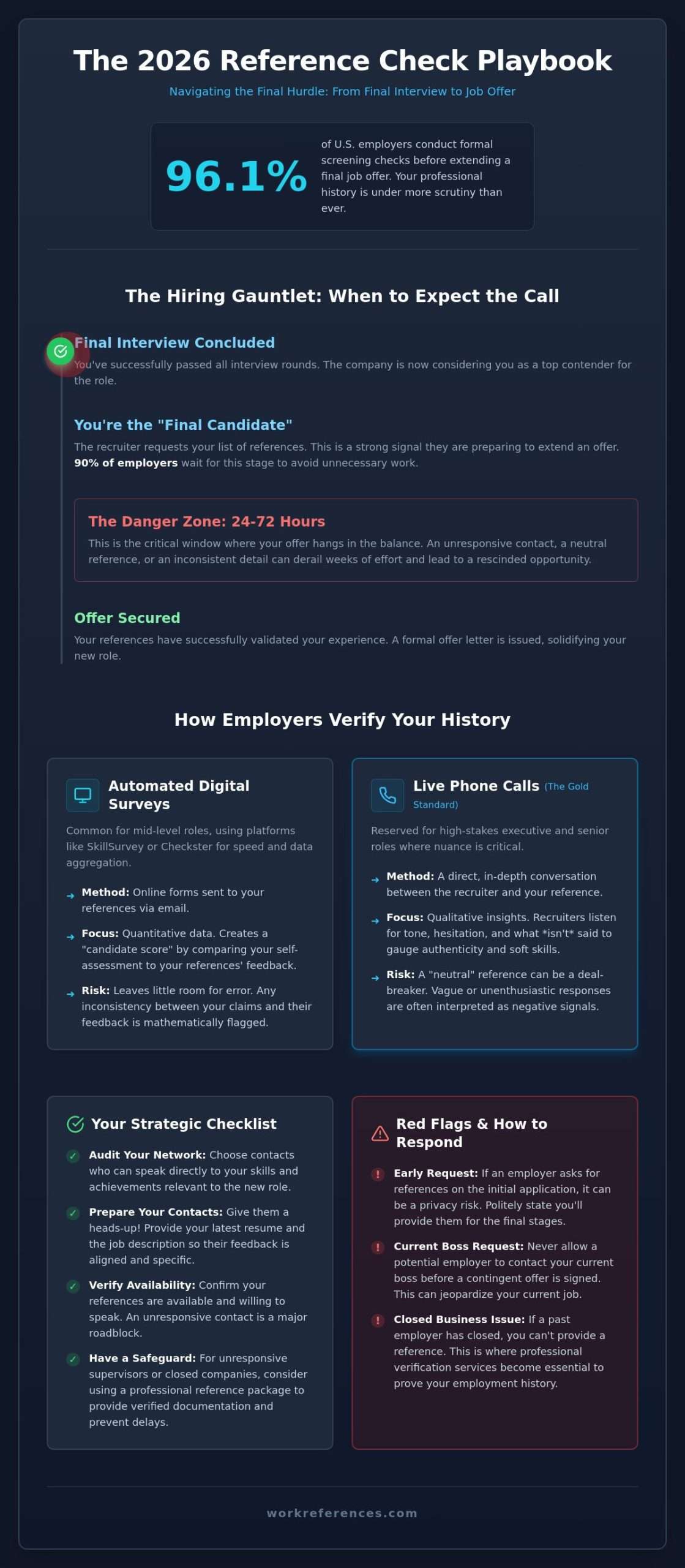
In the high-stakes environment of 2026 hiring, the reference check serves as the final gatekeeper between a candidate and their career advancement. This stage is a validation phase, typically occurring after the final interview has concluded but before a formal offer letter is issued. Knowing when do employers check references is vital because it signals that you’ve reached the “Final Candidate” status. It’s the moment where the recruiter moves from evaluating your potential to verifying your professional integrity.
Approximately 90% of employers adhere to the “Final Candidate” rule. They wait until they are prepared to extend an offer to avoid the administrative burden of checking multiple people. This is part of the broader process of what is a background check, where companies verify that your past performance matches your interview narrative. Once a recruiter asks for your list, the clock starts ticking. You should expect the process to move within a 24 to 48 hour window, especially as more firms adopt automated digital platforms to accelerate hiring.
This period is often called the “Danger Zone.” It’s the final 72 hours of a job search where the psychological stakes are highest. One unresponsive contact or a single inconsistent detail can derail weeks of effort. It’s the moment where professional momentum either solidifies into a contract or evaporates into a rescinded opportunity. You aren’t just waiting for a phone call; you’re waiting for your professional history to be sanctioned by a third party.
Standard vs. Accelerated Timelines
Recruitment speed varies by industry. High-volume recruiters might check references before the first interview to filter massive applicant pools. Conversely, executive-level roles often involve deeper, more methodical verification that occurs much later. In some cases, you might receive a “Contingent Offer,” meaning the check happens after you’ve signed. The job only becomes yours once your history is validated.
Red Flags in the Timing
Timing can also signal underlying organizational issues. If an employer asks for references in the initial application, view it with caution. Early-stage reference requests are a potential privacy risk for candidates. Similarly, if a recruiter asks to speak to your current boss before an offer is on the table, you must set boundaries. A premature call can jeopardize your current standing. If you face a hostile supervisor or a company that has shuttered its doors, exploring a Professional Reference Package can provide the necessary security to keep your timeline on track and your reputation protected.
How Employers Verify Your History: Phone Calls vs. Digital Surveys
While the timeline of when do employers check references is usually predictable, the methods they use have become increasingly sophisticated. By 2026, the industry has split into two distinct paths: automated data aggregation and high-touch professional inquiry. For many mid-level positions, recruiters rely on platforms like SkillSurvey or Checkster. These systems send digital surveys to your list, collecting feedback that is then distilled into a candidate score. This mathematical approach tracks consistency between your self-reported skills and your references’ assessments, leaving little room for error.
High-stakes executive roles still demand the “Gold Standard” of a live phone call. Recruiters at this level are trained to listen for what isn’t said. A three-second hesitation before answering a question about your reliability can be as damaging as a negative comment. They follow rigorous procedures similar to those outlined in federal pre-employment reference checks to ensure every detail is validated. Understanding the methodology behind these checks is just as important as knowing when do employers check references, as the format dictates how you should prepare your contacts.
The Anatomy of a Professional Reference Call
Recruiters don’t just ask if you were a good employee. They dig into specific scenarios to uncover soft skills and emotional intelligence. They might ask for examples of how you handled a conflict or managed a failing project. Your references’ tone of voice and speed of response are interpreted as indicators of authenticity. HR professionals are trained to spot coached answers. If you’re concerned about how these conversations actually unfold, you can read more about the 2026 reality in our guide: Do Jobs Actually Call References?
Digital Verification: The ‘Behavioral’ Reference
Digital platforms require a diverse list of “Reference Workers” to create a 360-degree view of your performance. These surveys are designed to flag outliers. If four references rate you highly on leadership but one rates you poorly, the system highlights the inconsistency. In 2026, your resume must align perfectly with this data cloud, as any deviation is flagged by AI-driven screening tools. This makes it vital to have a consistent, professional paper trail for every role you’ve held.
The most dangerous part of the process is the “Off the Record” check. Sophisticated recruiters often use their own professional networks to find “backdoor references” who you didn’t list. This is where automated systems fail and where professional consistency becomes your only defense. WorkReferences bridges this gap by providing live-answered verification that maintains the integrity of your narrative, even when your former companies are no longer reachable. If you’re unsure if your current list can withstand this level of scrutiny, it’s time to consult with a career advocate to secure your professional standing.
Why the Timing of Reference Checks Matters for Your Job Offer
A common misconception in the hiring world is that a request for references is a guarantee of a job offer. In reality, this stage is often used as a critical tie-breaker. When a hiring committee is split between two equally qualified candidates, they will frequently conduct simultaneous checks to see which professional history presents the least risk. Understanding when do employers check references is vital because it marks the moment your technical skills take a backseat to your professional reputation. If your references are lukewarm while your competitor’s are glowing, the offer will go to the other candidate every time.
The danger often lies in the “neutral” reference. In a high-stakes market, a former manager who simply confirms your dates of employment and job title can be just as damaging as a negative review. Recruiters interpret a lack of enthusiasm as a red flag. They’re looking for validation of your soft skills and reliability. If you’ve reached the stage where you’re asking when do employers check references, you must ensure your narrative remains positive through the finish line. This is where a “Vigilant Career Advocate” becomes essential, acting as a strategic partner to ensure your history is presented with the authority it deserves.
Sudden silence is the most reliable indicator of a verification problem. If you provided your list 48 to 72 hours ago and haven’t heard back, the process has likely stalled. Recruiters rarely wait more than three days for a response before moving to their second-choice candidate. This silence usually means a reference is unreachable, unresponsive, or provided information that contradicted your resume. You cannot afford to let your career momentum die because of a missed connection.
The Cost of a Delayed Reference
Recruiters are often measured by “time-to-fill” metrics. If a former manager is on vacation or simply ignores the outreach, the hiring manager may assume you’re hiding something or that you don’t have a strong enough relationship with your past supervisors. Following the “72-Hour Rule” is critical; if the check isn’t completed in this window, the risk of a rescinded offer increases exponentially. Professional answering services eliminate this risk by providing a guaranteed, live-answered point of contact that ensures the recruiter gets the data they need immediately.
Managing the ‘Current Employer’ Dilemma
Protecting your current job while allowing for a thorough background check is a delicate balance. You don’t want to alert your current supervisor until a written offer is in hand. To navigate this, you can provide a third-party verification source that validates your current tenure without triggering an internal HR alarm. Utilizing specific WorkReferences Services allows you to offer discreet verification options, ensuring your job search remains confidential while still providing the legitimacy the new employer requires.
Strategic Preparation: What to Do Before the Reference Check Happens
Preparation for the final stage of hiring must begin long before the recruiter asks for your contact list. By the time you are asking when do employers check references, the window for strategic defense has nearly closed. Successful candidates treat this phase as a proactive verification project rather than a passive formality. You must ensure that every person on your list is not only willing to speak but is also equipped with the specific narrative required to secure your new role.
To navigate this high-stakes hurdle, follow a methodical five-step preparation plan:
- Audit your list: Critically evaluate every contact to ensure they are truly in your corner and capable of discussing your recent achievements.
- Re-establish contact: Reach out personally to confirm their availability and provide them with your updated resume and the new job description.
- Address burned bridges: Identify potential negative feedback early and develop a strategy to mitigate it before the recruiter makes the call.
- Verify closed companies: Secure third-party verification services to bridge the gap for employers that no longer exist.
- Align for consistency: Ensure your resume dates, titles, and responsibilities match exactly what your references will report.
The Pre-Check Audit
A documented ‘test call’ to your own references can reveal hidden career risks that would otherwise remain invisible until your offer is rescinded. This audit allows you to hear exactly how a former manager describes your performance and reliability. If you encounter neutral feedback, which recruiters often interpret as a lack of endorsement, you must decide whether to coach that reference or replace them entirely. For candidates dealing with legacy companies, specialized resources such as References for Closed Companies can provide the necessary legitimacy when a physical office is no longer there to answer the phone.
Handling Unavailable or Hostile Supervisors
You don’t always leave on perfect terms, and managers often move on to new roles where they are unreachable. When a recruiter asks when do employers check references, be prepared with a script to explain these gaps. For example: “My previous supervisor has transitioned to a role with restricted phone access; however, I can provide a verified third-party confirmation of my tenure and performance.”
In cases involving a hostile supervisor, an Executive Reference Package offers a sophisticated safeguard by providing a professional, live-answered alternative that focuses on factual performance. You can also use the “Front-Loading” technique by providing documented commendations and performance reviews early in the interview process to preempt any potential negative calls. If you suspect a former supervisor might provide a neutral or damaging report, contact our career advocates to secure your professional narrative today.
Securing Your Offer with Professional Reference Verification
Reaching the final stage of the hiring process is a significant achievement, but it’s also where the most critical professional risks emerge. Proactive reference management is the ultimate safeguard for your career because it removes the element of chance from your background check. While you now understand when do employers check references, simply knowing the timeline isn’t enough. You must ensure that the information transmitted during that window is accurate, professional, and perfectly aligned with your resume.
In a digital-first world dominated by automated surveys, a live-answered, professional verification source provides a level of legitimacy that software cannot replicate. Recruiters appreciate the speed. This approach prevents the “ghosting penalty” that occurs when a former supervisor fails to respond within the standard 48 to 72 hour window. By providing a stable, third-party confirmation of your work history, you effectively eliminate the administrative delays that often lead to rescinded offers.
The WorkReferences Advantage
As your Vigilant Career Advocate, we work behind the scenes to ensure your professional narrative remains intact. There is a profound sense of peace that comes from knowing exactly what is being confirmed to a potential employer. Depending on your current career stage, you can select a level of protection that matches your professional stakes:
- Basic Reference Package: Ideal for entry-level roles or verifying specific dates of employment.
- Professional Reference Package: Designed for mid-career transitions where performance consistency is key.
- Executive Reference Package: A high-touch solution for C-suite candidates navigating complex, high-stakes background checks.
Selecting the right tier ensures your history is validated with the appropriate level of authority. You can explore the specific benefits of each tier by visiting WorkReferences Pricing to help you select your safeguard tier.
Taking Control of Your Professional Narrative
The transition from a hopeful applicant to a verified professional is a psychological shift that changes the dynamic of your final meetings. When you know your background is secure, you can pivot from the uncertainty of the reference check to the strategic leverage of salary negotiation. You aren’t just asking for a job. You’re finalizing a professional partnership backed by a validated history. This confidence is palpable to hiring managers and often leads to more favorable contract terms.
Don’t leave your career advancement to the whims of an unresponsive former manager or a closed company’s missing records. Take the final step toward your new role with absolute certainty. Contact WorkReferences today to secure your references and land the offer you’ve worked so hard to earn.
Master the Final Phase of Your Job Search
The transition from a candidate to a new hire depends entirely on the integrity of your professional verification. Understanding exactly when do employers check references allows you to time your preparation with precision, ensuring your narrative remains consistent when the recruiter finally makes the call. You’ve moved beyond the grueling interview rounds; now you must protect the progress you’ve made by resolving gaps from closed companies and managing unresponsive supervisors before they stall your momentum.
WorkReferences has provided trusted professional verification since 2005, acting as a strategic partner to secure your career advancement. We offer live phone answering for all reference checks and essential third-party confirmation for defunct or closed companies, ensuring no logistical hurdle stands between you and your contract. Don’t leave your professional reputation to chance in the final 72 hours of the hiring cycle. You’ve done the hard work; now it’s time to finalize the win. Secure your job offer with a Professional Reference Package and move forward with the confidence of a verified professional.
Frequently Asked Questions
Can an employer check my references without telling me first?
Yes, employers can and often do conduct “backdoor” reference checks through their own professional networks without your explicit permission. While formal background checks typically require your written consent, nothing prevents a recruiter from reaching out to shared contacts on LinkedIn or within the industry. This is why maintaining a consistent professional reputation is vital, as information can surface long before you are officially asked for a reference list.
What happens if a prospective employer can’t reach my references?
Recruiters typically wait between 48 and 72 hours for a response before they consider a reference unreachable. If your contacts don’t respond within this window, the hiring manager may assume you’re unorganized or that the reference is unwilling to vouch for you. This often leads to the recruiter moving forward with their second-choice candidate to avoid stalling the filling of the position.
Do jobs call every reference on my list or just one?
Most employers aim to contact at least two or three references to ensure a consistent narrative of your performance. They aren’t looking for a single opinion; they want to see a pattern of reliability and skill across different roles. If the first two calls provide conflicting information, the recruiter will almost certainly call a third or fourth person to resolve the discrepancy and mitigate hiring risk.
Is it a good sign if an employer asks for my references?
It is an excellent sign, as it indicates you’ve reached the final stage of the selection process. Understanding when do employers check references is key here; it usually happens only when you’re the preferred candidate or one of the final two. This request signals that the employer is ready to move toward an offer, provided your professional history validates your interview performance.
How far back do employers go for reference checks in 2026?
Standard practice in 2026 involves verifying the last seven years of your career or your three most recent positions. Employers prioritize your most recent experience because it’s the best predictor of your current skill level. For executive roles, the scrutiny may extend further to ensure a long-term pattern of integrity and leadership across multiple organizations and varying market conditions.
Can I use a colleague if my former supervisor is unavailable?
You can use a peer or colleague, but you should explain the supervisor’s absence to the recruiter first. While a peer can speak to your teamwork, a supervisor’s perspective carries more weight regarding your accountability and results. If your manager is truly unreachable, providing a professional verification from a third-party service can bridge this gap and maintain your credibility throughout the process.
What should I do if I know a former boss will give me a bad reference?
Don’t list a hostile supervisor as a primary contact if you can avoid it. Instead, provide references from other managers or senior leaders at the same company who can offer a balanced view. If the company requires a specific manager’s input, utilizing a professional reference package ensures that the verification remains focused on factual performance rather than personal grievances or subjective bias.
Do employers check references for internal promotions?
Formal external reference checks are rare for internal moves, but the process is actually more rigorous. Hiring managers will review your internal performance evaluations and speak with your current supervisor. In these cases, your daily work history acts as a living reference. Any inconsistencies in your internal reputation will be scrutinized just as heavily as an external check from a previous employer.
Article by
William Schmidt
William Schmidt is a former Fortune 500 recruiter and founder of WorkReferences.com, a pioneering employment verification and professional reference service established in 2009. With extensive experience working alongside hiring managers, recruiters, and background screening agencies, he helps job seekers overcome career obstacles through credible, third-party verification solutions that strengthen resumes and restore confidence in the hiring process