

What if the only thing standing between you and your dream role isn’t your professional skillset, but a phone call you aren’t allowed to hear? It’s a high-stakes scenario that leaves many job seekers feeling powerless and deeply anxious about their future. You’ve likely asked yourself: can a former employer give a bad reference and legally derail your career? While the law generally protects truthful statements, the line between a performance review and illegal defamation is often thinner than you think.
We recognize the stress of knowing your hard work might be overshadowed by a supervisor’s personal bias. You deserve a hiring process that values your actual contributions over a former manager’s opinion. This article clarifies your legal rights regarding defamation and “qualified privilege,” while also highlighting the 23 states that currently enforce strict anti-blacklisting laws as of 2026. You’ll learn how to identify a hostile reference and discover a strategic roadmap to bypass a difficult supervisor. We’ll provide the tools you need to secure your reputation and ensure your work history remains a professional asset rather than a liability.
Key Takeaways
- Understand the legal distinction between a critical performance review and illegal defamation to ensure your rights are protected during background checks.
- Discover the definitive answer to the question “can a former employer give a bad reference” by exploring how truth acts as a defense for employers and where state blacklisting laws draw the line.
- Learn why internal “neutral reference” policies often fail to stop “off-the-record” feedback and how to identify when a manager’s silence is intentionally damaging your prospects.
- Master a strategic recovery plan that involves pivoting to alternative references, such as clients or vendors, to maintain your professional credibility when a supervisor is hostile.
- Explore how a Professional Reference Package provides a secure, third-party verification of your employment history to counteract personal bias from former supervisors.
The Legal Reality: Can a Former Employer Give a Bad Reference?
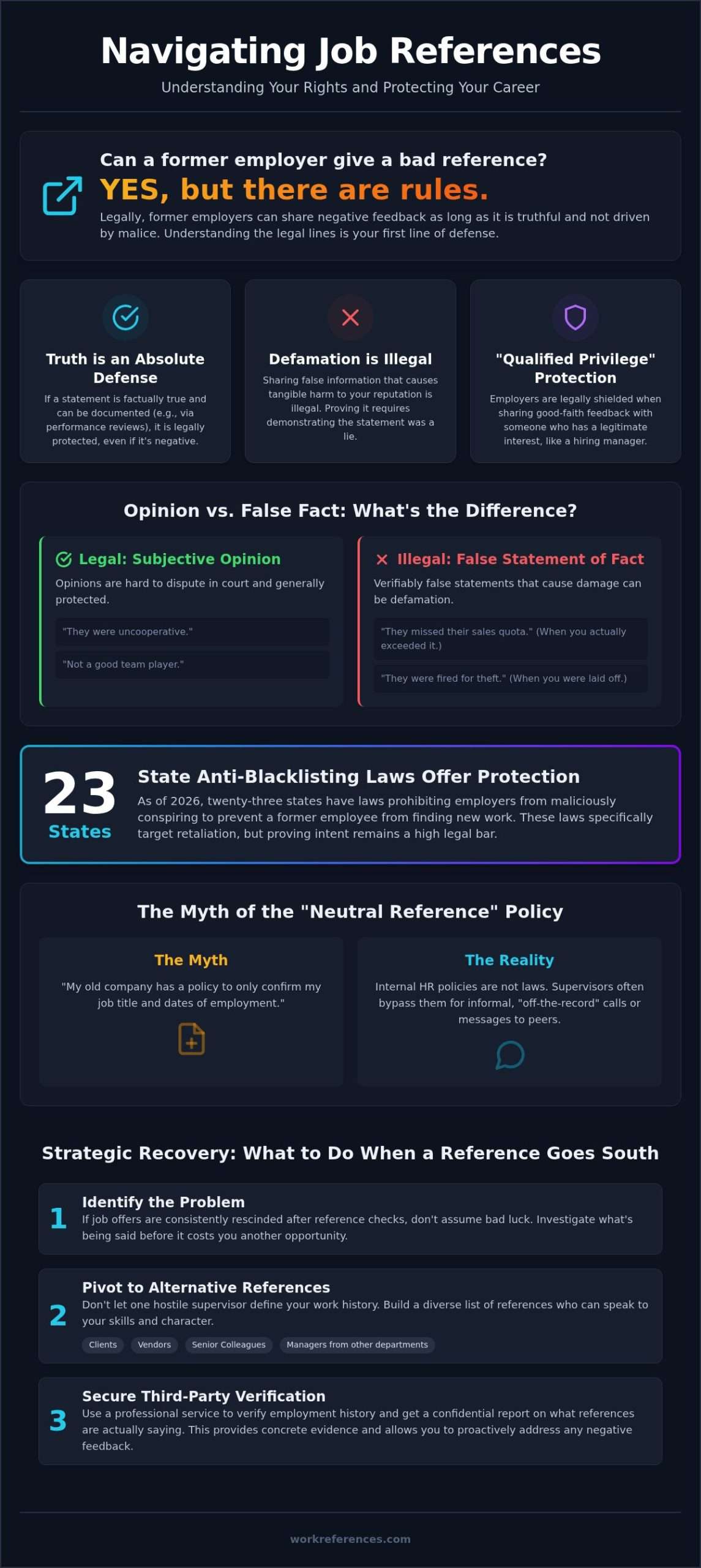
The short answer to the question “can a former employer give a bad reference” is an uncomfortable yes. Under current legal standards, truth serves as an absolute defense against defamation claims. If a former supervisor provides documented, factual evidence of poor performance or misconduct, they remain within their legal rights. This reality often creates significant anxiety for professionals transitioning between roles, as a single conversation can jeopardize months of networking. You aren’t powerless, but you must understand the rules of the game to protect your future.
Employers are further protected by a concept known as qualified privilege. This legal shield allows managers to share information in good faith with parties who have a legitimate interest, such as a prospective hiring manager. To overcome this protection, an employee must demonstrate that the statements made were not only false but also motivated by actual malice. The framework for these disputes is rooted in U.S. defamation law, which requires proving that the employer knowingly shared falsehoods that caused measurable professional damage. Without clear evidence of a lie, the law typically sides with the employer’s right to provide feedback.
Truth vs. Defamation in Professional Feedback
Defamation is the intentional sharing of false information that causes tangible harm to a person’s reputation. Proving this in a corporate context is notoriously difficult because the law distinguishes between objective facts and subjective opinions. For instance, a manager stating you were “uncooperative” is sharing an opinion, which is nearly impossible to litigate. However, claiming you failed to meet a specific sales quota when you actually exceeded it constitutes a false factual statement. Most organizations rely on performance reviews and formal warnings to provide a paper trail of legal cover, ensuring their feedback remains protected under the truth defense.
State Blacklisting Laws and Retaliation
While employers have broad leeway, they cannot use references as a tool for illegal retaliation. As of June 2026, 23 states have active blacklisting laws that prohibit employers from conspiring to prevent a former staff member from securing new work. These laws specifically target malicious intent. Proving malice is the highest hurdle in any legal challenge; you must show the supervisor intended to cause harm rather than simply providing an honest assessment. If you suspect your career is being sabotaged, securing a Professional Reference Package can help you verify exactly what is being said behind closed doors before a job offer is rescinded. Identifying the problem is the first step toward neutralizing a hostile supervisor.
The Myth of the “Neutral Reference” Policy
Many job seekers believe a dangerous misconception: that their former company is legally restricted to confirming only dates of employment and job titles. This is false. While many HR departments implement “neutral reference” policies to minimize litigation risk, these are internal guidelines rather than federal mandates. If you are wondering, “can a former employer give a bad reference,” you must realize that a policy is not a legal shield. A manager can choose to ignore company rules, and their honesty is generally protected by the law as long as they stick to the truth.
It is specifically illegal to give a negative or false employment reference if that feedback is based on protected characteristics like race, religion, or disability. Outside of these specific civil rights protections, however, a manager’s honest assessment of your work remains largely legal. You cannot rely on a corporate handbook to keep a hostile supervisor from sharing their perspective with a peer in your industry.
Why HR Policies Fail to Protect You
Managers often feel a personal obligation to “warn” peers about a difficult hire. They might ignore HR’s “dates and titles only” rule during an informal phone call or a private LinkedIn message. This “backdoor reference check” is becoming the standard in modern networking. Recruiters frequently bypass formal HR channels to speak directly with former colleagues or mutual connections. Many candidates ask can a former employer give a bad reference when they know a “neutral policy” is in place, but they forget about the human element. In some cases, a former boss’s refusal to comment speaks louder than a detailed critique. A recruiter hearing “I am only authorized to confirm dates” often interprets that silence as a strategic negative signal. It suggests there is a story the manager is afraid to tell. Silence speaks volumes.
The Risk of Inconsistent Information
Your professional narrative must be bulletproof. If your resume lists responsibilities or titles that your former employer’s HR department won’t verify, you risk being flagged for dishonesty. Achieving Resume and Reference Consistency is vital for passing modern background checks. Discrepancies in job titles or end dates can derail an offer even if the actual performance feedback was neutral. Professional verification services help you identify these gaps before they reach a recruiter. If you suspect your former manager is leaking “off-the-record” feedback despite company policy, you should consult with a professional advocate to discuss your options. Securing your reputation requires knowing exactly what is being said behind the scenes.
Red Flags: How to Tell if a Reference is Sabotaging Your Job Offer
The most frustrating moment in a job search occurs when a high-probability lead suddenly evaporates. You’ve cleared the technical hurdles and built rapport with the team. Then, following the request for your list of supervisors, the communication stops. Many candidates in this position feel a mounting sense of dread, asking themselves: can a former employer give a bad reference even after things seemed so positive? The answer is often found in the subtle, non-verbal cues provided during a reference call rather than an outright lie.
Recruiters are trained to listen for more than just facts. They pay close attention to tone, hesitation, and what is left unsaid. A “stealth” bad reference often takes the form of faint praise. If a former manager describes your work as “adequate” or notes that you were “usually on time,” they’re sending a strategic negative signal. In a competitive market, “fine” is often synonymous with “don’t hire.” These coded messages allow supervisors to damage your prospects while technically remaining within the boundaries of a truthful assessment.
The Anatomy of a Rescinded Job Offer
A reference-related rejection typically follows a specific, painful timeline: a verbal expression of intent is followed by 48 to 72 hours of silence, concluding with a generic email stating the company has “decided to move in another direction.” Employers rarely disclose the specific feedback that led to this decision because they want to avoid potential litigation. This lack of transparency leaves you in the dark, unable to defend your reputation or correct a misunderstanding. You must ensure your reference list is verified and safe before you ever hand it over to a prospective employer.
Auditing Your References
To regain control, you need to know exactly what is being said about you behind closed doors. Many large organizations, such as those following a formal Employment Reference Policy, have strict rules about who can speak for the company. Despite these rules, individual managers often go “off-script.” Using third-party verification allows you to conduct a professional audit of your former supervisors. This process identifies the specific weak link in your professional chain, allowing you to remove a hostile manager from your list before they can cause further damage. Exploring WorkReferences Services provides a legitimate way to safeguard your career by confirming the exact nature of the feedback being provided to your future employers. You shouldn’t have to guess why you’re losing opportunities.
Strategic Recovery: What to Do When a Reference Goes South
Discovering that a past supervisor is actively hindering your progress is a professional crisis. It forces you to revisit the central question: can a former employer give a bad reference and get away with it? While they can, you don’t have to accept the damage as permanent. Recovery requires a calculated, multi-step strategy to neutralize the negative feedback and restore your professional standing. You must move from a defensive posture to a proactive one to ensure your next job offer isn’t lost to a single phone call.
The first step involves a professional confrontation, but only if the relationship isn’t entirely toxic. Sometimes, a calm conversation about what they are willing to share can resolve the issue. If that fails, you must pivot immediately. Shift your reference list to include alternative voices such as long-term clients, vendors, or high-level peers who can attest to your results. Finally, you must prepare to address the “elephant in the room” with your new hiring manager before they reach out to that hostile supervisor. By framing the past conflict as a difference in management philosophy, you maintain control of the narrative.
The “Cease and Desist” vs. The Professional Pivot
Legal threats often feel like the most direct response to a bad reference. However, sending a cease and desist letter can backfire by making you appear litigious to future employers. It’s often more effective to establish a new baseline of credibility. Using a Professional Reference Package allows you to document your history through verified, third-party channels. This approach provides a balanced view of your career that outweighs the bias of one difficult manager. “Reference Workers” act as professional proxies, ensuring your work history is validated without the risk of personal vendettas interfering with the process.
Communicating with Potential Employers
When you know a negative reference is likely, transparency is your best defense. Don’t wait for the recruiter to find the problem; bring it up during the final interview stage. Describe the situation as a mismatch in management style rather than a failure of performance. You can counter a negative verbal reference by offering supplemental documentation, such as past awards or written performance reviews from other years. The team at WorkReferences understands these hurdles and acts as a sophisticated guide to help you navigate them. If you’re ready to secure your professional reputation and move forward with confidence, speak with a professional advocate today to stabilize your career history.
Securing Your Professional Reputation with Third-Party Verification
The persistent worry regarding whether can a former employer give a bad reference often stems from a lack of control over the verification process. In an era where background checks are increasingly rigorous, leaving your professional fate to a potentially biased individual is a significant career risk. A professional reference service acts as a legitimate safeguard, ensuring that your employment history is presented with procedural integrity and corporate compliance. This isn’t about hiding the past; it’s about validating your contributions through a structured, objective channel that prospective employers can trust.
One of the most challenging hurdles in modern hiring occurs when a former employer is no longer in business or a specific manager has become unreachable. Recruiters often view unverified gaps in work history with suspicion, yet you cannot provide a reference for a company that no longer exists. This is where professional verification becomes essential. By acting as a credible third-party, WorkReferences bridges this gap, providing the verification needed to maintain your professional momentum even when the original source is gone. This level of verification provides the stability and authenticity that modern HR departments require.
The WorkReferences Advantage
The Professional Reference Package is designed to provide a consistent, authoritative voice for your career history. Unlike informal personal references that may vary in quality or availability, this service ensures that every inquiry is met with professional decorum and industry-speak. A critical component of this trust is live phone answering. In a world of automated menus and unreturned emails, having a real professional handle verification requests ensures that your potential employer receives immediate, high-quality confirmation of your work history. For those struggling with defunct organizations, our specialized guide on References for Closed Companies details exactly how to secure your history in the 2026 market.
Taking Control of Your Career Narrative
You shouldn’t leave your future in the hands of a disgruntled former boss or an HR department that is difficult to reach. The peace of mind that comes from knowing your references are secure allows you to interview with a feeling of prepared confidence. By utilizing a dedicated team to handle verification requests, you eliminate the “sudden silence” and “faint praise” red flags that so often derail high-stakes job offers. This is a strategic partnership intended to facilitate your advancement by removing the hidden hurdles of the hiring world. Contact WorkReferences to secure your professional reputation today and ensure your hard-earned work history remains a protected asset.
Take Control of Your Professional Reputation
You’ve worked too hard to let a single biased supervisor dictate the trajectory of your career. While the legal answer to “can a former employer give a bad reference” is often yes, you aren’t forced to remain vulnerable to their personal vendettas or “off-the-record” comments. Understanding that corporate policies often fail to protect you is the first step toward true professional security. By pivoting to alternative references and utilizing structured verification, you ensure your work history is validated with the procedural integrity it deserves.
We provide a national service backed by over 20 years of career advocacy experience to help you bridge the gap between your past and your future. Our system utilizes live phone answering for all reference checks, offering legitimate third-party employment verification that prospective employers trust. Don’t leave your next opportunity to chance. Secure your professional future-get a Professional Reference Package today. You have the right to a fair hiring process, and we are here to help you claim it with confidence.
Frequently Asked Questions
Is it illegal for a former employer to give a bad reference if it is true?
No, it is not illegal. Truth serves as an absolute defense against defamation claims in the United States. If your former supervisor provides factual, documented information regarding poor performance or attendance, they are protected by law. This is why many candidates ask, can a former employer give a bad reference even if they have a neutral policy. The law prioritizes the employer’s right to share honest feedback with other businesses.
Can my old boss say I was fired even if I quit?
No, providing false information about the reason for your departure is a form of defamation. If you resigned and your former manager tells a recruiter you were terminated for cause, they have made a false statement of fact. Across various jurisdictions, this type of misrepresentation can be a specific violation of labor regulations. Such actions can lead to legal liability if you can prove the lie caused you to lose a job opportunity.
What if my former company has closed down and I need a reference?
When a business is defunct, you must rely on third-party verification to bridge the gap. Prospective employers still require confirmation of your titles and dates of service to satisfy their compliance standards. You can utilize professional employment verification packages to provide a legitimate point of contact. This ensures that a closed office doesn’t create a suspicious hole in your work history or stop your background check from clearing.
How can I find out what my former employer is actually saying about me?
The most effective way to uncover the truth is through a professional reference audit. You cannot rely on what a manager promised to say during your exit interview. A third-party service can contact your former supervisor to document their actual tone and the specific details they share. This process identifies potential red flags, allowing you to address or remove a hostile reference before you lose another offer.
Can I sue a former employer for a bad reference?
You can only sue if you can prove the information shared was both false and provided with malicious intent. The burden of proof rests entirely on the employee, which makes these cases notoriously difficult to win. You must demonstrate that the employer knowingly lied to prevent you from gaining employment. Most legal professionals suggest using a professional advocate to stabilize your reputation rather than pursuing expensive and public litigation.
Do employers actually call references for every job offer?
Most organizations conduct reference checks for every final-round candidate before extending a formal offer. While some companies only verify dates and titles through HR, many hiring managers prefer to speak directly with former supervisors. They do this to gauge cultural fit and verify the technical claims made during your interviews. In high-stakes executive roles, these checks are almost always exhaustive and include “backdoor” inquiries through mutual connections.
Can I use a co-worker as a reference if my manager hates me?
You can use a peer reference, but it often carries less weight than a supervisor’s perspective. Recruiters typically view a list of only co-workers as a red flag, as it suggests you are hiding a conflict with management. If you must bypass a hostile manager, it is better to use a Professional Reference Package. This provides a consistent, authoritative voice that satisfies the employer’s need for high-level verification without risking a biased supervisor’s input.
What should I do if a job offer is rescinded due to a bad reference?
Immediately request a copy of the background check report to see what was documented. If the offer was rescinded based on a verbal conversation, you should contact a professional verification service to audit that specific reference. Once you identify the falsehood or bias, you can confront the former employer or provide supplemental documentation to the recruiter. Acting quickly is essential to save your reputation and prevent future rejections.
Article by
William Schmidt
William Schmidt is a former Fortune 500 recruiter and founder of WorkReferences.com, a pioneering employment verification and professional reference service established in 2009. With extensive experience working alongside hiring managers, recruiters, and background screening agencies, he helps job seekers overcome career obstacles through credible, third-party verification solutions that strengthen resumes and restore confidence in the hiring process