
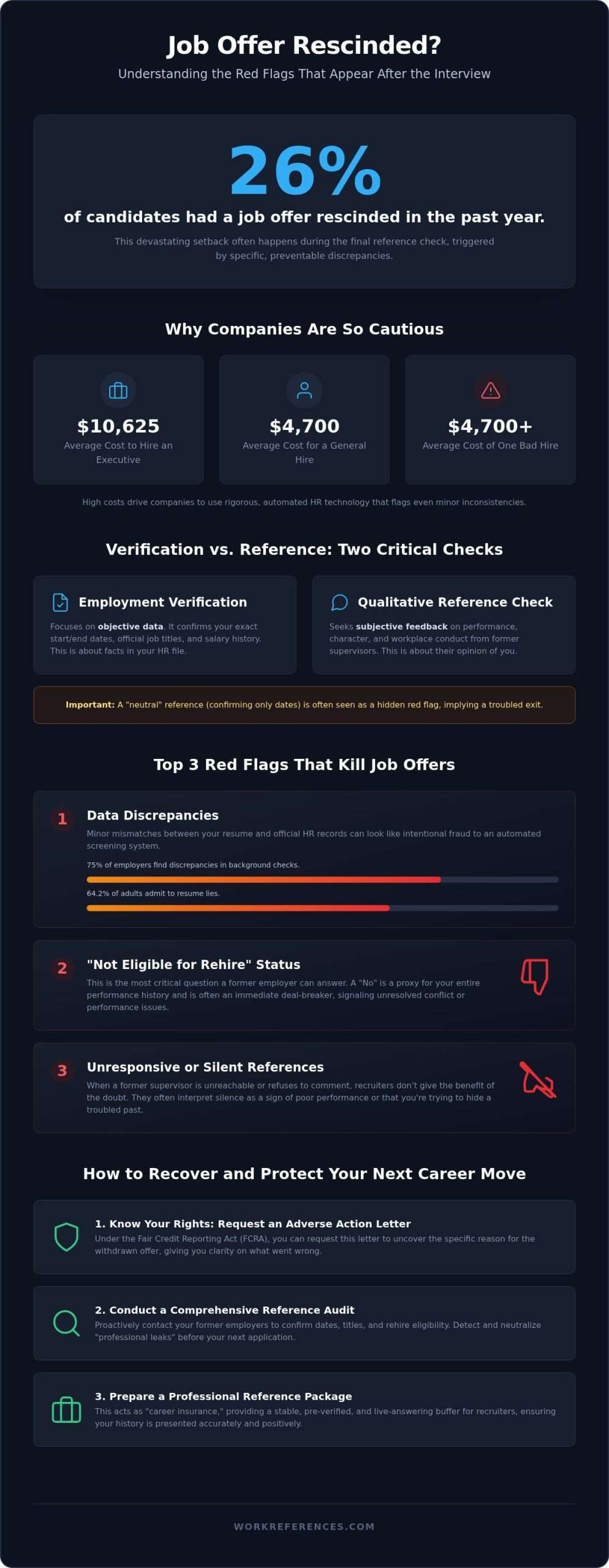
Recent data shows that 26% of candidates had a job offer rescinded within the past year. This statistic is more than a number; it represents a devastating blow to your career momentum and financial security. You’ve navigated the grueling interview process and reached the finish line, only to see the opportunity vanish. It’s a high-stakes moment that leaves many professionals feeling vulnerable and confused about what went wrong behind the scenes.
If you’ve experienced a job offer rescinded after reference check, you’re likely grappling with anxiety over unavailable supervisors or hidden discrepancies in your history. We understand that your professional reputation is your most valuable asset. This article will demystify the specific red flags that trigger late-stage rescindments and outline your legal rights under the Fair Credit Reporting Act. You’ll gain a methodical plan to rehabilitate your professional references and secure a stable offer, transforming a potential setback into a foundation for future career security. We’ll examine how to identify verification gaps and bridge them effectively to ensure your next transition is seamless and successful.
Key Takeaways
- Understand why a job offer rescinded after reference check often stems from technical data mismatches rather than subjective personality clashes.
- Learn the legal boundaries of qualified privilege and how companies protect their right to share professional history.
- Discover the specific steps to request an Adverse Action letter to uncover the true reason behind a withdrawn offer.
- Identify how a Professional Reference Package functions as career insurance by providing a stable, live-answering buffer for recruiters.
- Gain actionable strategies for conducting a comprehensive reference audit to detect and neutralize professional leaks before your next application.
Why a Job Offer is Rescinded After a Reference Check
Entering the pre-boarding phase brings a sense of relief, yet this period is often the most precarious for a candidate. Most professional agreements aren’t finalized until the employer completes their due diligence. If you find your job offer rescinded after reference check, it’s usually because the “contingent” nature of the offer was triggered by a specific discrepancy found during the final vetting stages. Under the at-will employment doctrine, companies maintain the broad latitude to withdraw an offer for any lawful, non-discriminatory reason. This legal framework means that until you actually start your first day, the opportunity remains technically pending.
The Mechanics of the Contingent Offer
A contingent offer is a legally binding yet revocable agreement that depends entirely on the successful completion of secondary screening. Companies wait until this final stage to conduct deep-dive references because of the significant costs and resources involved in thorough vetting. By 2026, the average cost to hire an executive has reached $10,625, while general hires cost approximately $4,700. These high stakes drive employers to use rigorous, data-driven HR technology that flags even minor inconsistencies. Automated platforms now complete these checks in as little as 24 hours, leaving no room for manual errors or unverified claims on a resume.
Reference Check vs. Employment Verification
It’s vital to distinguish between a standard employment background check and a qualitative reference check. Verification focuses on objective data like your exact start dates, end dates, and official job titles. In contrast, a reference check seeks subjective performance feedback and character assessments from former supervisors. You should be aware that a “neutral” reference, where a former boss only confirms your dates of service, can be just as damaging as a negative one in a high-pressure hiring environment. Recruiters often interpret a refusal to provide qualitative feedback as a hidden red flag or a sign of a troubled exit. To safeguard your reputation, you can Learn about our professional verification services to ensure your history is presented accurately and positively. Understanding these mechanisms is the first step toward protecting your career transition from sudden and unexpected reversals.
Common Reference Red Flags That Kill Job Offers in 2026
Finding your job offer rescinded after reference check can feel like a personal rejection, but it’s frequently the result of technical red flags that trigger automated HR safeguards. In 2026, the margin for error is razor-thin. Employers are no longer just looking for a general recommendation; they’re seeking data integrity across all professional touchpoints. When a discrepancy appears, the system often defaults to a “reject” status to protect the company from a bad hire, which now costs an average of $4,700 for non-executive roles.
The Danger of Resume and Reference Mismatches
Even minor date discrepancies can look like intentional fraud to a modern screening system. Research from HireRight in 2025 revealed that over 75% of employers worldwide found discrepancies during background screenings in the previous 12 months. Considering that 64.2% of U.S. adults admit to having lied on a resume according to StandOut-CV, recruiters are on high alert for any data that doesn’t align perfectly. When your resume states you started in January but the official HR record says March, it creates a trust gap that is difficult to bridge. This is why aligning your professional documents with your actual HR file is essential. You can review The Critical Guide to Resume and Reference Consistency in 2026 to ensure your paperwork is airtight.
Beyond dates, the most critical question a former employer can answer is whether you are eligible for rehire. This binary response serves as a proxy for your entire performance history. A “no” in this category is often an immediate deal-breaker, regardless of how well you interviewed. It signals unresolved conflict or performance issues that most companies are simply unwilling to risk in a competitive market.
When Former Employers Go Silent
Modern recruiters often view an unresponsive reference as a sign of poor performance or a candidate trying to hide a troubled past. They rely on an objective evaluation of an applicant’s past job performance to validate their hiring decision. If a supervisor has retired, moved to a different industry, or if the company has shuttered entirely, you face a “verification black hole.” This is a common hurdle for those seeking references for closed companies. Without a proactive plan to confirm your history through third-party verification, these silences can derail your career momentum. If you’re concerned about what your professional trail reveals, it’s prudent to speak with a career advocate to secure your history before your next application.
The Legal Reality: At-Will Employment and Reference Disclosure
Many candidates believe it’s illegal for a former employer to give a negative reference. This is a common myth that can lead to a false sense of security. As long as the information provided is truthful, employers generally have the right to share it. In 2026, the at-will employment doctrine remains the standard labor principle in the United States. This allows either the employer or employee to terminate the relationship at any time for any lawful reason. Many modern employment policies, effective January 9, 2026, reinforce this by mandating that formal offers outline all contingencies, such as background and reference checks. If you find your job offer rescinded after reference check, the legal foundation usually rests on these established doctrines.
To protect themselves from litigation, companies rely on the “qualified privilege” doctrine. This legal concept shields employers from defamation claims as long as they provide information in good faith to a party with a legitimate interest, such as a prospective recruiter. While state-level immunity laws vary, they typically encourage honest disclosure to facilitate informed hiring. Defamation only occurs when a former supervisor makes a false statement of fact that causes professional harm. Proving malice or a reckless disregard for the truth is a high legal bar, which is why most companies feel secure in sharing documented performance issues.
What a Former Boss Can Legally Say
Large corporations often adopt “neutral” reference policies, confirming only dates of service and job titles to minimize risk. Smaller firms don’t always follow these strict HR guardrails. A former manager at a small business might offer detailed, subjective feedback that feels personal. It’s vital to distinguish between a protected opinion, such as “they weren’t a good culture fit,” and a defamatory lie. If a boss falsely claims you were terminated for theft when you actually resigned, they’ve crossed a legal line. Identifying this distinction is the first step in addressing a “leaking” reference.
Your Rights Under the Fair Credit Reporting Act (FCRA)
When an employer uses a third-party screening firm, the Fair Credit Reporting Act (FCRA) grants you specific protections. You are entitled to a “Pre-Adverse Action” notice before an offer is officially withdrawn. This notice must include a copy of the background report and a summary of your rights. In 2026, the maximum charge for a consumer disclosure of this report is $16.00. This legal window allows you to dispute factually incorrect data before the rescindment is finalized. If a report contains errors regarding your employment dates or titles, you have the right to demand an immediate correction from the reporting agency.
How to Recover and Protect Your Next Career Move
Recovering from a job offer rescinded after reference check requires a tactical shift from defense to offense. You can’t afford to guess which part of your history failed; you need concrete data to stop the cycle of professional setbacks. The first step is demanding transparency. If an employer used a third-party screening firm, they’re legally obligated under the FCRA to provide an Adverse Action notice. This notice is your primary tool for discovery. It allows you to see exactly what triggered the withdrawal, whether it was a specific supervisor’s comment or a technical date mismatch in the HR file. Without this information, you’re essentially flying blind into your next interview.
The Professional Reference Audit
You can’t fix a leak you haven’t identified. A reference audit involves using a neutral third party to contact your list and document their exact responses. Many candidates discover that a supervisor they considered “safe” is actually providing lukewarm or hesitant feedback that sabotages their candidacy. Recruiters in 2026 are trained to spot these subtle hesitations as red flags. You can explore Do Jobs Actually Call References? The 2026 Reality to understand how modern verification works and why an audit is a necessary safeguard for your reputation.
Bridging Gaps with Professional Verification
Relying on a personal friend to act as a professional reference often fails under high-stakes corporate scrutiny. Modern hiring systems prioritize institutional legitimacy and verifiable data over casual recommendations. This is where the role of professional reference services becomes essential. By providing credible, live-answered verification, you can “pre-clear” your history before it ever reaches a recruiter’s desk. This proactive strategy addresses the “verification black hole” left by closed companies or missing supervisors, ensuring your professional narrative remains consistent and stable.
Once you’ve identified the specific red flags in your history, you must rehabilitate your list with professional alternatives. Look for peer references or clients who can attest to your performance with precision. The goal is to provide a verifiable history that overrides any single point of failure. Don’t leave your next career transition to chance. You should secure your professional reputation today to ensure your next offer remains firm and your career momentum continues uninterrupted.
Securing Your Professional History with WorkReferences
You’ve spent years building your professional reputation; you shouldn’t let a single unverified gap or an unreachable supervisor destroy your career momentum. Finding your job offer rescinded after reference check is a high-stakes crisis that requires more than just “moving on.” It demands a strategic intervention to secure your history. Our Professional Reference Package acts as a critical buffer between you and the unpredictable nature of former employers. By establishing a stable, institutional point of contact, we ensure that your narrative remains in your control, regardless of how a previous company has changed or closed.
Recruiters often view a missed call or a “no-response” result as a definitive red flag. Our Live Phone Answering service eliminates this risk by providing immediate, professional verification that aligns with corporate standards. For those pursuing senior leadership, the stakes are even higher. Research indicates that senior executives fail at twice the rate of other hires, leading companies to implement significantly more rigorous vetting for these roles. Our Executive Reference Package is specifically designed to withstand this level of deep-dive scrutiny, protecting your transition into high-level positions where the average cost of a “bad hire” can exceed $10,000.
Our Process: From Anxiety to Career Security
We believe that career security shouldn’t be a luxury. Our process moves you from a state of concern to prepared confidence by validating your history through established corporate protocols. We don’t just provide a name; we provide a verified professional trail that matches the data in your official HR file. This consistency is reinforced through our Resume Writing and Editing service, which ensures that every date, title, and achievement on your paperwork is perfectly aligned with what a background check will uncover. You can view our reference package pricing to find the safeguard that best fits your current career stage.
Take Control of Your Professional Narrative
Waiting until an offer is withdrawn is a reactive strategy that puts your income at risk. In a volatile market, a proactive “Vigilant Career Advocate” approach is the only way to guarantee your professional outcomes. By securing your references now, you’re investing in a career insurance policy that neutralizes potential leaks before they can sabotage your next opportunity. We act as your strategic partner, navigating the hidden hurdles of the hiring world so you don’t have to. Don’t leave your future to the whims of a former boss or an automated screening system. You should contact WorkReferences today to secure your next job offer and ensure your professional history works for you, not against you.
Securing Your Professional Future
Navigating a career transition requires more than just a polished resume; it demands a fortified professional history. You now understand that a job offer rescinded after reference check is often the result of technical discrepancies or verification silences rather than personal failure. By recognizing the legal standard of at-will employment and the rigor of 2026 HR technology, you can shift from a state of vulnerability to one of prepared confidence. Taking control of your narrative through a reference audit and proactive verification ensures that no “verification black hole” can derail your progress.
WorkReferences brings over 20 years of experience in professional career documentation to your side. We provide specialized support for cases involving defunct companies or unavailable supervisors, ensuring your history is never left to chance. With live phone answering for all professional reference checks, we act as your vigilant advocate in a high-stakes market. Don’t let unpredictable former bosses or administrative errors dictate your career path. You have the power to stabilize your trajectory and move forward with absolute certainty.
Protect your career and secure your next offer; Contact WorkReferences today. Your next professional milestone is within reach, and we’re here to help you secure it.
Frequently Asked Questions
Can a company rescind a job offer after I have already started working?
Yes, an employer can terminate your employment even after you’ve started, typically citing the failure of a contingency period. Under the at-will doctrine, the relationship can end for any lawful reason. If a late-stage reference check uncovers discrepancies, the company may choose to end the contract immediately. This is why securing your history before your start date is a critical safeguard for your career momentum.
How do I know if a bad reference is what caused my offer to be rescinded?
You can identify the cause by requesting an Adverse Action notice if the employer used a third-party screening agency. This document is legally required under the FCRA and will detail the specific report that influenced the decision. If the check was conducted internally, you may ask the recruiter for a specific reason for the job offer rescinded after reference check, though they aren’t always legally obligated to provide subjective details.
What should I do if my former company has gone out of business?
You should provide alternative documentation such as W-2 forms or tax records to prove your tenure. Since recruiters cannot contact a defunct entity, this creates a verification black hole. Using a professional verification service that offers live phone answering can bridge this gap by providing a legitimate, third-party confirmation of your work history. This ensures your professional narrative isn’t halted by administrative hurdles beyond your control.
Can I sue a former employer for giving me a bad reference?
You can only pursue legal action if the former employer provided false statements of fact that constitute defamation. Truthful negative feedback is generally protected under the qualified privilege doctrine. Most companies avoid lawsuits by sticking to documented performance issues. Proving malice or reckless disregard for the truth is a high legal burden, making professional rehabilitation a more effective strategy than litigation for most candidates.
Is it better to leave a bad boss off my reference list entirely?
It is generally advisable to omit a supervisor who cannot provide a supportive account of your performance. However, recruiters in 2026 frequently conduct backdoor checks by contacting mutual connections not on your official list. Instead of simply leaving a gap, you should secure professional alternatives who can speak to your institutional value. This proactive approach prevents a single negative voice from dominating your professional narrative or sabotaging your next offer.
How long does a typical reference check take in 2026?
Digital verification platforms in 2026 typically complete checks within 24 to 48 hours with an 85% to 90% response rate. Manual, phone-based methods can still take 4 to 10 days depending on the responsiveness of your former supervisors. This increased speed means that any discrepancy is flagged almost instantly, leaving you very little time to address issues before an offer is finalized. Professional verification ensures these checks don’t stall your hiring process.
What is an Adverse Action notice and why is it important?
An Adverse Action notice is a mandatory legal document that an employer must provide if a third-party background report leads to a rescinded offer. It is important because it grants you the right to review the information used against you and dispute any factual inaccuracies. This notice provides a narrow window to correct errors regarding your job titles or dates before the professional setback becomes permanent and impacts your future candidacy.
Can a recruiter call someone I did not list as a reference?
Yes, recruiters are increasingly conducting backdoor reference checks through mutual professional connections or LinkedIn networks. While you provide an official list, they aren’t legally barred from seeking independent verification of your performance. This trend makes it essential to maintain a consistent professional reputation across your entire network. A job offer rescinded after reference check often occurs when these unofficial sources provide feedback that contradicts your formal references.
Article by
William Schmidt
William Schmidt is a former Fortune 500 recruiter and founder of WorkReferences.com, a pioneering employment verification and professional reference service established in 2009. With extensive experience working alongside hiring managers, recruiters, and background screening agencies, he helps job seekers overcome career obstacles through credible, third-party verification solutions that strengthen resumes and restore confidence in the hiring process