
What if the only thing standing between you and your next executive offer isn’t your skill set, but a single phone call you aren’t even invited to hear? For many high-performing professionals, the final stage of the hiring process becomes a black hole where momentum mysteriously dies. You’ve likely felt the sting of a perfect opportunity vanishing after the background check. It’s frustrating to realize that 96% of employers are conducting these screenings. Learning how to check your own references is no longer a luxury; it’s a mandatory safeguard for your income and your professional identity.
We understand that silence from recruiters is more than just an inconvenience; it’s a direct threat to your career stability and peace of mind. This strategic guide provides the exact methods you need to identify, verify, and neutralize negative employment references before they ever reach a hiring manager’s desk. You’ll learn how to professionally audit your history, navigate the reality of truthful disclosure laws, and establish a reliable reference pool. We’ll examine how a Professional Reference Package creates a credible firewall for your reputation, moving you from the anxiety of failed checks to a position of prepared confidence.
Key Takeaways
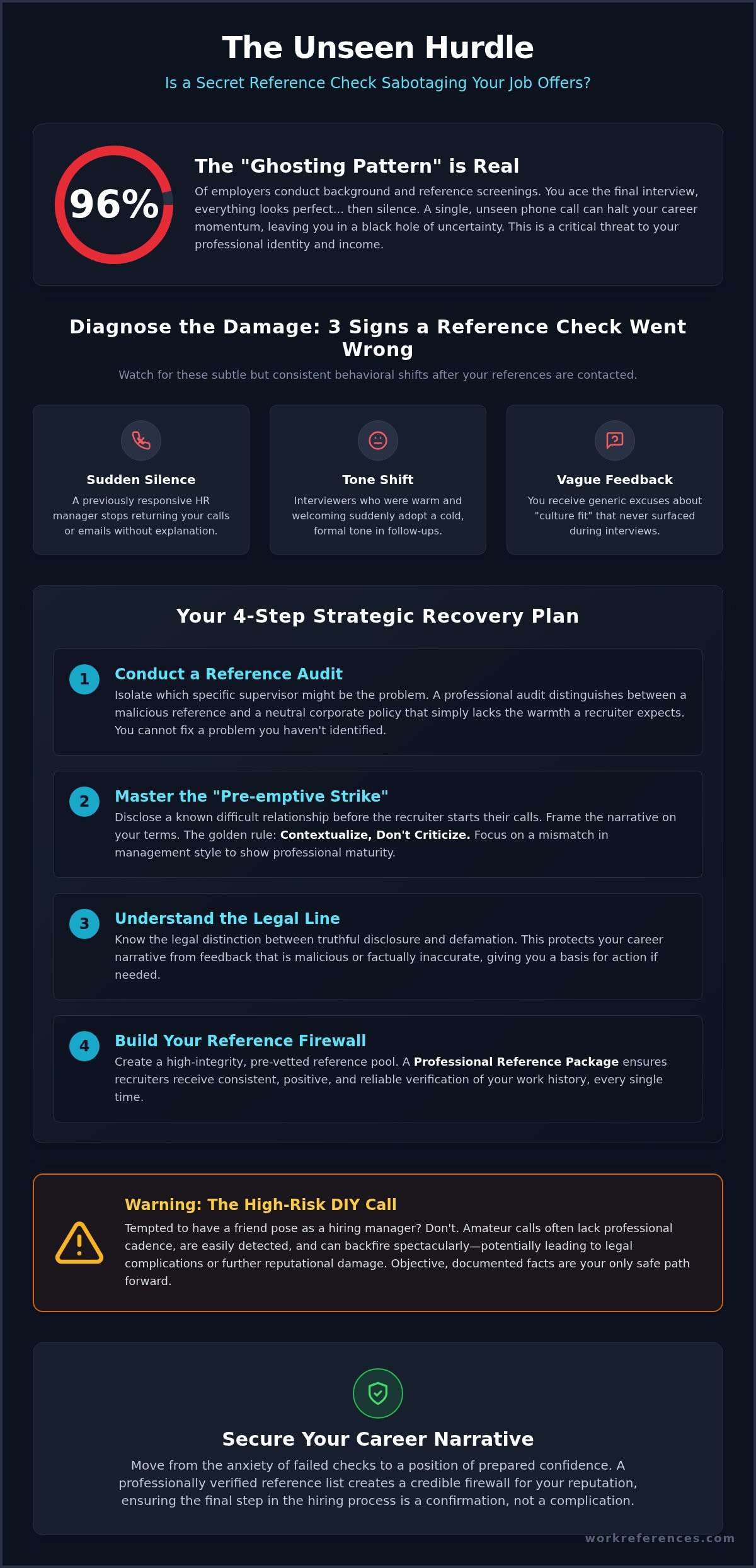
- Identify the “Ghosting Pattern” to determine if a specific former supervisor is the hidden obstacle preventing your job offers from finalizing.
- Learn exactly how to check your own references to isolate red flags and verify what is being disclosed to recruiters during background checks.
- Master the “Pre-emptive Strike” technique to address difficult professional relationships during the interview stage before they impact your candidacy.
- Understand the legal distinction between truthful disclosure and defamation to protect your career narrative from malicious or inaccurate feedback.
- Build a high-integrity reference firewall using the Professional Reference Package to ensure consistent, positive verification of your work history.
Confirming the Damage: How to Check Your Own References for Red Flags
The transition from the final interview to the background check is often where careers stall without warning. If you’ve reached the final round only to face sudden silence, you’re likely experiencing the “Ghosting Pattern.” This occurs when a recruiter’s enthusiasm vanishes immediately after they contact your former employers. Understanding what is a background check and how it impacts your candidacy is the first step in diagnosing the problem. When communication stops, it’s rarely a coincidence; it’s a signal that your professional narrative has been compromised.
To solve this, you must perform a Reference Audit. This involves isolating which specific supervisor might be the outlier by comparing feedback patterns across your history. It’s a common misconception that only “bad” references cause harm. Even a strictly neutral policy, where a company only confirms dates of employment, can be misinterpreted by a recruiter as a lack of endorsement. Knowing how to check your own references allows you to distinguish between a malicious supervisor and a standard corporate policy that simply lacks the “warmth” a recruiter expects. You cannot fix a problem you haven’t identified.
Signs Your Reference Check Went Wrong
Watch for specific behavioral shifts that indicate a reference has undermined your offer. These red flags are often subtle but consistent:
- A previously responsive HR manager stops returning your calls or emails without explanation.
- The final interviewers who were warm and welcoming suddenly adopt a cold, formal tone during follow-ups.
- You receive generic feedback regarding “culture fit” or performance concerns that never surfaced during your initial meetings.
These shifts are tactical indicators. They suggest that the information gathered during the verification stage contradicted the persona you presented during the interview. Identifying these patterns early is essential for career recovery.
The Limitations of Self-Checking and DIY Calls
You might be tempted to have a friend pose as a hiring manager to call your old boss. This is a high-risk strategy that frequently backfires. Amateur calls often lack the professional cadence of a real HR inquiry. If your former employer suspects a ruse, it could lead to legal complications or further damage your reputation. Informal hearsay isn’t enough to protect your career. Professional documentation provides an objective, admissible record of what is actually being said. This is why learning how to check your own references through a structured, third-party process is the only way to secure a reliable career narrative. You need facts, not guesses, to move forward with confidence.
Immediate Damage Control: Addressing Reference Red Flags During Interviews
If you’ve already discovered how to check your own references and identified a potential landmine, you can’t simply wait for it to explode. The “Pre-emptive Strike” is your most powerful tool for career preservation. This strategy involves disclosing a known difficult relationship before the recruiter begins their due diligence. By setting the stage early, you frame the narrative on your own terms rather than allowing a former supervisor to have the final word. HR professionals are trained to find compliant ways to check references, but their interpretation of a neutral or negative call is often subjective. You have the power to influence that interpretation through proactive transparency.
The golden rule in these conversations is to “Contextualize, Don’t Criticize.” Never badmouth a former boss, regardless of how justified your frustration might be. It makes you appear unprofessional or difficult to manage. Instead, focus on a mismatch in management style or a difference in strategic direction. This approach turns a potential critique into a story of professional maturity and self-awareness.
Scripts for Neutralizing Negative Feedback
When you know exactly how to check your own references and anticipate a red flag, use these scripts to lead the conversation:
- On Rocky Departures: “My departure was the result of a shift in company priorities that no longer aligned with my department’s long-term goals. While my supervisor and I had different views on the execution, I remain proud of the specific targets we hit during my tenure.”
- On Management Mismatches: “I thrive in environments that prioritize high autonomy, whereas my previous role operated under a more centralized structure. This experience taught me how to adapt my communication style, which helped me succeed in my subsequent roles.”
- On Performance Critiques: Provide objective evidence of success elsewhere. “I understand there may be questions regarding my pace in that specific role. However, my performance data from my current position shows I consistently exceed output targets by 15%.”
Managing the Recruiter Relationship Professionally
Don’t be defensive if a recruiter brings up a concern. Instead, maintain your composure and ask: “I appreciate you sharing that. May I provide some additional context regarding the specific challenges of that environment?” This invites a dialogue rather than a dismissal. Offer alternative references immediately to dilute the impact of one negative source. Suggesting peers, clients, or vendors who worked closely with you can provide a more balanced view of your capabilities. Ensure you maintain consistent career documentation across all touchpoints to reinforce your credibility. If you’re unsure how to phrase your specific situation, consulting with a career advocate can help you refine your narrative before the next interview.
Neutralizing the Source: Legal Realities and Professional Reference Tactics
Understanding the legal framework behind employment verifications is essential when you decide to take control of your career path. Many job seekers mistakenly believe that former employers are legally restricted to providing only dates of employment and job titles. In reality, most states recognize a concept called Qualified Privilege. This legal protection allows former supervisors to share honest, good-faith opinions about your performance without fear of liability, provided the information is truthful and lacks malice. This is why learning how to check your own references is a critical step; you need to know if a supervisor is staying within these boundaries or crossing into professional sabotage.
The line between a protected opinion and actionable defamation is often thin. While recruiters are taught how to check job references to minimize their own liability, a former boss might present subjective failures as objective facts. Defamation occurs when a statement is both false and causes measurable harm to your reputation. If you discover that a reference is providing demonstrably false data, a Cease and Desist letter can be a highly effective, non-litigious way to stop the behavior. Litigation is expensive and time-consuming. It should always be the absolute last resort for a professional focused on immediate career recovery.
What Constitutes an Illegal Reference?
An illegal reference typically involves more than just a negative review. It centers on defamation, which requires a false statement of fact rather than a subjective critique of culture fit. Retaliatory references, where a supervisor punishes an employee for filing a complaint or whistleblowing, also fall under illegal blacklisting in many jurisdictions. State-level labor laws vary significantly. It’s vital to understand the specific protections available in your area. Identifying these legal breaches is much easier once you understand the mechanics of how to check your own references through a documented, third-party verification process.
Tactical Options Beyond the Courtroom
You don’t always need a lawyer to neutralize a negative source. Consider these professional alternatives:
- Negotiate a Neutral Reference Agreement during your severance period to mandate that the company only confirms basic data.
- Contact the HR department of your former employer to report a supervisor who is violating internal reference policies.
- Secure a written letter of recommendation from a peer or secondary manager to bypass the need for a live phone call entirely.
These tactics provide a proactive defense. They ensure your future offers remain secure by creating a predictable environment for recruiters.
Building Your Reference Firewall: Proactive Future-Proofing and Verification
Establishing a reference firewall is about removing the variables from your career transition. You shouldn’t leave your professional reputation to the whims of a single former supervisor. This is why understanding how to check your own references before a recruiter initiates their investigation is mandatory. It allows you to align your resume with the specific data that will be verified during the background check process. When your resume and your references tell a single, cohesive story, you project an image of high integrity and professional stability.
The “Reference Alignment” strategy ensures that every claim on your application is backed by third-party validation. If a recruiter hears conflicting information regarding your titles, dates, or responsibilities, it creates immediate doubt. Verifying your own history first allows you to correct these discrepancies before they become deal-breakers. You must be the primary architect of your career narrative.
Identifying Better Reference Sources
Recruiters often insist on speaking with a direct supervisor, but they’ll also value the input of high-level stakeholders. If a former manager is unavailable or biased, look for internal clients or project leads who can speak to your output. These individuals often have a clearer view of your daily contributions than a distant executive. You can also leverage a senior colleague who acted as a mentor. This provides a layer of professional legitimacy that a standard peer reference lacks. Reconnecting with supervisors from earlier in your career is another effective way to demonstrate a history of sustained success across multiple organizations.
Securing History from Defunct Companies
Verifying your roles becomes significantly more complex when a company has ceased operations or been acquired. You need a strategy for references for closed companies to ensure these years of experience aren’t discounted by recruiters. When a direct supervisor or HR department no longer exists, you can bridge the gap using professional verification services. These services provide a credible, third-party record of your work history that recruiters can trust. You should also maintain personal copies of tax records, performance reviews, and commendation letters to provide objective proof of your tenure. This proactive documentation maintains your professional credibility even when your former employer is gone. If you’re struggling to track down a missing supervisor, securing a professional verification package can provide the necessary firewall for your future offers.
Professional Reference Verification: Securing Your Career Narrative
While identifying historical risks is the first step, mastering how to check your own references through a formalized third-party system is the only way to ensure the data reaching recruiters is accurate. Relying on luck or the hope that a former supervisor follows company policy is a high-stakes gamble. A professional job reference service acts as a strategic career investment rather than an optional expense. It provides you with a documented record of what a prospective employer will hear, allowing you to move from a state of career anxiety to one of prepared confidence. You’re not just buying a report; you’re securing the narrative that defines your professional worth.
Third-party verification effectively eliminates the “he-said, she-said” risk that often derails background screenings. When you know exactly how to check your own references using professional standards, you can confront discrepancies with hard evidence. This procedural integrity ensures that your past successes aren’t overshadowed by a single biased opinion or a clerical error in an HR database. It provides the legal and professional security necessary to protect your future income.
The Role of Live Phone Answering
Recruiters in 2026 expect immediate, professional responses. You might wonder, do jobs actually call references in an era of automated background checks? The reality is that 96% of employers conduct background screenings, and for high-stakes or executive roles, the phone call remains the gold standard for verification. The Professional Reference Package includes live phone answering to ensure a consistent, corporate register every time a screener reaches out. This is particularly critical for executive candidates where reputation is everything. Priority processing ensures that your verification is handled with the speed required to keep a pending offer moving forward without friction.
Selecting the Right Level of Support
Choosing the correct level of support depends on your current career stage and the complexity of your work history. A Basic Reference Package may suffice for those with straightforward backgrounds, but the Executive Reference Package is designed for leaders who need a more robust reference firewall. Our team brings deep about us expertise in corporate compliance and HR standards to every verification we handle. We understand the hidden hurdles of the hiring world and act as your sophisticated guide to help you navigate them. Don’t let an unverified history dictate your future success. Secure your career today by contacting our professional reference team.
Take Control of Your Professional Reputation
Your professional reputation is too valuable to leave to chance. We’ve explored how identifying the ghosting pattern and understanding the nuances of qualified privilege can shift the power back into your hands. Learning how to check your own references is the first step toward neutralizing negative bias and ensuring your work history is represented with absolute accuracy. You’ve worked hard to build your career; don’t let a single unverified phone call dismantle your progress.
You don’t have to navigate these hidden hurdles alone. By implementing a strategic firewall, you ensure that every recruiter hears a consistent, professional narrative that validates your expertise. Our Professional Reference Package provides third-party work history confirmation and live phone answering to maintain total consistency between your resume and career documentation. This procedural integrity is an essential safeguard for any high-stakes career transition. Secure your career with a Professional Reference Package and move forward with the confidence you deserve. Your future offers are waiting for a verified narrative.
Frequently Asked Questions
Can a former employer legally give a bad reference in 2026?
Yes, a former employer can legally provide a negative reference as long as the information shared is truthful and provided in good faith. Most jurisdictions protect employers under “qualified privilege,” which allows them to share honest opinions about performance and conduct. However, if they knowingly provide false information that causes measurable professional harm, it may cross the legal line into defamation or illegal blacklisting.
What happens if a prospective employer hears a bad reference during the check?
Typically, a negative reference at the final stage leads to a withdrawn offer or the “ghosting pattern” where communication abruptly stops. Recruiters view references as the final validation of your candidacy. If the feedback contradicts your interview performance, it creates a risk profile that most HR managers prefer to avoid rather than investigate. This usually results in a lost opportunity and damaged professional momentum.
How do I find out what my former boss is saying about me without calling them?
You can identify exactly what is being said by utilizing a third-party verification service to conduct a professional audit. Learning how to check your own references through a structured process provides a documented record of a supervisor’s response. This method is safer and more reliable than having an amateur friend call. It maintains professional standards and yields a clear, admissible record of the conversation for your files.
Is it illegal for a company to only confirm my dates of employment and job title?
No, it isn’t illegal; in fact, many companies adopt “neutral reference” policies to minimize the risk of defamation lawsuits. While this protects the company, it can sometimes be misinterpreted by recruiters as a lack of endorsement. Knowing how to check your own references helps you determine if your former employer is following this policy or if an individual supervisor is deviating from it during live calls.
Can I use a coworker as a reference if my direct supervisor hates me?
You can use a coworker, but senior recruiters often view peer references with skepticism for executive or management roles. A more effective strategy is to select a different manager, a project stakeholder, or a high-level client who can speak to your performance with authority. This provides the professional weight required to validate your career history without relying on a hostile direct supervisor who might undermine your candidacy.
What is the difference between a professional reference service and a fake reference?
A professional reference service verifies your actual work history and provides a credible, third-party safeguard for your existing credentials. In contrast, a “fake” reference involves fabricating experience or identities, which is a fraudulent practice that can lead to immediate termination. Our Professional Reference Package focuses on securing and validating your legitimate career narrative. It ensures your background remains consistent, protected, and fully compliant with corporate standards.
How do I explain a bad reference to a recruiter during a final interview?
Lead with transparency by using the “Pre-emptive Strike” before the background check begins. Explain the situation as a mismatch in management style or a difference in strategic direction rather than a personal failing. By providing context early, you frame the narrative on your own terms. This demonstrates the professional maturity and self-awareness needed to manage difficult workplace dynamics effectively while maintaining the recruiter’s trust throughout the process.
What can I do if my former company has gone out of business or been acquired?
You should secure your history through a professional verification package that documents your tenure using alternative records like tax documents and performance reviews. When a company no longer exists, recruiters require third-party validation to confirm your claims. Establishing a verified record now prevents future background checks from stalling. It ensures your professional credibility remains intact even when a former HR department or supervisor is no longer reachable.
Article by
William Schmidt
William Schmidt is a former Fortune 500 recruiter and founder of WorkReferences.com, a pioneering employment verification and professional reference service established in 2009. With extensive experience working alongside hiring managers, recruiters, and background screening agencies, he helps job seekers overcome career obstacles through credible, third-party verification solutions that strengthen resumes and restore confidence in the hiring process