

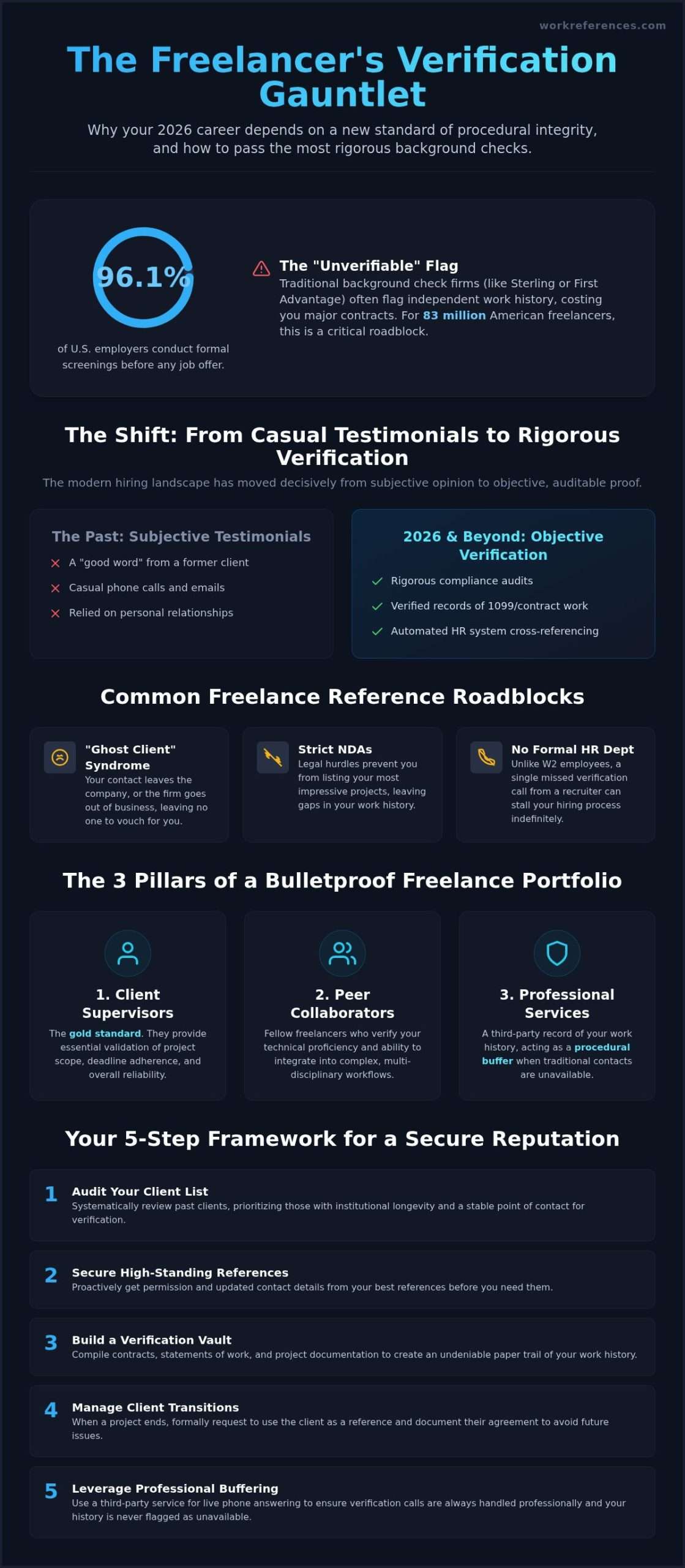
Did you know that 96.1% of U.S. employers now conduct formal screenings before finalizing any job offer? For the 83 million Americans currently freelancing, this statistic isn’t just a number. It’s a potential roadblock. Traditional background check companies like Sterling or First Advantage often flag independent work history as ‘unverifiable’ because they lack the procedural framework to handle non-traditional employment. When your former clients ghost you, go out of business, or hide behind strict NDAs, securing reliable job references for freelancers becomes a high-stakes challenge that can cost you your next major contract.
It’s frustrating to watch a career-defining opportunity slip away because of a verification technicality you can’t control. This guide provides the professional authority and strategic safeguards you need to protect your reputation. You’ll learn how to build a robust verification vault, manage client transitions with legal security, and leverage third-party confirmation services to ensure your history remains an asset rather than a liability. We’ll examine the mechanics of 2026 corporate compliance and provide a clear, step-by-step path to passing even the most rigorous background checks with absolute confidence.
Key Takeaways
- Understand the shift from casual testimonials to rigorous verification and why your 2026 career depends on procedural integrity.
- Master the specific strategies for securing job references for freelancers that satisfy the high-stakes requirements of corporate background check firms.
- Learn to distinguish between a creative portfolio and a verification vault, ensuring your work history is documented to survive a compliance audit.
- Implement a methodical five-step framework to audit your client list and secure high-standing professional references without damaging relationships.
- Discover how professional buffering and live phone answering can prevent your history from being flagged as ‘unverifiable’ due to unavailable supervisors.
Why Job References for Freelancers are a High-Stakes Challenge in 2026
In 2026, the concept of what are job references has evolved from a casual phone call into a rigorous compliance audit. For independent professionals, a freelance reference is no longer just a “good word” from a former client. It’s a verified record of 1099 or contract work that must meet exacting HR standards to be accepted. The modern hiring landscape has moved decisively from subjective testimonials to objective verification. This shift means your technical skills are often secondary to your ability to prove you actually performed the work you claim.
Securing job references for freelancers requires more than just a list of names. While W2 employees benefit from centralized payroll records, 1099 contractors are flagged significantly more often during screenings because their history lacks a standardized paper trail. Losing a dream job offer because your work history was labeled “unverifiable” is an emotional gut punch. It creates a sense of professional invisibility that can derail your career momentum and leave you feeling powerless against automated systems.
The Rise of Rigorous Background Screenings
Automated HR systems now cross-reference tax records and LinkedIn data with surgical precision. Simple client emails are no longer enough to satisfy firms like Sterling or First Advantage; they demand procedural integrity and documented proof of engagement. If a background check algorithm can’t find a direct match in a corporate database, it triggers the “unverifiable” flag, which often leads to an immediate rejection. Verification Fatigue is the administrative exhaustion caused by manually vetting non-traditional work histories; it’s the specific reason HR managers prefer professional reference services that provide a streamlined, authoritative response.
Common Freelance Reference Roadblocks
Managing job references for freelancers is complicated by the volatile nature of the gig economy. “Ghost Client” syndrome occurs when your primary point of contact leaves the company or the firm itself goes out of business, leaving no one to vouch for your contributions. Additionally, strict NDAs often create legal hurdles that prevent you from listing your most impressive projects, leaving your resume looking suspiciously thin. Unlike corporate employees, freelancers don’t have a dedicated HR department to handle incoming verification requests. This lack of a formal infrastructure means that even a single missed call from a recruiter can stall your hiring process indefinitely.
The Three Pillars of a Strong Freelance Reference Portfolio
A resilient career requires a diversified defense. Relying on a single point of contact is a professional risk you can’t afford in 2026. To secure job references for freelancers that withstand corporate scrutiny, you must build your portfolio on three distinct pillars. Each serves a specific function in the verification process, ensuring that no single “ghost client” can derail your next contract. Modern HR departments look for a balanced “Reference Mix” to form a complete picture of your professional integrity. If you’re missing even one of these pillars, you’re leaving your career vulnerable to verification gaps.
- Client Supervisors: These are your gold standard. They provide the essential validation of project scope, deadline adherence, and overall reliability.
- Peer Collaborators: Fellow freelancers or subcontractors verify your technical proficiency and your ability to integrate into complex, multi-disciplinary workflows.
- Professional Reference Services: These entities provide a permanent, third-party record of your work history, acting as a procedural buffer when traditional contacts are unavailable.
Passing a comprehensive background check requires more than just a list of names. It requires a strategy that mirrors the stability of a traditional corporate HR department. When you present a mix of supervisory authority, peer technical validation, and professional third-party confirmation, you project an image of legal security and procedural integrity.
Selecting the Right Client Contacts
Don’t just choose the person you liked most. Prioritize clients with institutional longevity. A project manager at an established corporation is a more stable reference than a founder at a three-person startup that might fold by next quarter. You should identify “Reference-Ready” clients during the offboarding phase of every project. Secure their personal contact details and commit to verifying their employment status at least once a year. If you find your network is thinning or contacts are becoming unreachable, it’s wise to consult with a professional advocate to stabilize your history.
Leveraging Peer and Subcontractor References
A fellow freelancer can be a powerful professional character witness. However, they must speak to your specific deliverables rather than your personality. HR professionals are trained to spot “friendship references” and will quickly discount them. Ensure your peer can describe the technical mechanics of your collaboration; they should discuss code quality, project management tools, or specific milestones. This distinguishes them as a professional colleague rather than a casual acquaintance. When peers provide data-driven accounts of your teamwork, they add a layer of technical legitimacy that supervisors often lack. It’s about proving you can function within a high-stakes professional environment, regardless of your 1099 status.
Testimonials vs. Verification: Why Your Portfolio Isn’t Enough
The “Talent Trap” is a common pitfall for independent professionals. You may have a five-star portfolio and a list of glowing testimonials, but these assets rarely satisfy a 2026 corporate compliance officer. Talent proves you can do the work; verification proves you actually did it. Background check giants like Sterling or First Advantage operate with clinical detachment. They don’t review your design files or read your code. They search for a match in a database or a human voice that can confirm specific dates and titles. If your history is fragmented across multiple 1099 contracts, these systems often fail to find a match, leading to an “unverifiable” flag that kills your candidacy.
Bridging this gap requires a dedicated “Reference Worker” strategy. This involves moving beyond marketing-focused testimonials and toward a procedural framework that mirrors a traditional HR file. Securing job references for freelancers in this environment is about identity and history validation. It’s a high-stakes process where the quality of your work is secondary to the legitimacy of your documentation. To ensure your history survives this scrutiny, you can learn more about our professional reference packages designed to provide the administrative weight your portfolio lacks.
The Mechanics of Corporate Employment Verification
When an HR manager or a third-party screener initiates a check, they follow a rigid script. They typically ask for start and end dates, job titles, and eligibility for rehire. This is where many freelancers stumble. Providing a personal cell phone number for a former client is a major risk. Screeners often flag mobile numbers as “unverifiable” or “high risk” because they cannot be traced back to a registered corporate entity. Live phone answering is the only way to ensure a reference is taken seriously. A professional, branded response provides the procedural integrity that automated systems and human screeners require to clear your file.
Handling Employment Gaps and Defunct Clients
The volatile gig economy means clients often disappear or companies fold. A reference check that goes to a dead line or an auto-reply is a massive red flag. Instead of presenting your history as a series of fragmented gigs, you must frame your 1099 work as a continuous “Career Chapter.” This narrative approach provides stability to your timeline. If you’ve worked with firms that no longer exist, you need a specialized strategy. You can read our guide on References for Closed Companies: How to Secure Your Work History in 2026 to learn how to bridge these specific gaps. By proactively managing these roadblocks, you transform a potentially suspicious gap into a verified period of professional growth.
How to Secure and Document Your References: A 5-Step Framework
Securing job references for freelancers requires a methodical approach that prioritizes procedural integrity over personal favors. In a corporate environment, a reference is a data point, not a testimonial. To ensure your history stands up to the scrutiny of modern background check agencies, you must treat your reference list as a managed asset. This framework moves you from a state of professional vulnerability to a position of prepared confidence, ensuring your 1099 history is as verifiable as any W2 role.
- Step 1: Audit your client list. Identify clients with the highest institutional standing. If you performed work under a strict NDA, focus on contacts who can verify the existence and duration of your contract without disclosing proprietary deliverables.
- Step 2: Formalize the request. Use professional, non-imposing language. Frame your request as “verification support” rather than asking for a favor. This shifts the dynamic from a personal burden to a standard administrative task.
- Step 3: Align your documentation. Your resume, LinkedIn profile, and reference statements must match perfectly. Any discrepancy in dates or titles will trigger a red flag in automated HR systems.
- Step 4: Centralize your data. Store your reference contact information and project summaries in a secure, third-party vault. This prevents your history from being lost if a former client moves to a new company.
- Step 5: Test your references. Do you know what your contacts will actually say? Verify their reliability before a recruiter calls. If you suspect a contact may be unreachable or inconsistent, secure your professional history today with a dedicated verification service.
The Professional ‘Ask’: Templates for 2026
The tone of your request depends on the depth of the relationship. For long-term clients, a direct approach works best. For short-term project managers you haven’t spoken to in a year, focus on the procedural necessity. A sample sentence for a reference request might be: “I am currently undergoing a standard corporate background screening and would appreciate your verification support regarding our contract dates and project scope.” This language is professional, clinical, and easy for a busy manager to approve. It removes the emotional weight of “vouching” for someone and replaces it with the simple task of confirming facts.
Alignment and Resume Consistency
Consistency is the primary metric for legitimacy in 2026. If your resume says you were a “Senior Consultant” but your reference remembers you as a “Technical Writer,” the background check may fail. You can read more in The Critical Guide to Resume and Reference Consistency in 2026. As a Vigilant Career Advocate, I recommend providing every reference with a brief summary sheet. Never let a contact guess your project details. Provide them with the exact dates, titles, and key milestones you’ve listed on your resume. This ensures that when the call comes, their answers reinforce your professional narrative with absolute precision.
The WorkReferences Solution: Professional Buffering for Freelancers
Freelancing shouldn’t mean sacrificing the administrative stability found in traditional corporate roles. When a high-stakes background check begins, your personal network might not be enough to satisfy a compliance officer. WorkReferences fills this void by acting as your dedicated HR department for contract work. We bridge the gap for defunct companies and unreachable supervisors, ensuring your professional narrative remains intact and verifiable. Our “Live Phone Answering” advantage is a critical safeguard. it guarantees that every inquiry from a recruiter or screening agency is met with a professional, branded response. This prevents the “unverifiable” flags that occur when calls go to personal cell phones or dead lines. To explore how we can stabilize your history, you can view our tiered pricing for reference packages.
Third-Party Confirmation and Career Credibility
A third-party verification service carries significantly more weight than a personal friend or a casual colleague. Recruiters view a personal contact as a character witness, but they view a service like ours as a procedural confirmation. This distinction is vital for maintaining legal and procedural integrity during a career transition. By utilizing a third-party buffer, you project an image of authenticity and stability. This shift in strategy moves you from a state of concern regarding potential setbacks to a feeling of prepared confidence. You’re no longer just a solo contractor; you’re a professional with a verified history that meets 2026 hiring standards. Securing job references for freelancers is about more than just talent; it’s about providing the institutional proof that corporate systems demand.
Getting Started with a Reference Package
Our tiers are designed to match your specific career trajectory. You can choose between the Basic Reference Package, the Professional Reference Package, or the Executive Reference Package depending on the complexity of your work history. The onboarding process is methodical and protective. We work with you to validate your career documentation, ensuring every date and title aligns with corporate expectations. We act as your sophisticated guide through the hiring world’s hidden hurdles, providing a strategic partnership that protects your professional advancement. If you’re ready to take control of your reputation and ensure your job references for freelancers are never questioned, contact our career consultants to secure your professional references today.
Securing Your Professional Future in the Gig Economy
The hiring landscape of 2026 demands more than just a high-quality portfolio; it requires a bulletproof verification strategy. You’ve learned that standard job references for freelancers must transition from casual testimonials to rigorous, audit-ready records that satisfy corporate compliance. By diversifying your reference pillars and maintaining absolute documentation consistency, you eliminate the “unverifiable” risks that often stall modern career transitions. It’s about taking active control of your professional reputation before the next background check begins.
Our team provides the essential procedural buffer you need to succeed. We offer professional third-party verification, live phone answering for background checks, and executive-level career documentation support to ensure your history remains a powerful asset. Don’t let a missing supervisor or a closed company stand in the way of your advancement. Secure Your Freelance Career with a Professional Reference Package today. You’ve done the hard work of building a career. Now, ensure you have the institutional verification to prove it. Your next great opportunity is within reach, and you’re finally prepared to claim it with absolute confidence.
Frequently Asked Questions
Can I use a client as a professional reference if I signed an NDA?
You can use a client as a reference even with an NDA by focusing on procedural verification rather than project specifics. Your contact can confirm your engagement dates and professional reliability without disclosing proprietary details. It’s about validating your presence and work ethic within the firm’s ecosystem. Providing a summary sheet to your reference ensures they stay within the legal boundaries of your agreement while supporting your career advancement.
What should I do if my freelance client’s company no longer exists?
If a former client’s company has closed, you must rely on third-party confirmation of work history. Traditional background check firms often flag these as “unverifiable,” which can jeopardize your candidacy. Utilizing a dedicated service provides a permanent administrative record that survives the volatility of the gig economy. This ensures your hard-earned experience isn’t erased simply because a startup or small business folded during a market shift.
How do I handle a reference check if I worked through a middleman agency?
When working through a middleman agency, your primary reference should be the agency’s account manager or HR representative. They hold the legal record of your contract and payment. However, a peer reference from the end client can often provide the technical validation needed to round out your portfolio. This dual approach ensures both administrative accuracy and technical credibility during the screening process, satisfying both HR and the hiring manager.
Is it legal to use a professional reference service for freelance work?
It is entirely legal to use a professional reference service to manage your reputation and history. These services act as a strategic buffer, ensuring that job references for freelancers are handled with the same procedural integrity as a corporate HR department. This isn’t about fabrication. It’s about providing a reliable, live answering service and documented history for legitimate work performed under high-stakes 1099 contracts in a volatile market.
How many references do I need as a 1099 contractor?
For most corporate roles in 2026, the standard is to provide three professional references. Providing fewer than three often flags a candidate as unverifiable or suggests a lack of professional depth. When managing job references for freelancers, your mix should ideally include at least one supervisor, one peer collaborator, and a third-party verification asset. This creates a comprehensive and stable professional profile that meets the rigorous standards of modern HR departments.
What happens if a background check company can’t verify my self-employment?
If a background check company cannot verify your self-employment, they will often request tax documents or bank statements. This is a high-stakes moment that can feel intrusive and stressful. To avoid this, maintain a “Verification Vault” containing signed commendations and project summaries. A professional reference service can also preempt these flags by providing a live, authoritative voice to confirm your professional standing and procedural history during the screening.
Can I use a fellow freelancer as a supervisor reference?
A fellow freelancer should not be listed as a supervisor, as this is often seen as a red flag by HR professionals. Instead, categorize them as a “Peer Collaborator” who can vouch for your technical deliverables and teamwork. To satisfy the supervisor requirement, you must provide a contact who had oversight of your project scope or utilize a third-party service that validates your professional history with administrative authority.
How long does a professional reference service take to set up?
Setting up a professional reference service is a rapid process, typically requiring only 24 to 72 hours to fully validate your documentation. This speed is essential for candidates in active interview cycles where timing is critical. Once your career history is audited and your package is active, you can provide your references with the confidence that every background check will be handled with meticulous care and procedural integrity.
Article by
William Schmidt
William Schmidt is a former Fortune 500 recruiter and founder of WorkReferences.com, a pioneering employment verification and professional reference service established in 2009. With extensive experience working alongside hiring managers, recruiters, and background screening agencies, he helps job seekers overcome career obstacles through credible, third-party verification solutions that strengthen resumes and restore confidence in the hiring process