

What if your most demanding “supervisor” wasn’t a manager in a corner office, but the diverse roster of clients you’ve served for years? For many independent professionals, the transition back to a corporate environment is haunted by the fear that their non-traditional background will be flagged as a red flag. You might worry that third party verification firms like HireRight will view your history as a gap rather than a career. It’s a common anxiety, especially as the U.S. Department of Labor continues to refine the economic reality test for independent contractors in 2026. However, your self-employed years are not a liability; they’re a proven track record of business results.
This guide explains exactly how to get a reference when self employed by transforming your client list into a high-impact portfolio that satisfies even the strictest corporate background checks. You’ll learn which categories of professional contacts carry the most weight and what specific documents you must prepare to validate your legitimacy to HR. We’ll show you how to move from informal testimonials to a rigorous verification package. By the end of this article, you’ll have the confidence to prove that your years of independence count as valid, high-level professional experience.
Key Takeaways
- Identify high-impact reference categories, such as long-term retainer clients and project managers, who serve as the professional equivalent of traditional supervisors.
- Master how to get a reference when self employed by constructing a “Verification Portfolio” to provide the empirical proof that modern HR departments demand.
- Learn a methodical approach to briefing your network, ensuring your references align their narrative with the specific requirements of your next corporate role.
- Understand why verbal phone references remain the “gold standard” for 2026 background checks and how to prepare your clients for these high-stakes calls.
- Discover how a professional reference package can formalize your history, providing the procedural integrity needed to navigate 3rd party verification firms.
The Challenge of Securing References When You Are Your Own Boss
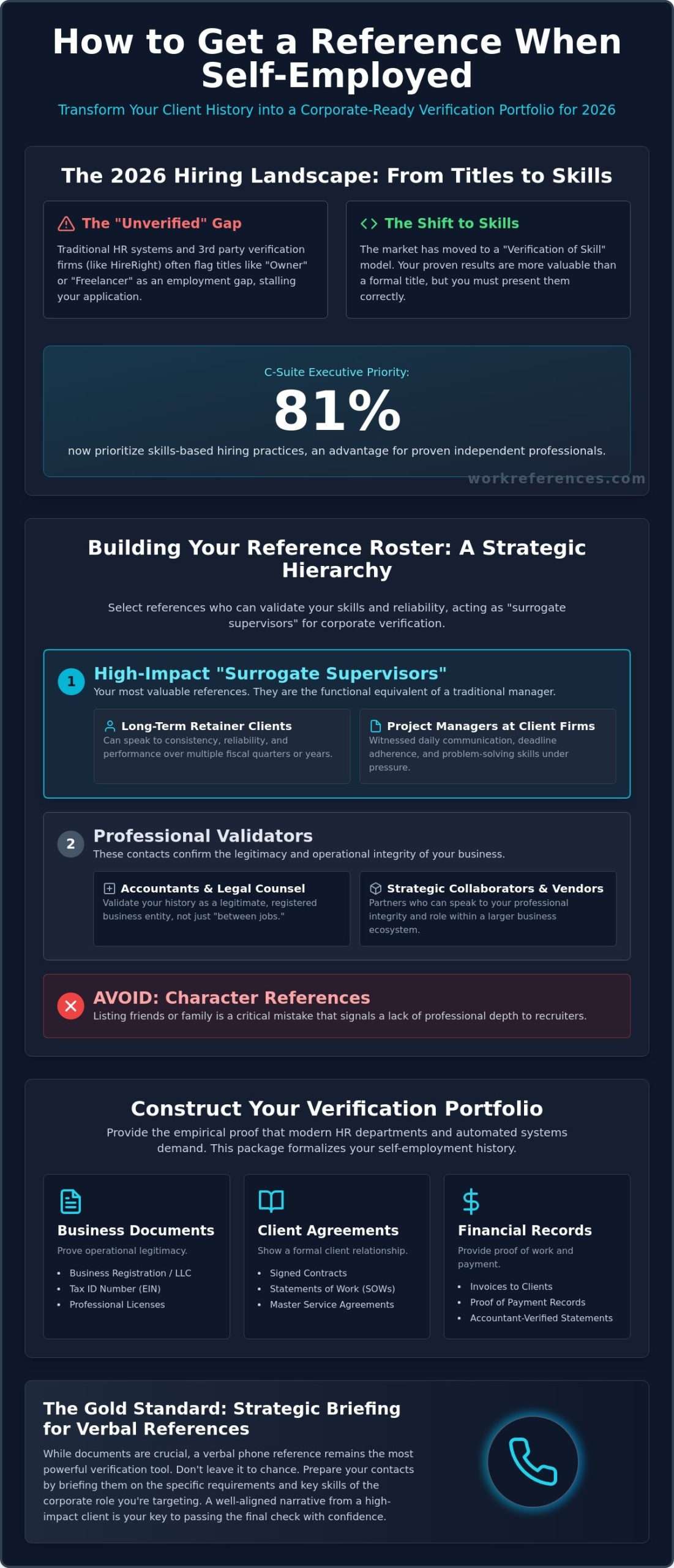
For the independent professional, a reference is not a simple phone call to a former manager in a corner office. It is a formal validation provided by a client, vendor, or strategic collaborator who can attest to your professional integrity. Traditional HR departments often struggle with titles like “Owner” or “Freelancer” because their systems are programmed to look for corporate hierarchy. Without a clear supervisor to contact, your application risks stalling in the “unverified” pile. Learning how to get a reference when self employed is the first step in protecting your professional reputation against these structural biases.
The hiring market in 2026 has shifted toward a “Verification of Skill” model over a “Verification of Title.” Recent data indicates that 81% of C-suite executives now prioritize skills-based hiring practices. This change is partly driven by the Department of Labor’s February 2026 proposal to revise independent contractor classifications, which emphasizes the economic reality of the work performed. This shift is a massive advantage for you. It means a client who can vouch for your technical delivery is often more valuable than a manager who only checked your timesheet. However, you must be proactive. Preparation is your only defense against a flagged background check.
The Distinction Between Character and Professional References
Listing your best friend or a family member is a critical mistake that signals a lack of professional depth. Recruiter expectations have evolved; they now require “surrogate supervisors” who can speak to your daily work habits. You should categorize your network into two groups. Technical surrogates explain your specific craft and expertise. Managerial surrogates, like long-term clients, speak to your reliability and project management. While a letter of recommendation provides a useful paper trail, modern vetting requires more active participation from your contacts. You need people who can describe your workflow, not just your personality.
Why 3rd Party Verification Firms Are Your Biggest Hurdle
Automated screening tools used by firms like Checkr or HireRight often flag self-employment as an “employment gap.” This happens because there is no centralized corporate HR database to query for your tax ID. When these systems fail to find a traditional match, they trigger a manual review process that can delay your start date by weeks. This is where many independent careers falter. You must have a live person ready to answer verification calls and confirm your history with authority. In 2026, having a dedicated professional to handle these inquiries is a necessity for meeting corporate hiring standards. If you’re concerned about how your history appears to these firms, exploring a Professional Reference Package can provide the institutional buffer you need to pass these checks with confidence.
Who to Use as a Reference When You Are Self-Employed
Selecting the right individuals to vouch for your work is a strategic exercise in risk mitigation. You don’t just need a “good word”; you need specific, verifiable data points that satisfy a recruiter’s checklist. When determining how to get a reference when self employed, start with your long-term retainers. These clients have the most extensive history with your workflow. They are the closest functional equivalent to a traditional supervisor. They can speak to your consistency over fiscal quarters or years, providing the longitudinal data that corporate HR departments crave.
Project managers at client firms are equally critical assets. While a CEO might sign your contracts, the project manager saw your daily communication habits and your ability to hit deadlines. They witnessed your problem-solving skills under pressure. These contacts provide the tactical evidence that high-stakes corporate roles require. Don’t overlook your professional service providers. Your accountant, business consultant, or legal counsel can validate the legitimacy of your operations. This proves you weren’t merely “between jobs” but were operating a verified business entity with professional oversight.
The High-Value Client: Your Surrogate Supervisor
Identify your “Anchor Clients.” These are the organizations that provided consistent work for a significant duration. By focusing on one major contract to validate a three-year window, you simplify the verification process for the hiring firm. Choose clients who observed your punctuality and communication style firsthand. Learn how our Professional Reference Package can manage these contacts for you to ensure they are always prepared for a sudden inquiry from a background check firm.
Handling References for Closed Companies or Defunct Clients
A common hurdle in 2026 is the “ghost client.” This is a firm that has since dissolved or been acquired. If your primary contact’s company no longer exists, don’t panic. Use LinkedIn to track down the specific project leads you worked with during that tenure. Their personal endorsement remains valid even if the corporate entity has vanished. It’s about the individual’s witness to your work, not the current status of the company’s tax ID. Secure your history with our guide to references for closed companies for a step-by-step recovery plan.
If you’re managing a complex history involving multiple subcontractors or partners, you can also use them as formal collaborators. These individuals can testify to your leadership and ability to manage a team. This is a vital skill for executive-level transitions. Mastering the selection process is a core component of understanding how to get a reference when self employed in a competitive market. If you’re unsure which category your network falls into, you can always speak with a career advocate to audit your list and ensure every name on your sheet adds maximum value to your candidacy.
Validating Self-Employment: Documentation vs. Conversation
Proving you were employed is a technical hurdle; proving you were excellent is a conversational one. In 2026, HR departments increasingly rely on automated verification reports from services like The Work Number, which can cost nearly $70 per report. These systems are designed for traditional employees with standard payroll records. When you are the owner of your firm, these automated checks often return “unverifiable” results. This technical failure forces a manual review, making your personal “Verification Portfolio” a critical asset. Understanding how to get a reference when self employed requires you to bridge the gap between tax forms and professional talent.
While contracts and invoices provide the “Verification of Employment” (VOE), a live phone conversation remains the gold standard for a “Reference Check.” Documentation proves you existed; a conversation proves you performed. You must address the “Managerial Gap” directly. Recruiters often fear that long-term business owners have become “unmanageable” or resistant to feedback. Your references must be briefed to speak specifically about your ability to collaborate and take direction from stakeholders. This evidence of coachability is often more important than your technical output when transitioning back to a corporate hierarchy.
The Essential Paper Trail for 2026 Background Checks
You should maintain a dedicated “Reference File” for every closed contract to avoid a last-minute scramble during a background check. Form 1099-NEC acts as secondary verification of your tenure, proving to 3rd party firms that you were actively generating income during your self-employed years. To protect your privacy while maintaining professional proof, use a heavy black digital marker to redact specific dollar amounts and bank account numbers on invoices, leaving only the dates, company names, and service descriptions visible. This level of meticulous preparation signals to HR that you operate with professional integrity.
Ensuring Resume and Reference Consistency
The most common reason for a flagged background check is “title inflation.” If your resume claims you were a “Senior Project Director” but your reference describes you as a “freelance consultant,” the discrepancy triggers an immediate red flag. You must ensure that the names listed as “Supervisors” on your application match the people who will actually answer the phone. Inconsistencies suggest a lack of transparency that even the best skills can’t overcome. For a deeper look at aligning your history, see The Critical Guide to Resume and Reference Consistency. Mastering how to get a reference when self employed means ensuring your paper trail and your professional network tell the exact same story.
Strategic Coordination: How to Brief Your References
Securing a reference is only half the battle. The final hurdle is ensuring that your contact delivers a narrative that perfectly aligns with your career goals. When you’re figuring out how to get a reference when self employed, you cannot leave the conversation to chance. A casual “lunch invite” approach is insufficient for high-stakes corporate vetting. You must treat your references as strategic partners who require a formal briefing to represent your history accurately. This coordination prevents discrepancies that could lead to a rescinded offer.
Follow this five-step protocol to prepare your network for the recruiter's call:
- Step 1: Re-establish the professional connection. Reach out before you submit their name. This “catch-up” phase ensures the relationship is warm and your request isn’t a surprise.
- Step 2: Share the specific job description. Your reference needs to understand the requirements of the new role so they can highlight your most relevant skills.
- Step 3: Remind them of specific project wins. Don’t assume they remember your exact metrics from three years ago. Briefly recap the value you delivered during your contract.
- Step 4: Confirm availability and contact methods. Ask for their preferred phone number and the best time for a recruiter to reach them.
- Step 5: Provide a “Cheat Sheet.” Send them a summary of your contract start and end dates. Consistency in these dates is the primary metric 3rd party verification firms use to validate your history.
The “Target Narrative” Approach
Your references must understand the specific professional story you’re telling. If you’ve been “the boss” for several years, a recruiter’s primary fear is that you’ll be too independent to function within a team. You must instruct your reference to emphasize your collaborative nature and your ability to take direction from stakeholders. This prevents them from accidentally describing you as a “lone wolf,” which can be a disqualifying trait in corporate environments. Ensuring they have your exact contract dates also prevents the accidental verification flags that occur when a client guesses your tenure incorrectly.
Handling Unavailable or Unresponsive Clients
In 2026, the speed of hiring is faster than ever. If a recruiter can’t reach your reference after two attempts, they may move to the next candidate or flag your history as “unverifiable.” Busy clients often lack the time to navigate a complex HR inquiry. When your primary contacts are unresponsive, you need a professional buffer to maintain your momentum. You can check our pricing for live phone answering and reference support to ensure a live, professional voice is always available to validate your history. If you’re concerned about a specific gap in your network, consult with a career advocate today to build a more resilient verification strategy.
Professional Solutions for Complex Self-Employment Histories
There comes a point where a simple “lunch invite” request to a former client is insufficient to meet the demands of modern corporate compliance. High-stakes career transitions require more than just a list of names; they require a secure, professional infrastructure that stands up to intense scrutiny. Mastering how to get a reference when self employed often means recognizing when your history needs a formal, third-party buffer. WorkReferences provides this essential safeguard, acting as a credible entity that validates your professional standing with the same procedural rigor found in a traditional HR department.
One of the most significant risks in the 2026 hiring environment is the “automated voicemail trap.” When a verification firm calls a busy client who doesn’t answer, your application can sit in limbo for days. A “Live Phone Answering” service ensures that every inquiry is met with a professional response, preventing the delays that often lead to lost opportunities. It’s about maintaining professional momentum. By positioning yourself with a dedicated support system, you signal to potential employers that your business operations were legitimate and your history is fully documented. This proactive stance transforms your self-employment from a perceived risk into a verified asset.
Why Executive-Level Roles Require More Than Just a Client List
Leadership positions trigger “Deep Dive” background checks that go far beyond basic employment dates. These audits look for inconsistencies in your narrative and evaluate your “managerial readiness” in light of the 2026 Department of Labor standards. Our Executive Reference Package is designed for these high-pressure scenarios, ensuring your professional file is complete and ready before an offer is ever extended. We act as your strategic partner, helping you navigate the hidden hurdles of executive vetting with the authority of an industry insider who understands the stakes of your advancement.
Securing Your Professional Future
The transition from independent work to a corporate role doesn’t have to be a source of anxiety. True confidence comes from knowing your references are verified, briefed, and ready to act as your advocates. You’ve done the work; now you must ensure that work is recognized by the systems designed to verify it. To ensure your story is ready for an executive-level review, follow this final checklist:
- Audit your client list and identify your top three advocates today.
- Verify that your contract dates match your resume exactly to avoid automated flags.
- Confirm you have a live, professional point of contact for every major tenure.
- Ensure your “Verification Portfolio” of redacted contracts is ready for immediate submission.
Don’t let a non-traditional background stall your career trajectory. Contact WorkReferences today to professionalize your self-employment history and secure the role you deserve. We’re here to act as your vigilant career advocate, providing the integrity and validation required for the next chapter of your professional life.
Securing Your Professional Legacy
Your self-employed years represent a period of significant professional growth and technical achievement. They shouldn’t be treated as a liability during a background check. By curating a surrogate supervisor network and maintaining a meticulous documentation portfolio, you’ve already laid the groundwork for a successful transition. Mastering how to get a reference when self employed requires moving from informal client relationships to a structured, audit-ready verification strategy that leaves no room for ambiguity.
When the stakes are high, you need a partner who understands the mechanics of corporate compliance. We provide the procedural integrity necessary to satisfy even the most rigorous 3rd party vetting firms. Our services provide essential safeguards, including live phone answering for all reference checks, specialized verification support for closed or defunct businesses, and a comprehensive consistency audit between your resume and reference story. Don’t let a non-traditional history stall your advancement.
Secure your professional credibility with a WorkReferences Package today and step into your next role with absolute confidence. Your expertise is verified. Your future is protected.
Frequently Asked Questions
Can I list myself as my own reference if I am self-employed?
No, you cannot list yourself as your own reference. Doing so is a significant red flag for recruiters as it suggests a lack of external professional validation. Instead, you must identify “surrogate supervisors” such as long-term clients or project leads who can objectively attest to your work quality and reliability. Learning how to get a reference when self employed requires moving beyond your own business entity to find third-party advocates who can verify your professional conduct.
What if my clients are not allowed to give official references due to company policy?
You should request a personal reference from the individual project manager you reported to. Many large corporations have strict “no-comment” policies regarding official company letters, but individuals can often provide a personal endorsement. This bypasses the corporate legal department while still providing the recruiter with a live person who can validate your daily workflow and technical expertise. It’s a standard practice that maintains procedural integrity without putting your contact at risk.
How do I prove my employment dates if I was a freelancer?
You prove your tenure through a combination of signed contracts, invoices, and tax documentation. Form 1099-NEC is a vital tool for verifying the years you were active as an independent contractor. If automated systems like The Work Number fail to find your records, having a “Verification Portfolio” ready for manual review prevents your history from being flagged as a gap. This paper trail serves as the empirical evidence that modern HR departments demand.
Is it better to use a client or a professional colleague as a reference?
A client is generally the superior choice because they occupied the “managerial” role in your professional relationship. They can speak to your punctuality, communication, and ability to meet project milestones. While a professional colleague can validate your technical skills, a client provides the closest functional equivalent to a traditional supervisor’s report. For executive-level transitions, having a client advocate is essential for proving you can manage high-stakes deliverables.
Do employers actually call references for self-employed applicants?
Yes, employers absolutely call references for self-employed applicants. In fact, vetting for independent professionals is often more rigorous because there is no traditional HR department to provide a standard verification of employment. Recruiters use these calls to ensure you weren’t simply “between jobs” and to verify that you possess the collaborative skills necessary for a corporate environment. In 2026, these manual checks are a standard part of the risk mitigation process.
What happens if a background check firm cannot verify my business?
If a background check firm cannot verify your business through automated databases, they will flag your history as “unverifiable.” This status can delay your start date or even lead to a rescinded offer. To resolve this, you must proactively provide manual proof such as your business license or articles of incorporation. Having a live person available to answer the phone and confirm your business operations is the most effective way to clear these flags quickly.
How far back should my self-employed references go?
Your references should typically cover the last five to seven years of your professional history. This timeline aligns with the standard look-back period used by most corporate background check firms. If you had a major “Anchor Client” during this window, their testimony can often validate several years of work. Ensuring you have a consistent narrative across this period is vital for passing the deep-dive audits required for senior or executive roles.
Can a professional reference service help if my business has closed?
A professional reference service is an essential tool if your previous business or primary client has closed. These services provide a consistent, live point of contact for recruiters even when the original corporate entity no longer exists. By understanding how to get a reference when self employed through a third-party buffer, you ensure that your work history remains verified and accessible. This prevents defunct companies from becoming permanent gaps on your professional record.

Article by
William Schmidt
William Schmidt is a former Fortune 500 recruiter and founder of WorkReferences.com, a pioneering employment verification and professional reference service established in 2009. With extensive experience working alongside hiring managers, recruiters, and background screening agencies, he helps job seekers overcome career obstacles through credible, third-party verification solutions that strengthen resumes and restore confidence in the hiring process