

What if your years of dedicated performance were suddenly reduced to a sterile confirmation of your job title and dates of employment? For many high achievers, learning how to get a reference when company has no-reference policy is the difference between a stalled career and a successful transition. You understand the anxiety of a pending background check when you know your former HR department won’t say a word about your actual contributions. It’s a high-stakes hurdle that can make even the most qualified candidate appear like a “problem employee” to an outsider.
You aren’t alone in feeling that your career trajectory is being unfairly stalled by a corporate liability shield. This article provides a definitive roadmap to bypass these restrictive policies without compromising your professional integrity. We will break down the strategies for identifying personal-professional advocates, navigating the legal landscape of corporate silence, and using specialized verification services to validate your work history. You’ll gain the tactical knowledge needed to ensure your next employer sees the full value of your experience, moving you from concern to prepared confidence.
Key Takeaways
- Understand the corporate liability shields that lead to neutral reference policies and why they don’t have to dictate your professional value.
- Discover actionable strategies on how to get a reference when company has no-reference policy by shifting focus from HR bureaucracy to personal-professional advocates.
- Learn how to navigate the internal conflict between rigid HR mandates and supervisors who are willing to provide off-the-record performance validation.
- Identify how to leverage public endorsements, such as LinkedIn recommendations, to create a policy-exempt record of your career achievements.
- Explore professional verification services as a strategic safeguard to ensure your employment history remains verifiable and secure during background checks.
What Is a No-Reference Policy and Why Do Companies Use Them?
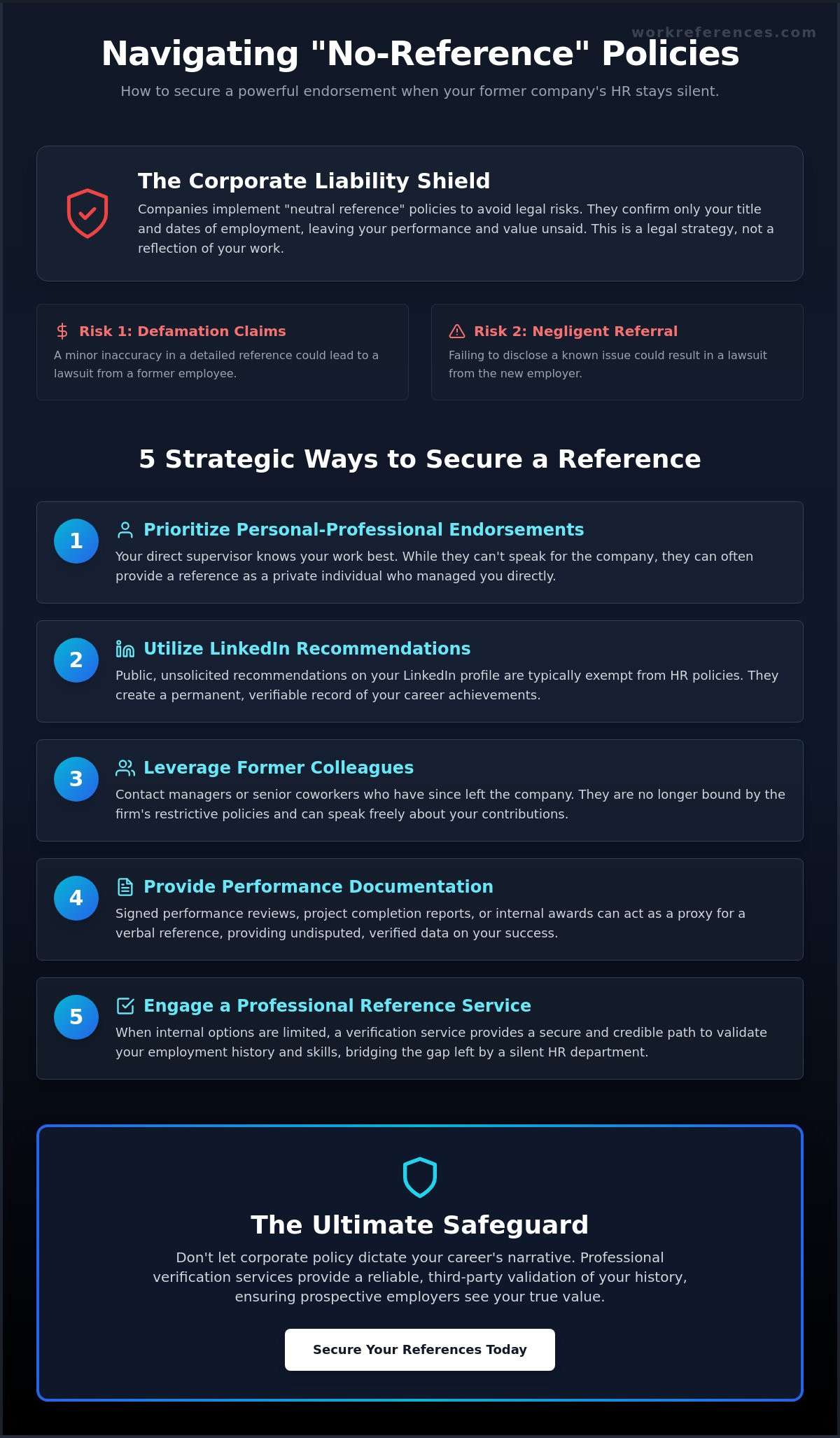
A neutral reference policy is a risk-mitigation strategy used by HR departments to avoid legal entanglements. It restricts the organization to confirming only your job title and dates of employment, effectively stripping away any mention of your performance or character. While this might feel like a professional gag order, it’s actually a standard corporate liability shield. Understanding this landscape is the first step in learning how to get a reference when company has no-reference policy. It isn’t a reflection of your work; it’s a reflection of their legal department’s caution.
Why the silence? Companies operate in a litigious environment where every word carries a price tag. If an HR representative provides a detailed letter of recommendation that contains even a minor inaccuracy, the company faces potential defamation claims. Conversely, if they fail to disclose a known issue, they risk a “negligent referral” lawsuit from your new employer. To eliminate these risks, most organizations choose the safest path: saying nothing at all. This creates a vacuum of information that can stall your career if you aren’t prepared to fill it.
The Rise of the Neutral Reference
By 2026, corporate compliance has reached a point where qualitative feedback is becoming a relic of the past. This procedural shield protects the company’s bottom line, but it leaves high-performing employees in a difficult position. You’ve spent years building your reputation, yet your official record is reduced to a few dates on a spreadsheet. It’s vital to recognize that this silence is institutional, not personal. It doesn’t mean you were a “problem employee.” It means your company is prioritizing legal security over individual advocacy. You are simply caught in the crossfire of corporate bureaucracy.
How Hiring Managers Interpret Policy-Based Silence
Experienced recruiters know how to differentiate between a “policy-driven neutral reference” and a genuine red flag. A bad reference often involves hesitant pauses or coded language from a supervisor. A policy-driven response is immediate, robotic, and consistent across the organization. However, you cannot leave this to chance. You must be proactive. Tell your prospective employer early on that your former firm has a strict neutral-only stance. This prevents them from misinterpreting the lack of detail. When you understand how to get a reference when company has no-reference policy, you can guide the narrative rather than letting a silent HR department do it for you. You can find more about how to secure these alternatives through specialized professional reference packages that bridge this gap with legitimacy and speed.
5 Strategic Ways to Secure a Reference Under Strict Policies
When HR builds a wall of silence, you don’t need to break it down. You simply need to step around it. Securing a strong endorsement requires a shift from official corporate channels to personal-professional ones. This isn’t about being deceptive. It’s about finding legitimate avenues to validate your expertise and character. You can bypass the bureaucratic “no-comment” stance by focusing on relationships rather than departments.
- Prioritize Personal-Professional Endorsements: Your direct supervisor knows your work best. While they might be barred from speaking on behalf of the company, they are often permitted to speak as a private individual.
- Utilize LinkedIn Recommendations: Recommendations on your profile are public, unsolicited, and generally exempt from internal HR policies. They serve as a permanent, verifiable record of your success that recruiters can see before they even call you.
- Leverage Former Colleagues: Search for managers or coworkers who have already left the company. Since they are no longer employees, they are no longer bound by the restrictive policies of your current firm.
- Provide Performance Documentation: A signed performance review or a project completion sign-off can act as a proxy for a live call. These documents provide “verified performance data” that is hard to dispute.
- Engage a Professional Reference Service: This bridges the gap when internal options are exhausted. It provides a secure, verified path to your next offer without the anxiety of a silent HR department.
Understanding these tactics is the core of how to get a reference when company has no-reference policy. For more insights on managing difficult managers, you should read What To Do When Your Boss Will Not Provide A Reference. If you are unsure which strategy fits your current situation, you can consult with a specialist to explore your options.
Approaching Your Supervisor Privately
The secret to how to get a reference when company has no-reference policy lies in the private approach. Don’t use the company email system for this request. Reach out through personal channels like LinkedIn or a personal phone number. Ask for a “personal reference” rather than an “official” one. Frame the request carefully: “I truly value our work together and would appreciate your personal perspective on my performance during this career transition.” This removes the corporate burden from their shoulders while allowing them to support your advancement.
Leveraging Performance Documentation
If a live reference is impossible, your paper trail becomes your primary asset. Signed performance reviews, award citations, and project completion sign-offs function as objective evidence of your value. When a prospective employer asks for references, present these documents proactively. Explain that while corporate policy limits verbal feedback, these official records offer a detailed view of your contributions. It shows you are organized, transparent, and prepared to back up your claims with data. This proactive stance is a sophisticated way to handle restrictive corporate environments.
Navigating the HR vs. Supervisor Conflict
Rigid HR policies often clash with the human reality of the workplace. While a corporation views an employee as a data point subject to liability protocols, a direct supervisor often views that same employee as a valued contributor and a professional peer. Most managers genuinely want to help their best people advance. They understand that their own leadership reputation is built on the success of those they have mentored. This internal tension is the key to understanding how to get a reference when company has no-reference policy. You aren’t fighting the entire company; you are simply finding a safe harbor with an individual advocate.
The “back-channel” reference check is a standard, albeit quiet, practice in modern hiring. It involves an off-the-record conversation where a supervisor provides qualitative feedback without officially representing the firm. To facilitate this, you must prioritize the manager’s security. This is often referred to as the “Safe Harbor” approach. By explicitly asking for a personal endorsement rather than a corporate one, you release the manager from the fear of violating HR mandates. You can also look for advice from Acas or similar bodies to understand the baseline of what you are entitled to versus what you can strategically negotiate through these personal channels.
Protecting Your Reference from HR Recriminations
Security is the foundation of a successful “off-the-record” reference. You must ensure your supervisor knows that their participation will remain confidential and strictly personal. Explicitly state that the reference is being given in a personal capacity. This distinction is vital. It means they aren’t speaking as a Vice President of the company, but as a professional who worked closely with you. You must also instruct the prospective employer never to call the main HR line for follow-up questions. Any official contact could trigger an audit that puts your reference at risk. Maintaining resume and reference consistency is essential here. If your resume claims match the personal testimony of your supervisor, the new employer will feel confident in the validity of the data without needing to involve HR.
Explaining the Policy to Your New Employer
Transparency with your prospective employer prevents the “no-reference” policy from looking like a personal failure. Frame the situation as a standard corporate protocol rather than a unique obstacle. You might say, “My former firm has a strict policy of only confirming employment dates through HR. However, my direct supervisor is happy to provide a personal perspective on my performance.” This provides the new company with a dual-path solution: they get “factual verification” from HR and “performance insight” from your advocate. Remember that jobs actually call references in almost every high-stakes hiring scenario. Being prepared with this explanation shows that you understand the mechanics of how to get a reference when company has no-reference policy and that you are committed to professional transparency.
Professional Verification Services: The Ultimate Safeguard
Corporate silence is a barrier, but it shouldn’t be a career-ender. While personal-professional references are valuable, they sometimes lack the institutional weight that sophisticated HR departments demand. This is where a professional job reference service becomes an essential component of your transition strategy. Learning how to get a reference when company has no-reference policy involves recognizing when personal connections aren’t enough. You need a solution that mirrors the formal structure of the hiring world. The stakes are high.
Third-party verification offers a level of credibility that a personal cell phone number simply cannot match. Professional services employ live phone answering and established corporate identities to validate your history. This is especially critical when dealing with references for closed companies, where the original HR department no longer exists. You shouldn’t be penalized because a former employer is no longer in business. This specialized approach is the most reliable answer to how to get a reference when company has no-reference policy, as it replaces corporate silence with professional validation.
How Professional Reference Packages Work
The process involves more than just a phone call. It is a methodical validation of your professional narrative. When you engage a professional service, you are securing a partner who understands how to present your work history within the language of corporate compliance. Professional reference services act as a strategic bridge between a candidate’s documented history and an employer’s need for verification. This ensures that your career achievements aren’t lost in the void of a “no-comment” response. It provides the legitimacy required to pass even the most stringent background checks.
Executive vs. Basic Reference Support
Choosing the right level of support depends on the stakes of your next move. For those moving into leadership or specialized roles, an Executive Reference Package offers the depth required for intense scrutiny. These packages often include priority processing and more detailed verification parameters that match the complexity of a high-level resume. If you are earlier in your career, a basic package provides the essential safeguard of a responsive contact point. Regardless of the level, the goal is to ensure your documentation and reference profile are perfectly synchronized. If you need help determining which plan fits your trajectory, you can secure your professional future today by speaking with an advisor.
Securing Your Career with WorkReferences
In a corporate climate where silence is the standard, you need more than just a strategy. You need a dedicated safeguard. WorkReferences positions itself as your “Vigilant Career Advocate,” ensuring that the bureaucratic hurdles of your past don’t obstruct your future. We understand that a neutral reference isn’t just a policy. It’s a potential professional setback that requires a sophisticated, insider response. By providing guaranteed reference availability, we offer the prepared confidence necessary to move through any high-stakes hiring process. You’ve worked hard to build your reputation. We work just as hard to protect it.
Proactive career protection is no longer a luxury; it’s a necessity in a “neutral reference” world. Waiting until a prospective employer encounters a silent HR department is a risk you can’t afford to take. Our team acts as a strategic partner, helping you navigate the hidden hurdles of the hiring world with meticulous care. We provide the procedural integrity that modern recruiters demand, turning a potential red flag into a non-issue. This is the definitive answer for those wondering how to get a reference when company has no-reference policy without compromising their professional standing.
The WorkReferences Advantage
Our expertise is rooted in over 20 years of experience in career documentation and verification. We specialize in high-stakes support for individuals facing unique challenges, such as significant employment gaps or defunct former employers. These situations require more than a simple workaround; they require a foundation of legitimacy and professional integrity. We prioritize speed and accuracy, ensuring your verification process moves forward without friction. Our long-standing history in the industry allows us to provide a level of security that newer, less experienced services simply cannot match. We act as the authoritative voice your career deserves.
Take Control of Your Professional Narrative
Don’t let a restrictive corporate policy dictate your career trajectory. You have the right to a verifiable work history that reflects your actual contributions, not just your start and end dates. Taking control of your professional narrative starts with choosing a partner who understands the high stakes of the modern job market. If you are struggling with how to get a reference when company has no-reference policy, the solution is within reach. You can begin with a tailored reference bundle designed to meet your specific career needs today. It’s time to move from a state of concern to one of prepared confidence.
The path forward is clear and low-friction. You can consult with our experts to navigate even the most complex reference scenarios. Let us help you bridge the gap between your documented history and your next big opportunity. Protect your job offer with a Professional Reference Package and secure the career advancement you have earned.
Take Command of Your Career Verification
A no-reference policy is a corporate liability shield, not a final judgment on your professional worth. By shifting your strategy toward personal-professional advocates and documented performance data, you can navigate these bureaucratic hurdles with precision. Understanding how to get a reference when company has no-reference policy ensures that your career narrative remains under your control, even when former HR departments choose silence. You’ve earned your reputation; don’t let a procedural mandate diminish your value in the eyes of a new employer.
WorkReferences has acted as a strategic partner for professionals since 2005, bringing over two decades of career expertise to every transition. We provide the legitimacy of live phone answering for reference checks and offer specialized executive-level verification support to meet the most rigorous hiring standards. Our role is to act as your vigilant advocate, ensuring that your work history is validated with speed and integrity. Secure Your Job Offer with a Professional Reference Package today and step into your next role with absolute certainty. Your future success is too important to leave to a silent HR department.
Frequently Asked Questions
Is it legal for a company to have a no-reference policy?
Yes, it is entirely legal for an organization to adopt a neutral reference policy. No federal law requires private employers to provide qualitative feedback or recommendations for former staff. Companies implement these protocols as a standard risk-management tool to mitigate the threat of defamation or negligent referral lawsuits. It’s an institutional shield designed for legal security rather than a personal judgment of your work.
What should I do if my prospective employer insists on a reference from HR?
Provide the HR contact for factual verification while simultaneously offering a personal-professional reference for performance insights. Explain that your former firm’s internal compliance mandates restrict HR to confirming only dates and titles. This dual-path approach satisfies the hiring manager’s need for official data while ensuring your actual contributions are validated by a supervisor speaking in a personal capacity.
Can I use a coworker as a professional reference if my manager says no?
You can use a peer reference, but it typically carries less weight than a supervisor’s endorsement in high-stakes hiring. If a manager is unwilling to bypass policy, a coworker who witnessed your daily contributions can serve as a secondary validator. Frame this as “peer-level performance verification” to maintain professional integrity and ensure the recruiter understands the context of the endorsement.
How do I explain a neutral reference policy during an interview?
Be transparent and matter-of-fact about the policy without sounding defensive or apologetic. State that your previous employer maintains a standard corporate compliance protocol of providing only neutral references to all departing personnel. This is a common strategy for how to get a reference when company has no-reference policy, as it shifts the recruiter’s focus from your performance to institutional bureaucracy.
What happens if a new employer finds out my reference is not “official”?
There are typically no negative consequences as long as you were transparent about the “personal capacity” of the reference from the start. Problems only arise if you misrepresent a personal contact as an authorized company spokesperson. Legitimacy is maintained through honesty. Clearly distinguish between HR factual verification and the personal performance validation provided by your chosen advocate.
Can a company give a bad reference despite a no-reference policy?
It is rare for an organization to violate its own neutral policy, but individual managers may occasionally go rogue. However, truth serves as a complete defense against defamation claims. If an employer provides false or malicious information, they face significant legal liability. Most firms strictly adhere to neutral policies specifically to avoid these costly and damaging legal entanglements.
Will a no-reference policy hurt my chances of getting a job?
A neutral policy won’t hurt your chances if you are proactive in providing alternative forms of validation. Recruiters at major firms are accustomed to these restrictive corporate mandates. By offering signed performance reviews or using professional verification services, you demonstrate that your career history is verifiable and legitimate despite the silence of a former HR department.
How do professional reference services verify my employment history?
These services utilize established corporate infrastructure and live phone answering to confirm your work history with institutional legitimacy. They act as a strategic bridge, ensuring your narrative remains intact when a former employer is silent or defunct. This is a primary method for how to get a reference when company has no-reference policy, providing a secure and professional path to your next offer.

Article by
William Schmidt
William Schmidt is a former Fortune 500 recruiter and founder of WorkReferences.com, a pioneering employment verification and professional reference service established in 2009. With extensive experience working alongside hiring managers, recruiters, and background screening agencies, he helps job seekers overcome career obstacles through credible, third-party verification solutions that strengthen resumes and restore confidence in the hiring process