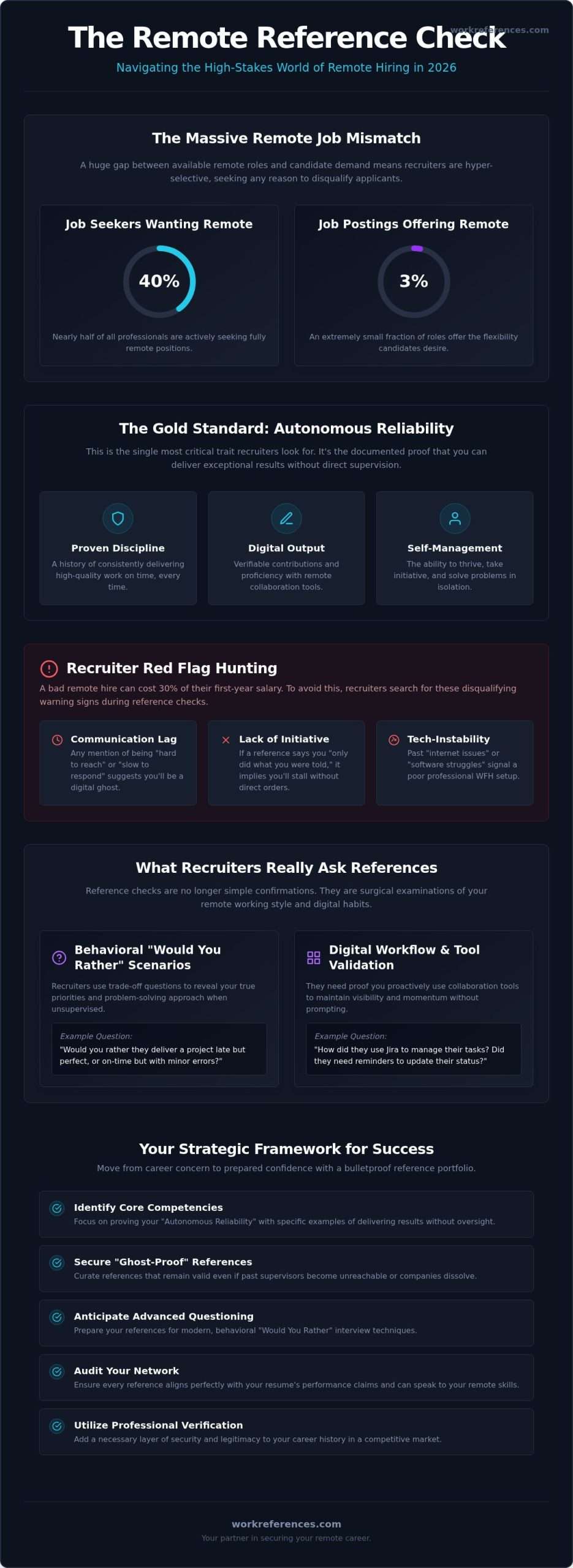
As of July 2026, only 3% of job postings are for fully remote positions, yet nearly 40% of professionals are actively seeking them. This massive supply-demand gap means recruiters are looking for any reason to thin the herd. In this high-stakes environment, professional references for remote workers must do more than just confirm employment; they must prove your “Autonomous Reliability.” If your former supervisor has become a digital ghost or your previous remote firm has closed its doors, your path to a new offer is blocked by skepticism. You shouldn’t lose a career-defining opportunity just because a past manager is unreachable.
We understand the anxiety of watching a dream job slip away while waiting for a reference check. You’ve earned your reputation through discipline, and your documentation should reflect that. This guide will show you how to curate and verify references that validate your ability to excel without physical oversight. We’ll examine how to build a bulletproof history, handle unresponsive contacts, and utilize verification protocols to ensure your remote performance is never questioned. It’s time to move from career concern to prepared confidence.
Key Takeaways
- Identify the core components of “Autonomous Reliability” to prove you can deliver high-level results without physical oversight.
- Learn how to secure professional references for remote workers that remain valid even when past supervisors become unreachable or companies dissolve.
- Anticipate and prepare for advanced remote-competency interview techniques, including the “Would You Rather” questioning style used by modern recruiters.
- Master a strategic framework for auditing your professional network to ensure every reference aligns perfectly with your resume’s performance claims.
- Discover how professional verification services provide a necessary layer of security for your career in an increasingly competitive remote market.
The Evolution of Professional References for Remote Workers
The hiring landscape in 2026 has become increasingly selective. With only 3% of job postings offering fully remote options, the competition for these roles is fierce. Employers no longer prioritize “who you know” in the traditional sense. Instead, they focus on who can verify your digital output and personal discipline. The gold standard for professional references for remote workers has shifted toward a single, critical metric: Autonomous Reliability. This is the documented ability to deliver high-quality results consistently without the need for physical oversight or constant managerial check-ins.
In a remote-first environment, the stakes are exceptionally high. A single weak or vague reference can immediately end your candidacy. Hiring managers view remote hires as higher-risk investments because they cannot rely on office culture to keep a worker on track. They need absolute certainty that you possess the self-management skills to thrive in isolation. While a standard employment reference or job reference used to suffice for office roles, today’s recruiters require granular proof of your remote-specific competencies.
Why Remote Hiring Managers Are “Red Flag Hunting”
Recruiters are currently in a state of hyper-vigilance. During remote interviews, they lose 90% of the non-verbal body language cues that traditionally help build trust. To compensate, they’ve turned reference checks into a search for “red flags.” This scrutiny is financially driven; industry data suggests the cost of a bad hire can reach 30% of that employee’s first-year earnings. For a high-paying remote role, that represents a massive liability for the company.
When contacting your references, managers are specifically hunting for three primary warning signs:
- Communication Lag: Any mention of “hard to reach” or “slow to respond” is an instant disqualifier.
- Lack of Initiative: If a reference suggests you only did what you were told, the recruiter assumes you’ll stall without direct supervision.
- Tech-Instability: Frequent “internet issues” or “software struggles” in past roles signal a lack of professional infrastructure.
The Trust Gap in Distributed Teams
Physical distance naturally breeds skepticism. Without seeing you at a desk, some managers harbor a persistent worry regarding your actual work hours and focus. This “trust gap” is the greatest hurdle for any remote job seeker. To bridge this distance, third-party verification has become an essential tool. It provides an objective layer of legitimacy that a casual phone call to a former peer cannot match.
To combat this skepticism, many candidates utilize a Professional Reference Package to ensure their history is presented with procedural integrity. Professional references for remote workers act as a strategic safeguard that preserves your career momentum by transforming supervisor silence into verified professional achievement.
What Remote Recruiters Really Ask Your References
Gone are the days when a recruiter would simply ask if you were a “team player.” In the current 2026 market, where fully remote roles are a rarity, the inquiry process has become a surgical examination of your digital habits. Recruiters now employ behavioral “Would You Rather” scenarios to force references into revealing your true working style. They might ask, “Would you rather have this employee deliver a project late but perfect, or on-time but with minor errors?” For a remote manager, the answer reveals whether you prioritize transparency or hide behind your screen when things go wrong. Professional references for remote workers must be prepared to handle these nuanced trade-offs with specific, positive examples.
Your references must also validate your proficiency with specific collaboration tools like Slack, Jira, and Zoom. It’s no longer enough to list these on a resume. A hiring manager will ask your reference how you used these platforms to maintain visibility. Did you update your status? Did you manage the Jira board without being prompted? These details confirm you can meet deadlines without a manager physically present to monitor your progress. If a reference cannot speak to your digital workflow, the recruiter assumes you require high-touch supervision, which is a major red flag for distributed teams.
Verifying Self-Management and Independence
Recruiters are terrified of “high-maintenance” remote workers who require constant hand-holding. They will ask your references: “How does the candidate handle ambiguous instructions?” If you can’t decipher a vague brief independently, you’re viewed as a liability. They also want to hear about a time you solved a technical hurdle solo, such as troubleshooting a VPN issue or software crash without calling IT. Using a professional job reference service ensures your references are prepared for these high-pressure questions, preventing a hesitant or vague answer from costing you the offer.
Digital Communication and Collaboration Skills
The core of remote success is asynchronous communication. Recruiters check if you can move projects forward without real-time feedback. They look for “over-communication” as a strength rather than a nuisance. A reference who says, “I always knew exactly where they stood on a project because they documented everything in Slack,” is worth their weight in gold. They also verify how you contributed to a distributed team culture. Did you support peers across time zones? Did you maintain a professional presence in virtual meetings? If you’re unsure how your past managers will describe your remote collaboration, it may be time to consult with a career advocate to secure your professional history.
The Challenge of Unresponsive Remote Supervisors
Professional references for remote workers act as the final gatekeeper to your next high-paying offer. However, the transient nature of distributed teams means your strongest advocates are often the hardest to track down. Remote-first industries, particularly the tech sector, are notorious for rapid pivots and frequent job hopping. When a manager leaves a company, their corporate email account is typically deactivated within 24 hours. If that business eventually closes its doors, which is a common occurrence in a volatile market, you’re left with a massive gap in your verifiable history. Relying on a defunct contact point is a high-risk strategy that can derail your career advancement. You shouldn’t be penalized for a former employer’s lack of organization or a manager’s decision to move on.
The “closed company” scenario is particularly prevalent in the remote sector, where businesses frequently merge or dissolve. In these instances, traditional HR departments vanish, leaving no one to answer employment verification requests. Recruiters, who are already hunting for red flags, see these dead ends as a sign of potential deception. They don’t have the time to investigate why a company email bounces; they simply move to the next candidate in the queue. Positioning yourself with a third-party verification service removes this friction. It provides a stable, permanent contact point that survives even when the original company does not.
When Your Former Manager Is “Off the Grid”
What happens when a recruiter’s call goes straight to a generic voicemail? In the high-stakes world of remote hiring, silence is rarely interpreted as a neutral event. Hiring managers often view a non-responsive reference as a passive-aggressive negative review. They assume the former supervisor is avoiding the call to escape giving a poor recommendation. This “ghosting” effect creates an immediate trust deficit that most candidates cannot overcome. To protect your reputation, you must proactively manage these gaps. You may find it helpful to read our guide on References for Closed Companies: How to Secure Your Work History in 2026 to learn how to bridge these professional voids.
The Role of Live Phone Answering Services
In 2026, automated email verifications are no longer sufficient for high-level remote roles. Recruiters want to hear a human voice that can provide context and nuanced validation of your skills. A live phone answering service acts as a vital bridge between your past performance and your future offer. When a recruiter reaches a professional, live representative, it projects an image of organizational stability and procedural integrity. WorkReferences ensures that your history is validated every time the phone rings, removing the variable of an unresponsive manager from the equation. This third-party confirmation transforms a potential red flag into a verified asset, allowing you to proceed with prepared confidence. Professional references for remote workers should be a source of strength, not a point of failure.
Strategy: Preparing Your Remote Reference Portfolio
Securing a high-paying remote offer in today’s competitive market requires more than a polished resume; it demands a strategically engineered portfolio of proof. You cannot leave your professional reputation to the whims of an unguided supervisor. A methodical preparation process ensures that your history remains bulletproof, even under intense recruiter scrutiny. Professional references for remote workers must be curated with the same precision as a legal filing to ensure procedural integrity and career security.
To build a portfolio that commands trust, follow these five essential steps:
- Step 1: Audit your network for “Reliability Scores.” Identify which former supervisors respond to digital inquiries within 24 hours and possess the articulate communication style needed to validate your autonomy.
- Step 2: Align resume claims with potential talking points. If your resume highlights a 20% increase in output during a remote transition, your reference must be prepared to confirm that specific metric.
- Step 3: Formalize your verification. Utilize a professional service to act as a permanent, stable anchor for your employment history.
- Step 4: Brief your references. Provide your contacts with a concise summary of the remote-competencies you want them to emphasize, such as your proficiency in asynchronous communication.
- Step 5: Monitor the process. Regularly verify that the information provided by your references remains consistent across all documentation and background check platforms.
Aligning Resume and Reference Consistency
Recruiters in 2026 use sophisticated automated systems to cross-reference your claims. A single discrepancy in job titles or employment dates is often viewed as a “deal-breaker” that suggests a lack of transparency. This mismatch is the most common reason remote offers are rescinded at the final stage. You should review The Critical Guide to Resume and Reference Consistency in 2026 to understand how to synchronize your records. Investing in a unified Professional Reference Package provides a central safeguard that ensures your story never changes, regardless of who is asking.
Choosing the Right “Remote-First” References
The hierarchy of credibility has shifted. A manager who oversaw your daily output in a distributed team carries significantly more weight than a high-ranking executive who barely knew your digital workflow. Prioritize supervisors who can speak directly to your self-management during high-stakes projects. While colleagues can serve as secondary character references, they should never be your primary source of validation. When providing professional references for remote workers in a digital-only environment, prioritize three individuals who can specifically attest to your performance during periods of minimal oversight. If you are concerned about gaps in your remote network, it is time to get in touch with our verification experts to secure your professional future.
Secure Your Remote Career with WorkReferences
In the volatile 2026 job market, leaving your professional history to chance is more than a gamble; it’s a liability. With fully remote roles becoming increasingly scarce, recruiters are searching for any reason to disqualify candidates. Relying on an old Slack connection or a personal cell phone number for a former manager doesn’t project the procedural integrity that high-level firms demand. Professional references for remote workers need to be grounded in legitimacy and speed. If a recruiter hits a dead end while trying to verify your history, they won’t wait for you to fix it; they’ll simply move to the next candidate.
The WorkReferences Professional Reference Package serves as the ultimate safeguard for your career. It transforms your work history from a collection of hopeful contacts into a verified, bulletproof record. By providing live phone answering and third-party confirmation, we offer the corporate legitimacy that remote recruiters crave. They don’t just want to know you worked there; they want to know your history is documented, accessible, and aligned with your resume. This proactive approach ensures that your “Autonomous Reliability” is never questioned during the final stages of a job offer.
Why 2026 Requires Professional Verification
Background screening has evolved into a complex, multi-layered process. In a distributed workforce, traditional HR lines are often blurred or non-existent, especially when companies pivot or dissolve. WorkReferences acts as your “Vigilant Career Advocate,” ensuring that your documentation is ready before the recruiter even picks up the phone. It’s helpful to understand the current climate by reading Do Jobs Actually Call References? The 2026 Reality of Employment Verification. Our service bridges the gap between your past performance and your future potential, providing a level of security that personal contacts cannot match.
Take Control of Your Professional Narrative
You cannot allow an unresponsive manager or a defunct startup to derail your career advancement. Taking a proactive approach to your documentation is the only way to secure a high-paying remote offer with confidence. When you know your history is validated, the anxiety of the reference check vanishes. You’ve done the work; now ensure the world can verify it. Get your professional reference strategy started today and step into your next interview with the certainty of a protected professional legacy. Your career is too valuable to leave to the whims of a digital ghost.
Secure Your Future in the Remote-First Economy
The 2026 job market offers no room for error when it comes to your professional history. As the landscape shifts toward “Autonomous Reliability,” your past performance must be verifiable and consistent across all digital platforms. You shouldn’t let an unresponsive manager or a defunct startup silence your hard-earned achievements. By prioritizing career documentation alignment and third-party confirmation of work history, you transform potential red flags into assets of professional credibility.
We provide the live phone answering for reference checks that remote recruiters demand, ensuring your professional narrative remains under your control at all times. Don’t leave your next high-paying offer to the chance of a digital ghost or a disconnected line. It’s time to transition from career anxiety to prepared confidence with a bulletproof portfolio of professional references for remote workers. You’ve earned your reputation through discipline and results; it’s time to ensure your references reflect that high standard.
Secure your next remote offer-contact our reference experts today
Frequently Asked Questions
Can I use a coworker as a professional reference for a remote job?
Coworkers are acceptable only as secondary character references. Remote recruiters demand validation from a supervisor who monitored your digital output and autonomous reliability. While a peer can discuss Slack collaboration, they cannot officially verify your professional standing or performance metrics. Always prioritize managers who held you accountable for specific results.
What should I do if my remote manager has disappeared or is unresponsive?
You must proactively secure third-party verification to prevent a recruiter from assuming the worst. Silence from a former manager is frequently viewed as a hidden negative review. A professional service provides a stable contact point; this ensures that your history is validated even when individuals become unreachable or move to new roles.
How do employers verify my remote work history if the company closed?
Employers verify history through third-party confirmation and documented professional records. When a remote-first firm dissolves, its HR infrastructure vanishes, making traditional checks impossible. Maintaining a validated history through a dedicated service ensures recruiters receive a live, professional response regarding your past performance and specific dates of employment.
Is it better to provide personal or professional references for remote roles?
Professional references are essential because they validate your technical competencies and self-discipline. Personal references cannot provide the corporate authority required to prove you can work without physical oversight. Always choose supervisors who can attest to your specific performance and your ability to meet deadlines during distributed team projects.
Do remote employers actually call references every time?
Recruiters call references for almost every remote offer to mitigate the high cost of a bad hire. In a market where remote roles are rare, the reference check is a critical final safeguard. They use these calls to identify red flags, such as communication delays or a lack of initiative, before finalizing an offer.
How do I explain an employment gap in my remote work history?
Address the gap directly and focus on your readiness to return to a high-output environment. Providing professional references for remote workers who can validate your previous achievements helps bridge the gap. It demonstrates that your skills remain sharp and your past performance was consistently reliable despite any period of inactivity.
Can I use a professional reference service to verify my remote experience?
A professional reference service is a legitimate way to ensure your career documentation remains secure. It provides the procedural integrity that recruiters expect, especially when managers move on or companies close. This service acts as a vigilant advocate; it validates your professional references for remote workers every time a recruiter calls for verification.
What are the top questions recruiters ask references for remote positions?
Recruiters focus on your ability to solve technical hurdles solo and handle ambiguous instructions. They often ask if you required constant check-ins or hand-holding. They want to confirm you can manage your own workflow and maintain high visibility within a distributed team culture without being prompted by a manager.
Article by
William Schmidt
William Schmidt is a former Fortune 500 recruiter and founder of WorkReferences.com, a pioneering employment verification and professional reference service established in 2009. With extensive experience working alongside hiring managers, recruiters, and background screening agencies, he helps job seekers overcome career obstacles through credible, third-party verification solutions that strengthen resumes and restore confidence in the hiring process